
Andere Kunden interessierten sich auch für
 The Study of Indigenous Landscape and Seascape Stewardship on the Central California Coast65,99 €
 Mesolithic Exploitation Patterns in the Central Pennines72,99 €
 Ancient Central China41,99 €
 China's Non-State Soft Power Actors55,99 €
 The Untold Story of China's Nuclear Weapon Development and Testing39,99 €
 World History as the History of Foundations, 3000 BCE to 1500 CE53,99 €
 China's Cultural Trade Strategy55,99 €





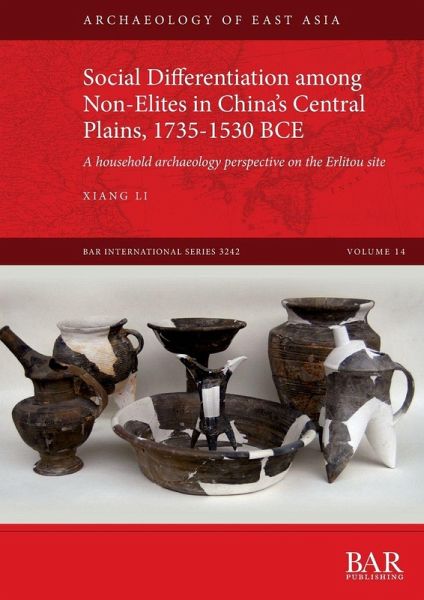
Since its discovery in 1959, research on the Erlitou site has revealed China's first territorial state, dating from 1753 to 1530 BCE according to the latest C-14 dating. The capital's large rammed-earth structures and enclosed inner city suggest strong royal economic and labor-organizing capacities. The southern workshop enclosure housed elite-sponsored crafts like bronze casting and turquoise working. The city's settlement system relied on resource acquisition and tribute. However, existing studies lack focus on internal social complexity, especially bottom-up social differentiation. This book challenges the notion of a homogeneous non-elite class, being the first to study Erlitou society via household archaeology, focusing on non-elite households in the capital. Using multi-dimensional scaling, it uncovers the majority, overshadowed by elites and splendid artifacts, expanding household archaeology's application in China's Bronze Age.