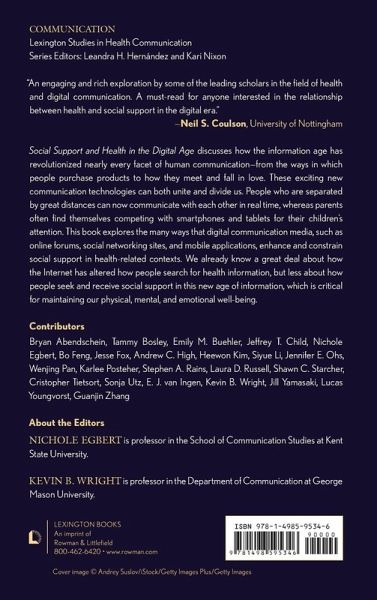
This book explores the many ways that digital communication media, such as online forums, social networking sites, and mobile applications, enhance and constrain social support in health-related contexts.
This book explores the many ways that digital communication media, such as online forums, social networking sites, and mobile applications, enhance and constrain social support in health-related contexts.
Nichole Egbert is professor in the School of Communication studies at Kent State University. Kevin B. Wright is professor in the Department of Communication at George Mason University.
Inhaltsangabe
Section 1: Social Support via Social Network Sites Chapter 1: Social Network Sites as Vehicles for Effective/Ineffective Social Support by Sonja Utz Chapter 2: Communication Technology Affordances and Social Support Provision by Stephen A. Rains Chapter 3: The Mechanics of Supportive Facebook Messages: An Analysis of Health-Related Posts, Responses, and Perceptions by Nichole Egbert and Tammy Bosley Chapter 4: Complexities of Channel Publicness and (In)Effective Support Behaviors by Andrew C. High, Emily M. Buehler, and Lucas Youngvorst Chapter 5: Communicating Loneliness on Social Networking Sites: Challenges to Emotional Disclosure and Online Support Seeking by Guanjin Zhang and Jesse Fox Section 2: Social Support in Dedicated Online Groups Chapter 6: Online Support Groups Dedicated to Specific Health Problems by Wenjing Pan, Bo Feng, and Siyue Li Chapter 7: What Determines the Quality of Relationships in Health-Related Online Support Groups? A Study of Attitudinal Similarity, Degree of Online Participation, and Personal Characteristics by Kevin Wright and E.J. van Ingen Chapter 8: Uncertainty Management in Online Support Forums for Stroke Survivors and Caregivers by Bryan Abendschein Chapter 9: Making Collective Sense of Uncertainty: How Online Social Support Communities Negotiate Meaning for Contested Illnesses by Laura D. Russell Section 3: Emerging Research Trends and Perspectives Chapter 10: Examining Health Communication Practices and Social Support through Mediated Channels: A Communication Privacy Management (CPM) Theory Perspective by Jeffrey T. Child and Shawn C. Starcher Chapter 11: Aging in Computer-Mediated Community: The Importance of Online Connections for Older Adults by Jill Yamasaki and Jennifer E. Ohs Chapter 12: When Big Data Meet Supportive Communication: Advancing mHealth Intervention Informed by Social Support Scholarship by Heewon Kim, Cristopher Tietsort, and Karlee Posteher
Section 1: Social Support via Social Network Sites Chapter 1: Social Network Sites as Vehicles for Effective/Ineffective Social Support by Sonja Utz Chapter 2: Communication Technology Affordances and Social Support Provision by Stephen A. Rains Chapter 3: The Mechanics of Supportive Facebook Messages: An Analysis of Health-Related Posts, Responses, and Perceptions by Nichole Egbert and Tammy Bosley Chapter 4: Complexities of Channel Publicness and (In)Effective Support Behaviors by Andrew C. High, Emily M. Buehler, and Lucas Youngvorst Chapter 5: Communicating Loneliness on Social Networking Sites: Challenges to Emotional Disclosure and Online Support Seeking by Guanjin Zhang and Jesse Fox Section 2: Social Support in Dedicated Online Groups Chapter 6: Online Support Groups Dedicated to Specific Health Problems by Wenjing Pan, Bo Feng, and Siyue Li Chapter 7: What Determines the Quality of Relationships in Health-Related Online Support Groups? A Study of Attitudinal Similarity, Degree of Online Participation, and Personal Characteristics by Kevin Wright and E.J. van Ingen Chapter 8: Uncertainty Management in Online Support Forums for Stroke Survivors and Caregivers by Bryan Abendschein Chapter 9: Making Collective Sense of Uncertainty: How Online Social Support Communities Negotiate Meaning for Contested Illnesses by Laura D. Russell Section 3: Emerging Research Trends and Perspectives Chapter 10: Examining Health Communication Practices and Social Support through Mediated Channels: A Communication Privacy Management (CPM) Theory Perspective by Jeffrey T. Child and Shawn C. Starcher Chapter 11: Aging in Computer-Mediated Community: The Importance of Online Connections for Older Adults by Jill Yamasaki and Jennifer E. Ohs Chapter 12: When Big Data Meet Supportive Communication: Advancing mHealth Intervention Informed by Social Support Scholarship by Heewon Kim, Cristopher Tietsort, and Karlee Posteher
Es gelten unsere Allgemeinen Geschäftsbedingungen: www.buecher.de/agb
Impressum
www.buecher.de ist ein Internetauftritt der buecher.de internetstores GmbH
Geschäftsführung: Monica Sawhney | Roland Kölbl | Günter Hilger
Sitz der Gesellschaft: Batheyer Straße 115 - 117, 58099 Hagen
Postanschrift: Bürgermeister-Wegele-Str. 12, 86167 Augsburg
Amtsgericht Hagen HRB 13257
Steuernummer: 321/5800/1497
USt-IdNr: DE450055826