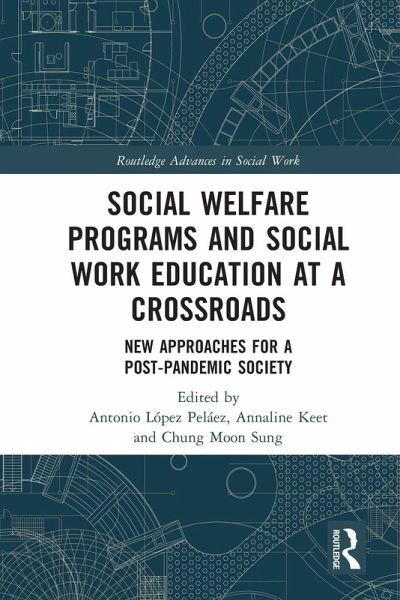
This book explores a key phenomenon that has been accelerated by the COVID-19 crisis, namely, the crossroads at which social welfare professionals find themselves.
This book explores a key phenomenon that has been accelerated by the COVID-19 crisis, namely, the crossroads at which social welfare professionals find themselves.
Antonio López Peláez is a Professor of Social Work and Social Services, Department of Social Work, National University of Distance Education (UNED), Madrid, Spain, and Executive Director of the International Council of Social Welfare (www.icsw.org). Annaline Keet is a Professor (Associate) at Nelson Mandela University, South Africa, and National Representative of South Africa at IASSW. Chung Moon Sung is a Professor in the Department of Social Welfare, Soongsil University, and President of the Korean Value Convergence Association.
Inhaltsangabe
1.Introduction - Social Welfare Programs and Social Work Education at a Crossroads: New Approaches for a Post-Pandemic Society. Part One - Theory and Professional Practice in Post-Covid Social Work. 2.The theory of Rupture Frames: A new map for social work education and practice to understand, explain and address urban conflicts in vulnerable neighborhoods with high socio-cultural diversity in contemporary democracies. 3.'Leave No-one Behind'. Leveraging the Power of Hope in Social Work and Social Development: A Theoretical Approach. 4.Digital Human Rights, Metaverse and Spaceship Earth: Rethinking Social Policies and Social Work Practice after COVID19. 5.Challenges to the Scientific Practice of Social Work: Historical Tensions between Cause and Function. Part Two - New Challenges for Social Welfare Programs, Data and Social Welfare Research. 6.Women in recovery - Women's perspective on the women-only Alcoholics Anonymous (AA) mutual-help group from Romania and its benefits for recovery: A qualitative study. 7.Assessment and diagnosis of Exclusion through Social Work: An analysis of segmentation based on cases registered using the SiSo tool. 8.The emotions of social workers: The cognitive and motivational potential of reflective micro stories. 9.Moving the social protection agenda forward: International cooperation and beyond. Part Three - Social Work Education. 10.Transforming the social work supervision core competence framework after the Covid-19 Pandemic experience. 11.Remote micro strategies in working with communities during the time of pandemic: Introducing change through model-building. 12.The place of Shared Decision Making as a Core Skill in Social Work. 13.PhotoVoice in Social Work Research, Practice, and Education: Challenges and Possibilities. 14.Virtual exchange in a Nordic context: New pedagogical strategies for improving digital interaction between Nordic Social Work students. 15.Beyond COVID-19: Priorities for social welfare programs and social work education.
1.Introduction - Social Welfare Programs and Social Work Education at a Crossroads: New Approaches for a Post-Pandemic Society. Part One - Theory and Professional Practice in Post-Covid Social Work. 2.The theory of Rupture Frames: A new map for social work education and practice to understand, explain and address urban conflicts in vulnerable neighborhoods with high socio-cultural diversity in contemporary democracies. 3.'Leave No-one Behind'. Leveraging the Power of Hope in Social Work and Social Development: A Theoretical Approach. 4.Digital Human Rights, Metaverse and Spaceship Earth: Rethinking Social Policies and Social Work Practice after COVID19. 5.Challenges to the Scientific Practice of Social Work: Historical Tensions between Cause and Function. Part Two - New Challenges for Social Welfare Programs, Data and Social Welfare Research. 6.Women in recovery - Women's perspective on the women-only Alcoholics Anonymous (AA) mutual-help group from Romania and its benefits for recovery: A qualitative study. 7.Assessment and diagnosis of Exclusion through Social Work: An analysis of segmentation based on cases registered using the SiSo tool. 8.The emotions of social workers: The cognitive and motivational potential of reflective micro stories. 9.Moving the social protection agenda forward: International cooperation and beyond. Part Three - Social Work Education. 10.Transforming the social work supervision core competence framework after the Covid-19 Pandemic experience. 11.Remote micro strategies in working with communities during the time of pandemic: Introducing change through model-building. 12.The place of Shared Decision Making as a Core Skill in Social Work. 13.PhotoVoice in Social Work Research, Practice, and Education: Challenges and Possibilities. 14.Virtual exchange in a Nordic context: New pedagogical strategies for improving digital interaction between Nordic Social Work students. 15.Beyond COVID-19: Priorities for social welfare programs and social work education.
Es gelten unsere Allgemeinen Geschäftsbedingungen: www.buecher.de/agb
Impressum
www.buecher.de ist ein Internetauftritt der buecher.de internetstores GmbH
Geschäftsführung: Monica Sawhney | Roland Kölbl | Günter Hilger
Sitz der Gesellschaft: Batheyer Straße 115 - 117, 58099 Hagen
Postanschrift: Bürgermeister-Wegele-Str. 12, 86167 Augsburg
Amtsgericht Hagen HRB 13257
Steuernummer: 321/5800/1497
USt-IdNr: DE450055826