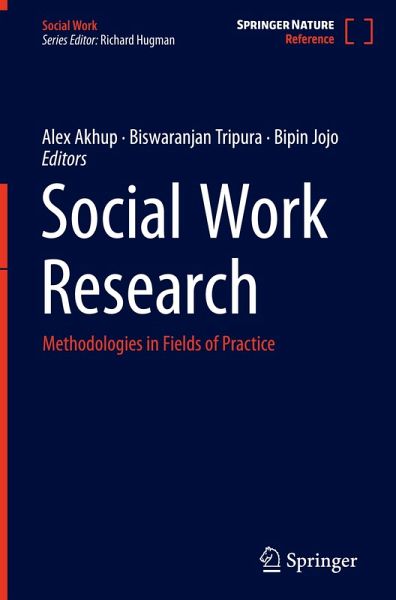
This book, sourced from the experience of the social work researchers, educators and practitioners, offers, for the first time from the Indian context, a reflexively situated and insightful pathways to social work research and theorising practice that underlines the importance of 'methodologies in fields of practice' epistemologies, locationalities and positionalities embedded at varied sites of practices. This understanding is built on the observation that research capturing specific Fields of subjectivities (rural tribal communities, women, children and youth, and persons with disabilities)…mehr
This book, sourced from the experience of the social work researchers, educators and practitioners, offers, for the first time from the Indian context, a reflexively situated and insightful pathways to social work research and theorising practice that underlines the importance of 'methodologies in fields of practice' epistemologies, locationalities and positionalities embedded at varied sites of practices. This understanding is built on the observation that research capturing specific Fields of subjectivities (rural tribal communities, women, children and youth, and persons with disabilities) located in the Indian contexts responds to social issues in complex and diverse situations - a relational ontology. It underscores the scope and new possibilities of research in the Social Work discipline, and its function in contextualizing fields of practice . The strength of the book lies in capturing and visibilizing these varied sites of practices through research-practice continuum approach while demonstrating the primacy of methodologies of practice in building a social work knowledge i.e. democratic, emancipatory and locally empowering.
Accordingly, the book suggests that strengthening of social work research and theorising practice would entail recognition of 'methodologies in fields of practice' in the context. In doing so, the book underlines the need to take a decolonial approach and intends to strengthen practice-based knowledge for an immediate reference point for social work scholars, researchers, educators, practitioners, administrators and policymakers.
Alex Akhup is a Professor and PhD Coordinator of the School of Social Work, TISS Mumbai. He completed a Master of Arts and M.Phil Degrees in Social Work from the Delhi School of Social Work, Delhi University. He was awarded a PhD in Social Science from the Tata Institute of Social Sciences (TISS), Mumbai. He actively contributes to curriculum formulation, teaching, research, fieldwork and publication on issues concerning social justice and governance within social work education and practice. His research interests include Identities (Tribal and Adivasi), Culture, Governance and Politics; Forest, land and Tribal Communities; Education Policy and Practice; and Social Work Interventions and Practice in Rural/Adivasi Areas. He is editor of book titled, ‘Identities and Their Struggles in North East’ (2015), Adivaani, Kolkata. ORCiD id: https://orcid.org/0000-0002-9955-0541 Biswaranjan Tripura teaches Indigenous/Tribal Studies within the Centre for Social Justice and Governance, School of Social Work at the Tata Institute of Social Sciences, Mumbai, India. He has BA in Economics from Loyola College, Chennai, University of Madras, MA in Social Work (Specialization in Tribal Studies) from TISS, Mumbai, and earned his PhD (magna cum laude) in International Development Studies from the Institute of Development Research and Development Policy (German acronym: IEE), Ruhr-University Bochum, Germany. He was recipient of the Brot für die Welt (Berlin) Development Scholarship to undertake his doctorate studies. His research interests include anthropology of everyday state and development, social work education and intervention, indigenous studies, decolonial methodologies, governance, indigenous education, political economy, Tiprasa Studies and Northeast India studies. He is the author of ‘Everyday State and Development in Northeast India’ (2025), Routledge, London and Educational Experiences of Indigenous Peoples’ (2014), Mittal Publication, New Delhi. ORCiD id: https://orcid.org/0000-0002-2406-7213 Bipin Jojo is Professor and Dean of the School of Social Work at Tata Institute of Social Sciences (TISS), Mumbai. Previously, he was chairperson of the Centre for Social Justice and Governance and International Relations Office at TISS. He was Commonwealth visiting fellow at the School of Oriental and African Studies, University of London, during 2008-09, visiting professor at the University of Tampree, Finland, in 2018, and delivered lectures at the University of Bilbao, Spain, and Masaryk University, Czech Republic. He also worked on a collaborative research project on communities' informal care and welfare systems with Charles Sturt University, Australia. His research on Tribal Education and Ashram Schools in Maharashtra has made a significant contribution to tribal studies in India. Being a founding member of Tribal Intellectual Collective India, he is also associated with multiple community outreach initiatives and community-based civil society organisations in India. He is co-editor to book titled, ‘Children and Scars of COVID-19 Pandemic in India: Issues and Challenges’ (2024), Routledge, London. ORCiD id: https://orcid.org/0000-0001-8364-4802
Inhaltsangabe
Acknowledgements.- List of Tables, Figures and Maps.- List of Abbreviations.- 1. Introduction - The Frame of Reference.- Part I: Social Work Research and Theorising Practice.- 2. Methodological Foundations for Social Work Research.- 3. Trends and Scope of Social Work Research for Practice: The Indian Experience.- 4. Research Methodology for Critical Social Work: A Review.- Part II: Negotiating with Methods and Fields.- 5. Non-Passive Field and the (attempt to) Reflexive Ethnography: Learnings from Ethnographic Exploration at Indo (Naga)-Myanmar Borderland.- 6. Why Do I Do What I Do? Home, Being and the Paradigm.- 7. Indigenous Knowledge and Cultural Identity: An Ethnomusicological Exploration of Irulas in Attappady, Kerala.- 8. Reading 'Methodologies' in Tribes and Community Development Practice: Insights from the Peripheral/Endangered Tribe of Tripura.- 9. Methodological Insights from Studying Governing Commons: Towards Indigenous and Situated Methodologies.- Part III: Strengthening Community Development Research and Practice.- 10. Development as a Tool towards Epistemic Justice: Where Narratives Define Development.- 11. Pastoralism and Livelihood Resilience in Himalayan Region: Evidence from Changpa Community of Korzok Village, Leh Ladakh.- Part IV: Framing Child and Youth Practice and Research.- 12. Adolescent Well-being and Practice: Monitoring and Evaluation Strategy of Nalanda Way Foundation.- 13. Hlamzuih (Infant Death) Practice in Mizoram: A Case for Cultural-Human Rights-Based Social Work.- Part V: Contextualising Feminist Research and Practice.- 14. Shadows within Shadows: Domestic Violence Interventions in the Context of Conflict in Kashmir through Special Cell for Women Approach.- 15. Unravelling Lived Realities of Dalit Single Women of Beed, Maharashtra: Towards Dalit Feminist Research and Praxis.- 16. Towards Indigenous Feminist Research Approach in Northeast India: A Self-Reflective Engagement with Yelhou Nuramlon.- 17. Enhancing Support for Women in Prison: Social Justice and Care in Social Work Methods.- 18. Women's Experiences with Jail at Bijnor, Uttar Pradesh: A Case for Feminist Research.- Part VI: Deepening Disability Studies and Practice.- 19. Breaking Barriers: A Socio-Cultural Analysis of Women's Sexuality in Sri Lanka with a Focus on Women with Disabilities.- 20. A Rapid Review of Social Stigma Among Persons with Learning Disability: Towards a Framework for Disability Research in Global South.- Part VII: Situating Trans-gender Identities Research and Practice.- 21. Examining Queer Intimacies Using Queer-Feminist Standpoint in Social Research.- 22. Building the Queer Affirmative Counselling Practice (QACP) Curriculum: An Exercise in Self-Disclosure, Positionality and Reflexivity.- Concluding Analysis.
Acknowledgements.- List of Tables, Figures and Maps.- List of Abbreviations.- 1. Introduction - The Frame of Reference.- Part I: Social Work Research and Theorising Practice.- 2. Methodological Foundations for Social Work Research.- 3. Trends and Scope of Social Work Research for Practice: The Indian Experience.- 4. Research Methodology for Critical Social Work: A Review.- Part II: Negotiating with Methods and Fields.- 5. Non-Passive Field and the (attempt to) Reflexive Ethnography: Learnings from Ethnographic Exploration at Indo (Naga)-Myanmar Borderland.- 6. Why Do I Do What I Do? Home, Being and the Paradigm.- 7. Indigenous Knowledge and Cultural Identity: An Ethnomusicological Exploration of Irulas in Attappady, Kerala.- 8. Reading 'Methodologies' in Tribes and Community Development Practice: Insights from the Peripheral/Endangered Tribe of Tripura.- 9. Methodological Insights from Studying Governing Commons: Towards Indigenous and Situated Methodologies.- Part III: Strengthening Community Development Research and Practice.- 10. Development as a Tool towards Epistemic Justice: Where Narratives Define Development.- 11. Pastoralism and Livelihood Resilience in Himalayan Region: Evidence from Changpa Community of Korzok Village, Leh Ladakh.- Part IV: Framing Child and Youth Practice and Research.- 12. Adolescent Well-being and Practice: Monitoring and Evaluation Strategy of Nalanda Way Foundation.- 13. Hlamzuih (Infant Death) Practice in Mizoram: A Case for Cultural-Human Rights-Based Social Work.- Part V: Contextualising Feminist Research and Practice.- 14. Shadows within Shadows: Domestic Violence Interventions in the Context of Conflict in Kashmir through Special Cell for Women Approach.- 15. Unravelling Lived Realities of Dalit Single Women of Beed, Maharashtra: Towards Dalit Feminist Research and Praxis.- 16. Towards Indigenous Feminist Research Approach in Northeast India: A Self-Reflective Engagement with Yelhou Nuramlon.- 17. Enhancing Support for Women in Prison: Social Justice and Care in Social Work Methods.- 18. Women's Experiences with Jail at Bijnor, Uttar Pradesh: A Case for Feminist Research.- Part VI: Deepening Disability Studies and Practice.- 19. Breaking Barriers: A Socio-Cultural Analysis of Women's Sexuality in Sri Lanka with a Focus on Women with Disabilities.- 20. A Rapid Review of Social Stigma Among Persons with Learning Disability: Towards a Framework for Disability Research in Global South.- Part VII: Situating Trans-gender Identities Research and Practice.- 21. Examining Queer Intimacies Using Queer-Feminist Standpoint in Social Research.- 22. Building the Queer Affirmative Counselling Practice (QACP) Curriculum: An Exercise in Self-Disclosure, Positionality and Reflexivity.- Concluding Analysis.
Es gelten unsere Allgemeinen Geschäftsbedingungen: www.buecher.de/agb
Impressum
www.buecher.de ist ein Internetauftritt der buecher.de internetstores GmbH
Geschäftsführung: Monica Sawhney | Roland Kölbl | Günter Hilger
Sitz der Gesellschaft: Batheyer Straße 115 - 117, 58099 Hagen
Postanschrift: Bürgermeister-Wegele-Str. 12, 86167 Augsburg
Amtsgericht Hagen HRB 13257
Steuernummer: 321/5800/1497
USt-IdNr: DE450055826