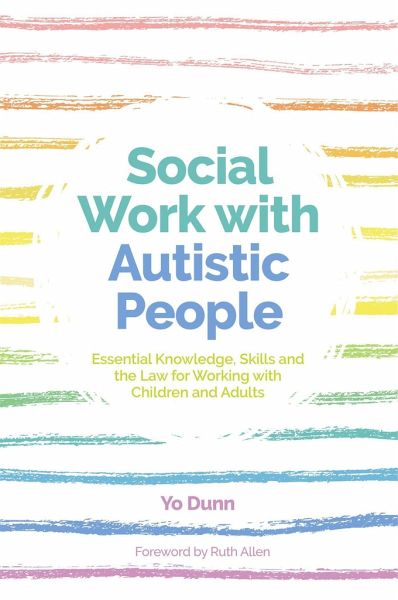
Achievable solutions for social workers working with autistic people - including those with complex needs - to maintain full lives in their communities, and avoid inappropriate institutional placements. Practical, autism-specific approaches are offered to enable practitioners to support and empower autistic people to achieve a good quality of life.
Achievable solutions for social workers working with autistic people - including those with complex needs - to maintain full lives in their communities, and avoid inappropriate institutional placements. Practical, autism-specific approaches are offered to enable practitioners to support and empower autistic people to achieve a good quality of life.
Yo Dunn. Forewords by Alex Ruck Keene and Ruth Allen
Inhaltsangabe
Foreword Acknowledgements 1. Where does autism fit from a social work perspective? 1.1 Autism in the context of social work 1.2 Why do I need to do anything differently for autism? 1.3 Autism and co-occurring conditions 1.4 Undiagnosed autism 1.5 How can this book help social workers? 2. Social care assessment and autism 2.1 Before the assessment 2.2 During the assessment 2.3 Chapter summary and key points 3. Social care eligibility and autism 3.1 Assumptions 3.2 Thresholds or barriers? 3.3 Autistic Needs in Daily Living 3.4 Chapter summary and key points 4. Person-centred care planning in autism 4.1 Person-centred approaches, needs-led planning and the wider context 4.2 What does good care look like? - Goals 4.3 What does good care look like? - A framework 4.4 Chapter summary and key points 5. Life stages, aging and transition planning 5.1 Introduction 5.2 Autism and attachment difficulties 5.3 Human development and developmental delay in autism 5.4 Autistic identity development 5.5 Managing transitions 5.6 Chapter summary and key points 6. Assessing mental capacity and autism 6.1 Introduction 6.2 Who does the assessment? 6.3 Assumptions 6.4 Autistic people and the development of decision-making skills 6.5 Providing all relevant information 6.6 Types of decision 6.7 Timing 6.8 The functional test 6.9 Chapter summary and key points 7. Supporting decision making in autism 7.1 Introduction 7.2 Lack of experience 7.3 Adapting communication 7.4 Providing information 7.5 Weighing information and making a decision 7.6 Communicating and executing the decision 7.7 Chapter summary and key points 8. Safeguarding and Autism 8.1 How big is the risk? 8.2 Types of abuse 8.3 Prevention 8.4 Safeguarding enquiries 8.5 Chapter summary and key points 9. Behaviour which may challenge 9.1 Overload: fight, freeze or flight 9.2 Managing behaviour: reaction 9.3 Managing behaviour: prevention 9.4 The wider context: preventing the breakdown of community placements and ending the inappropriate use of inpatient settings 9.5 Crisis planning 9.6 Chapter summary and key points References
Foreword Acknowledgements 1. Where does autism fit from a social work perspective? 1.1 Autism in the context of social work 1.2 Why do I need to do anything differently for autism? 1.3 Autism and co-occurring conditions 1.4 Undiagnosed autism 1.5 How can this book help social workers? 2. Social care assessment and autism 2.1 Before the assessment 2.2 During the assessment 2.3 Chapter summary and key points 3. Social care eligibility and autism 3.1 Assumptions 3.2 Thresholds or barriers? 3.3 Autistic Needs in Daily Living 3.4 Chapter summary and key points 4. Person-centred care planning in autism 4.1 Person-centred approaches, needs-led planning and the wider context 4.2 What does good care look like? - Goals 4.3 What does good care look like? - A framework 4.4 Chapter summary and key points 5. Life stages, aging and transition planning 5.1 Introduction 5.2 Autism and attachment difficulties 5.3 Human development and developmental delay in autism 5.4 Autistic identity development 5.5 Managing transitions 5.6 Chapter summary and key points 6. Assessing mental capacity and autism 6.1 Introduction 6.2 Who does the assessment? 6.3 Assumptions 6.4 Autistic people and the development of decision-making skills 6.5 Providing all relevant information 6.6 Types of decision 6.7 Timing 6.8 The functional test 6.9 Chapter summary and key points 7. Supporting decision making in autism 7.1 Introduction 7.2 Lack of experience 7.3 Adapting communication 7.4 Providing information 7.5 Weighing information and making a decision 7.6 Communicating and executing the decision 7.7 Chapter summary and key points 8. Safeguarding and Autism 8.1 How big is the risk? 8.2 Types of abuse 8.3 Prevention 8.4 Safeguarding enquiries 8.5 Chapter summary and key points 9. Behaviour which may challenge 9.1 Overload: fight, freeze or flight 9.2 Managing behaviour: reaction 9.3 Managing behaviour: prevention 9.4 The wider context: preventing the breakdown of community placements and ending the inappropriate use of inpatient settings 9.5 Crisis planning 9.6 Chapter summary and key points References
Es gelten unsere Allgemeinen Geschäftsbedingungen: www.buecher.de/agb
Impressum
www.buecher.de ist ein Internetauftritt der buecher.de internetstores GmbH
Geschäftsführung: Monica Sawhney | Roland Kölbl | Günter Hilger
Sitz der Gesellschaft: Batheyer Straße 115 - 117, 58099 Hagen
Postanschrift: Bürgermeister-Wegele-Str. 12, 86167 Augsburg
Amtsgericht Hagen HRB 13257
Steuernummer: 321/5800/1497
USt-IdNr: DE450055826