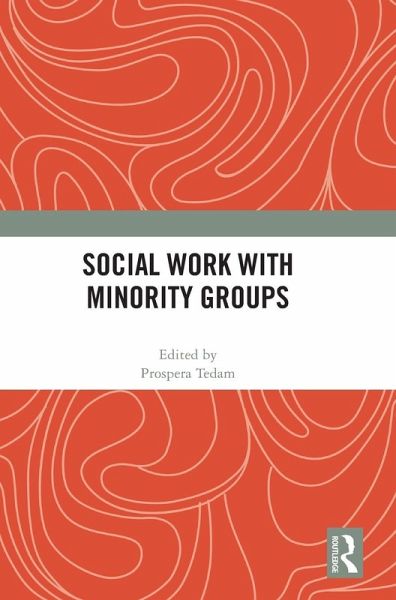
This book makes an important contribution to developing theorizing, empirical work, and practice awareness of how social work education with minority groups is framed, evidenced, and experienced.
This book makes an important contribution to developing theorizing, empirical work, and practice awareness of how social work education with minority groups is framed, evidenced, and experienced.
Prospera Tedam is Associate Professor in Social Work at the United Arab Emirates University where she has been since 2018. Prior to this, Prospera was a Principal Lecturer at Anglia Ruskin University in Cambridge, UK, where she taught on a range of undergraduate and postgraduate courses. She was a member of the Independent Family Returns Panel at the Home Office, advising on child safeguarding in relation to children and families who had no legal right to remain in the United Kingdom. Prospera is an international consultant and trainer in the areas of anti-racist social work education and practice, cultural competence, and harmful cultural practices.
Inhaltsangabe
Introduction Prospera Tedam 1. How is 'racism' understood in literature about black and minority ethnic social work students in Britain? A conceptual review Dharman Jeyasingham and Julie Morton 2. Culturally responsive social work practice with D/deaf clients Reshawna L. Chapple 3. Do we practice (or teach) what we preach? Developing a more inclusive learning environment to better prepare social work students for practice through improving the exploration of their different ethnicities within teaching, learning and assessment opportunities. Sue Hollinrake, Garfield Hunt, Heidi Dix and Anja Wagner 4. Teaching cultural humility for social workers serving LGBTQI Aboriginal communities in Australia Bindi Bennett and Trevor G. Gates 5. Racial microaggressions and black social work students: a call to social work educators for proactive models informed by social justice Shena Leverett Brown, Zoe Johnson and Shari E. Miller 6. What do we know the experiences and outcomes of anti-racist social work education? An empirical case study evidencing contested engagement and transformative learning Sukhwinder Singh 7. Challenging implicit bias: preparing students to practice with African American families Belinda E. Bruster, Tiffany Y. Lane and Belinda D. Smith 8. Decrypting cultural nuances: using drama techniques from the theatre of the oppressed to strengthen cross cultural communication in social work students Lana Burroughs and Bethel Muzuva Conclusion Prospera Tedam
Introduction Prospera Tedam 1. How is 'racism' understood in literature about black and minority ethnic social work students in Britain? A conceptual review Dharman Jeyasingham and Julie Morton 2. Culturally responsive social work practice with D/deaf clients Reshawna L. Chapple 3. Do we practice (or teach) what we preach? Developing a more inclusive learning environment to better prepare social work students for practice through improving the exploration of their different ethnicities within teaching, learning and assessment opportunities. Sue Hollinrake, Garfield Hunt, Heidi Dix and Anja Wagner 4. Teaching cultural humility for social workers serving LGBTQI Aboriginal communities in Australia Bindi Bennett and Trevor G. Gates 5. Racial microaggressions and black social work students: a call to social work educators for proactive models informed by social justice Shena Leverett Brown, Zoe Johnson and Shari E. Miller 6. What do we know the experiences and outcomes of anti-racist social work education? An empirical case study evidencing contested engagement and transformative learning Sukhwinder Singh 7. Challenging implicit bias: preparing students to practice with African American families Belinda E. Bruster, Tiffany Y. Lane and Belinda D. Smith 8. Decrypting cultural nuances: using drama techniques from the theatre of the oppressed to strengthen cross cultural communication in social work students Lana Burroughs and Bethel Muzuva Conclusion Prospera Tedam
Es gelten unsere Allgemeinen Geschäftsbedingungen: www.buecher.de/agb
Impressum
www.buecher.de ist ein Internetauftritt der buecher.de internetstores GmbH
Geschäftsführung: Monica Sawhney | Roland Kölbl | Günter Hilger
Sitz der Gesellschaft: Batheyer Straße 115 - 117, 58099 Hagen
Postanschrift: Bürgermeister-Wegele-Str. 12, 86167 Augsburg
Amtsgericht Hagen HRB 13257
Steuernummer: 321/5800/1497
USt-IdNr: DE450055826