Schäfer5th European Software Engineering Conference, Sitges, Spain, September 25 - 28, 1995. Proceedings
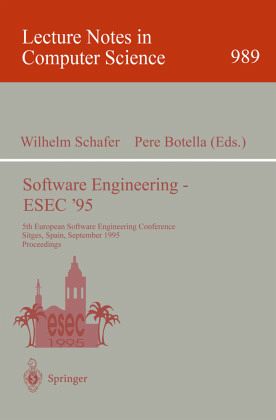
Software Engineering - ESEC '95
5th European Software Engineering Conference, Sitges, Spain, September 25 - 28, 1995. Proceedings
Herausgegeben:Schäfer, Wilhelm; Botella, Pere
Schäfer5th European Software Engineering Conference, Sitges, Spain, September 25 - 28, 1995. Proceedings
Software Engineering - ESEC '95
5th European Software Engineering Conference, Sitges, Spain, September 25 - 28, 1995. Proceedings
Herausgegeben:Schäfer, Wilhelm; Botella, Pere
- Broschiertes Buch
- Merkliste
- Auf die Merkliste
- Bewerten Bewerten
- Teilen
- Produkt teilen
- Produkterinnerung
- Produkterinnerung
This book constitutes the proceedings of the 5th European Software Engineering Conference, ESEC '95, held in Sitges near Barcelona, Spain, in September 1995. The ESEC conferences are the premier European platform for the discussion of academic research and industrial use of software engineering technology. The 29 revised full papers were carefully selected from more than 150 submissions and address all current aspects of relevance. Among the topics covered are business process (re-)engineering, real-time, software metrics, concurrency, version and configuration management, formal methods,…mehr
Andere Kunden interessierten sich auch für
Heinrich HussmannFormal Foundations for Software Engineering Methods39,99 €
Tom Maibaum (ed.)Fundamental Approaches to Software Engineering39,99 €
AstesianoFundamental Approaches to Software Engineering39,99 €
Jean-Pierre Finance (ed.)Fundamental Approaches to Software Engineering39,99 €
Michel Wermelinger / Tiziana Margaria-Steffen (Eds.)Fundamental Approaches to Software Engineering39,99 €
NaftalinFME '94: Industrial Benefit of Formal Methods77,99 €
JohnsonAlgebraic Methodology and Software Technology77,99 €-
-
-
This book constitutes the proceedings of the 5th European Software Engineering Conference, ESEC '95, held in Sitges near Barcelona, Spain, in September 1995.
The ESEC conferences are the premier European platform for the discussion of academic research and industrial use of software engineering technology. The 29 revised full papers were carefully selected from more than 150 submissions and address all current aspects of relevance. Among the topics covered are business process (re-)engineering, real-time, software metrics, concurrency, version and configuration management, formal methods, design process, program analysis, software quality, and object-oriented software development.
Produktdetails
- Produktdetails
- Lecture Notes in Computer Science 989
- Verlag: Springer / Springer Berlin Heidelberg / Springer, Berlin
- Artikelnr. des Verlages: 978-3-540-60406-8
- 1995.
- Seitenzahl: 540
- Erscheinungstermin: 13. September 1995
- Englisch
- Abmessung: 235mm x 155mm x 29mm
- Gewicht: 748g
- ISBN-13: 9783540604068
- ISBN-10: 3540604065
- Artikelnr.: 23142591
- Herstellerkennzeichnung
- Springer-Verlag GmbH
- Tiergartenstr. 17
- 69121 Heidelberg
- ProductSafety@springernature.com
- Lecture Notes in Computer Science 989
- Verlag: Springer / Springer Berlin Heidelberg / Springer, Berlin
- Artikelnr. des Verlages: 978-3-540-60406-8
- 1995.
- Seitenzahl: 540
- Erscheinungstermin: 13. September 1995
- Englisch
- Abmessung: 235mm x 155mm x 29mm
- Gewicht: 748g
- ISBN-13: 9783540604068
- ISBN-10: 3540604065
- Artikelnr.: 23142591
- Herstellerkennzeichnung
- Springer-Verlag GmbH
- Tiergartenstr. 17
- 69121 Heidelberg
- ProductSafety@springernature.com
Demands and perspectives for future software engineers: An industrial viewpoint.- Why we need object databases.- A personal commitment to software quality.- Distributed modeling and distributed enaction of business processes.- Improvise: Interactive multimedia process visualization environment.- Design process improvement case study using process waiver data.- Using a symbolic model checker for verify safety properties in SA/RT models.- Instrumentation of Synchronous Reactive Models for performance engineering.- A formal framework for ASTRAL inter-level proof obligations.- An objective reuse metric: Model and methodology.- Measuring product attributes of object-oriented systems.- Specifying distributed software architectures.- A specification-based methodology for testing concurrent programs.- Dynamic configuration abstraction.- Handling version sets through feature logic.- Integrating incremental analysis with version management.- Graph grammar engineering with PROGRES.- A structured analysis formalism with execution semantics to allow unambiguous model interpretation.- An integrated formal model of scenarios based on statecharts.- Tool support for formal software development: A generic architecture.- The treatment of non-functional requirements in MIKE.- Supporting design rationale for system evolution.- PQL: A language for specifying abstract program views.- An exploratory study of program metrics as predictors of reachability analysis performance.- An empirical evaluation of three defect-detection techniques.- Assessing the quality of large, software-intensive systems: A case study.- The impact of incremental delivery on maintenance effort: An analytical study.- Metrics for quality factors in the LESD project.- Quantitative evaluations of software quality built in with domain-specific disciplines.- Component Programming - a fresh look at software components.- Designing a framework by stepwise generalization.- Object-oriented re-architecturing.