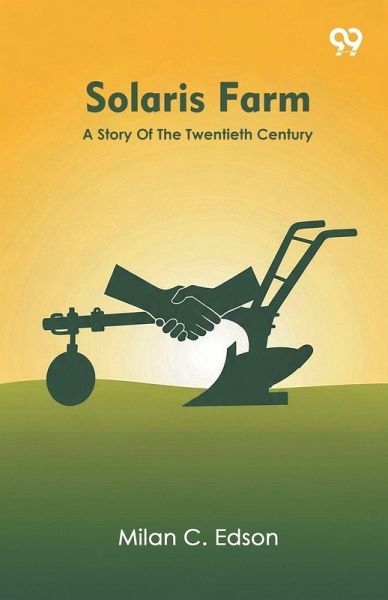
Solaris farm: A story of the twentieth century examines the challenges and potential of agricultural life in the face of economic inequality and land monopolization. The narrative reflects on the vital role of farmers not only in sustaining society but also in driving progressive change. It explores how reform-minded individuals envision agriculture as more than labor - it becomes a foundation for social improvement, dignity, and independence. Through conversations and reflective planning, the story emphasizes collaboration, innovation, and moral responsibility. It portrays farming as a…mehr
Solaris farm: A story of the twentieth century examines the challenges and potential of agricultural life in the face of economic inequality and land monopolization. The narrative reflects on the vital role of farmers not only in sustaining society but also in driving progressive change. It explores how reform-minded individuals envision agriculture as more than labor - it becomes a foundation for social improvement, dignity, and independence. Through conversations and reflective planning, the story emphasizes collaboration, innovation, and moral responsibility. It portrays farming as a deliberate act of resistance against exploitative systems, with characters committed to restoring balance and fairness to rural life. The novel critiques the concentration of land ownership and calls for a renewed understanding of how the land and those who cultivate it shape national integrity. It underscores the need for visionary leadership in the agricultural sphere, highlighting how education, cooperation, and determination can transform both individuals and communities. At its core, the book is an argument for empowerment through purposeful stewardship of the land.
Milan C. Edson was born on 18 March 1839 and became known for his contributions to agrarian thought through literature. As an author, he integrated the principles of self-sufficiency, rural reform, and agricultural idealism into his writing, most notably in Solaris Farm: A Story of the Twentieth Century. This novel reflected his belief in the transformative power of farming and the importance of empowering rural communities. Edson's work aligns with a tradition of social reform literature that highlights the economic and moral potential of land stewardship. He used fiction to present a compelling argument for agrarian values, envisioning a future in which cooperation and ethical land use could counteract inequality and monopolization. His portrayal of agriculture went beyond labor, depicting it as a civic and spiritual pursuit. Through both character and narrative structure, Edson advocated for a socially conscious vision of farming. He died on 3 May 1921 at the age of 82, leaving behind a legacy rooted in the intersection of literature and rural advocacy.
Es gelten unsere Allgemeinen Geschäftsbedingungen: www.buecher.de/agb
Impressum
www.buecher.de ist ein Internetauftritt der buecher.de internetstores GmbH
Geschäftsführung: Monica Sawhney | Roland Kölbl | Günter Hilger
Sitz der Gesellschaft: Batheyer Straße 115 - 117, 58099 Hagen
Postanschrift: Bürgermeister-Wegele-Str. 12, 86167 Augsburg
Amtsgericht Hagen HRB 13257
Steuernummer: 321/5800/1497
USt-IdNr: DE450055826