
Andere Kunden interessierten sich auch für
 Nuclear South Asia15,99 €
 Does South Asia Exist?33,99 €
 Nepal's Peace Process56,99 €
 Examination of the Principles and Policy of the Government of British India18,99 €
 Baloch Nationalism and the Geopolitics of Energy Resources15,99 €
 Challenge") Pakistan's Federally Administered Tribal Areas (FATA) Challenge15,99 €
Pakistan's Federally Administered Tribal Areas (FATA) Challenge15,99 € Air Force Strategy Study 2020-203018,99 €




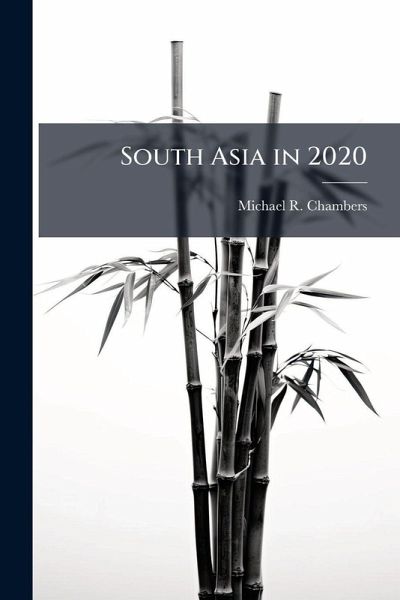
This volume consists of revised versions of papers presented at conference sponsored by the Asia/Pacific Research Center and the Center for International Security and Cooperation of Stanford University, and the U.S. Army War College's Strategic Studies Institute on January 4-5, 2002. While there are numerous ways to approach the question of "whither South Asia?" the conference organizers decided to focus on the future of strategic balances and alliances in the region, with 2020 as the target date. This choice of topic allowed the conference participants to talk not only about the patterns of amity and enmity within the region, but also about the role of extraregional powers and issues such as social and economic trends, domestic political conditions, strategic culture, and the role of nuclear weapons. These factors can affect the relative power of countries as well as their relations of friendship and hostility. This work has been selected by scholars as being culturally important, and is part of the knowledge base of civilization as we know it. This work was reproduced from the original artifact, and remains as true to the original work as possible. Therefore, you will see the original copyright references, library stamps (as most of these works have been housed in our most important libraries around the world), and other notations in the work. This work is in the public domain in the United States of America, and possibly other nations. Within the United States, you may freely copy and distribute this work, as no entity (individual or corporate) has a copyright on the body of the work. As a reproduction of a historical artifact, this work may contain missing or blurred pages, poor pictures, errant marks, etc. Scholars believe, and we concur, that this work is important enough to be preserved, reproduced, and made generally available to the public. We appreciate your support of the preservation process, and thank you for being an important part of keeping this knowledge alive and relevant.