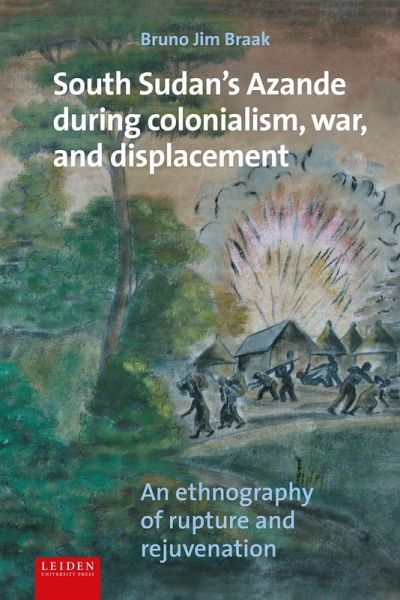
South Sudan's Azande during colonialism, war, and displacement revisits a people long frozen in time by E. E. Evans-Pritchard's classical anthropology. Its ethnographic research draws on archival sources and hundreds of interviews with chiefs, bureaucrats, former combatants, refugees, and stayees, beginning in a hopeful, post-independence South Sudan and continuing through war and displacement to Uganda. The book traces how colonialism, wars, and mass displacement have fractured Azande society, while also laying the ground for cultural renewal, historical consciousness, and even the…mehr
South Sudan's Azande during colonialism, war, and displacement revisits a people long frozen in time by E. E. Evans-Pritchard's classical anthropology. Its ethnographic research draws on archival sources and hundreds of interviews with chiefs, bureaucrats, former combatants, refugees, and stayees, beginning in a hopeful, post-independence South Sudan and continuing through war and displacement to Uganda. The book traces how colonialism, wars, and mass displacement have fractured Azande society, while also laying the ground for cultural renewal, historical consciousness, and even the reinstatement of an Azande kingdom. Yet the Azande's cultural renaissance may also bear the seeds of renewed conflict.
Dr. Bruno Jim Braak works at the Netherlands' Ministry of Foreign Affairs and remains a guest researcher at Leiden University, the Netherlands. His research interests include peace and conflict, (forced) migration, law and governance, and identity and belonging.
Inhaltsangabe
Table of Contents Acknowledgements Abbreviations Illustrations Chapter 1: Introduction; Portraits: Introducing key respondents Chapter 2: Ruptures: Traditional authorities, violence, and the state in Western Equatoria (1500s–2014) Chapter 3: Movements: Im/mobility, violence, and state control in Western Equatoria (1500s–2014) Chapter 4: Grounding conflicts: Land and formalisation in times of post-conflict return in Western Equatoria (2011–2015) Chapter 5: Being traditional in mercurial times: Chiefs in Western Equatoria (2005–2016) Chapter 6: 'It has started again': The eruption of civil war and people's decisions to stay or go (2015–2017) Chapter 7: Encountering the state upon arrival: Aid, papers, and land in Uganda (2015–2019) Chapter 8: Displaced traditional authority and the reconstruction of order in Uganda (2016–2019) Chapter 9: Overcoming ruptures: The pursuit of future Bibliography Index
Es gelten unsere Allgemeinen Geschäftsbedingungen: www.buecher.de/agb
Impressum
www.buecher.de ist ein Internetauftritt der buecher.de internetstores GmbH
Geschäftsführung: Monica Sawhney | Roland Kölbl | Günter Hilger
Sitz der Gesellschaft: Batheyer Straße 115 - 117, 58099 Hagen
Postanschrift: Bürgermeister-Wegele-Str. 12, 86167 Augsburg
Amtsgericht Hagen HRB 13257
Steuernummer: 321/5800/1497
USt-IdNr: DE450055826