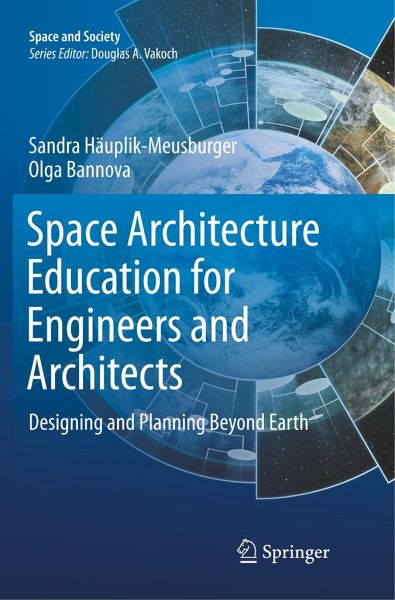
This book considers two key educational tools for future generations of professionals with a space architecture background in the 21st century: (1) introducing the discipline of space architecture into the space system engineering curricula; and (2) developing space architecture as a distinct, complete training curriculum. Professionals educated this way will help shift focus from solely engineering-driven transportation systems and "sortie" missions towards permanent off-world human presence. The architectural training teaches young professionals to operate at all scales from the "overall…mehr
This book considers two key educational tools for future generations of professionals with a space architecture background in the 21st century: (1) introducing the discipline of space architecture into the space system engineering curricula; and (2) developing space architecture as a distinct, complete training curriculum. Professionals educated this way will help shift focus from solely engineering-driven transportation systems and "sortie" missions towards permanent off-world human presence. The architectural training teaches young professionals to operate at all scales from the "overall picture" down to the smallest details, to provide directive intention-not just analysis-to design opportunities, to address the relationship between human behavior and the built environment, and to interact with many diverse fields and disciplines throughout the project lifecycle. This book will benefit individuals and organizations responsible for planning transportation and habitat systems in space, while also providing detailed information on work and design processes for architects and engineers.
Sandra Häuplik-Meusburger, PhD, is an architect and researcher specializing in compact habitability design solutions for extreme environments. She teaches at the Institute for Architecture and Design at the Vienna University of Technology and is appointed academic director of the course Space at the Science Academy in Lower Austria. Sandra uses cross-program comparison and analysis of inhabited isolated, confined and extreme environments (ICEs) on Earth and Space from a human perspective as a basis for the systematic assessment of existing and future living and working environments. She is corresponding member of the International Academy of Astronautics (IAA) and Vice-chair of the Space Architecture Technical Committee (SATC) of the American Institute of Aeronautics and Astronautics. Sandra has published several scientific papers and is author of the book 'Architecture for Astronauts' (Springer, 2011) and 'Space Architecture Education for Engineers and Architects' (Springer, 2016). Sheryl L. Bishop, PhD, is a social psychologist and behavioral scientist who has applied her skills widely over her career. A Professor Emeritus at the University of Texas Medical Branch, she has taught in all four schools, Medicine, Nursing, Health Sciences and the Graduate School of Biomedical Sciences as well as served as faculty for the International Space University, Strasbourg, France. As an internationally recognized behavioral researcher in extreme environments, for the last 35 years Dr. Bishop has investigated human performance and group dynamics in teams in extreme, unusual environments, involving deep cavers, mountain climbers, desert survival groups, polar expeditioners, Antarctic winter-over groups and various simulations of isolated, confined environments for space, including a number of missions at remote habitats. She has routinely presented her research at numerous scientific conferences, has over 60 publications (including contribution to NASA's Historical Series on Psychology in Space) and over 50 scholarly presentations in both the medical and psychological fields. She is frequently sought out as a content expert by various media and has participated in several television documentaries on space and extreme environments by Discovery Channel, BBC and 60 Minutes.
Inhaltsangabe
Introduction: Space Architecture as a Discipline.- Building and Planning.- Different Educational Systems and Approaches.- Case Studies and examples.- Conclusions.- Appendices.
Introduction: Space Architecture as a Discipline.- Building and Planning.- Different Educational Systems and Approaches.- Case Studies and examples.- Conclusions.- Appendices.
Rezensionen
"Each chapter begins with an abstract, ends with references and is illustrated with line diagrams and colour photographs. ... An interesting innovation is the inclusion of 'guest statements' embedded within the chapters. Written by experts in the field of space architecture and space education, they provide additional insight and perspective. ... As well as being a well organised educational text, this book offers a useful introduction to the field." (Mark Williamson, Room, room.eu.com, 2016)
Es gelten unsere Allgemeinen Geschäftsbedingungen: www.buecher.de/agb
Impressum
www.buecher.de ist ein Internetauftritt der buecher.de internetstores GmbH
Geschäftsführung: Monica Sawhney | Roland Kölbl | Günter Hilger
Sitz der Gesellschaft: Batheyer Straße 115 - 117, 58099 Hagen
Postanschrift: Bürgermeister-Wegele-Str. 12, 86167 Augsburg
Amtsgericht Hagen HRB 13257
Steuernummer: 321/5800/1497
USt-IdNr: DE450055826