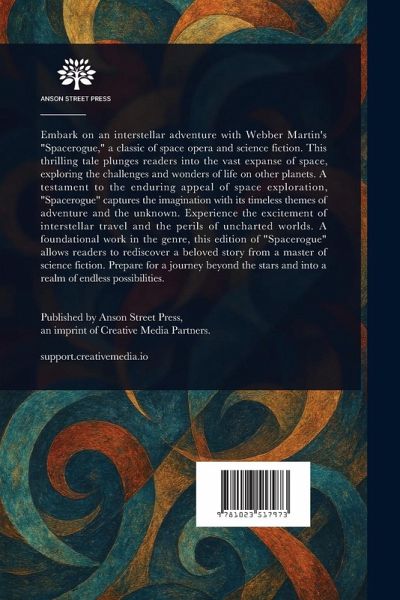
Embark on an interstellar adventure with Webber Martin's "Spacerogue," a classic of space opera and science fiction. This thrilling tale plunges readers into the vast expanse of space, exploring the challenges and wonders of life on other planets. A testament to the enduring appeal of space exploration, "Spacerogue" captures the imagination with its timeless themes of adventure and the unknown. Experience the excitement of interstellar travel and the perils of uncharted worlds. A foundational work in the genre, this edition of "Spacerogue" allows readers to rediscover a beloved story from a…mehr
Embark on an interstellar adventure with Webber Martin's "Spacerogue," a classic of space opera and science fiction. This thrilling tale plunges readers into the vast expanse of space, exploring the challenges and wonders of life on other planets. A testament to the enduring appeal of space exploration, "Spacerogue" captures the imagination with its timeless themes of adventure and the unknown. Experience the excitement of interstellar travel and the perils of uncharted worlds. A foundational work in the genre, this edition of "Spacerogue" allows readers to rediscover a beloved story from a master of science fiction. Prepare for a journey beyond the stars and into a realm of endless possibilities. This work has been selected by scholars as being culturally important, and is part of the knowledge base of civilization as we know it. This work is in the public domain in the United States of America, and possibly other nations. Within the United States, you may freely copy and distribute this work, as no entity (individual or corporate) has a copyright on the body of the work. Scholars believe, and we concur, that this work is important enough to be preserved, reproduced, and made generally available to the public. We appreciate your support of the preservation process, and thank you for being an important part of keeping this knowledge alive and relevant.
Robert Silverberg (born January 15, 1935) is an American author and editor, best known for writing science fiction. He is a multiple winner of both Hugo and Nebula Awards, a member of the Science Fiction and Fantasy Hall of Fame, and a Grand Master of SF. He has attended every Hugo Awards ceremony since the inaugural event in 1953. In the mid-1960s, science fiction writers were becoming more literarily ambitious. Frederik Pohl, then editing three science fiction magazines, offered Silverberg carte blanche in writing for them. Thus inspired, Silverberg returned to the field that gave him his start, paying far more attention to depth of character development and social background than he had in the past and mixing in elements of the modernist literature he had studied at Columbia. Silverberg continued to write rapidly-Algis Budrys reported in 1965 that he wrote and sold at least 50,000 words weekly - but the novels he wrote in this period are considered superior to his earlier work; Budrys in 1968 wrote of his surprise that "Silverberg is now writing deeply detailed, highly educated, beautifully figured books" like Thorns and The Masks of Time. Perhaps the first book to indicate the new Silverberg was To Open the Sky, a fixup of stories published by Pohl in Galaxy Magazine, in which a new religion helps people reach the stars. That was followed by Downward to the Earth, a story containing echoes of material from Joseph Conrad's work, in which the human former administrator of an alien world returns after the planet's inhabitants have been set free. Other acclaimed works of that time include To Live Again, in which the memories and personalities of the deceased can be transferred to other people; The World Inside, a look at an overpopulated future; and Dying Inside, a tale of a telepath losing his powers. In the August 1967 issue of Galaxy, Pohl published a 20,000-word novelette called "Hawksbill Station". This story earned Silverberg his first Hugo and Nebula story award nominations.
Es gelten unsere Allgemeinen Geschäftsbedingungen: www.buecher.de/agb
Impressum
www.buecher.de ist ein Internetauftritt der buecher.de internetstores GmbH
Geschäftsführung: Monica Sawhney | Roland Kölbl | Günter Hilger
Sitz der Gesellschaft: Batheyer Straße 115 - 117, 58099 Hagen
Postanschrift: Bürgermeister-Wegele-Str. 12, 86167 Augsburg
Amtsgericht Hagen HRB 13257
Steuernummer: 321/5800/1497
USt-IdNr: DE450055826