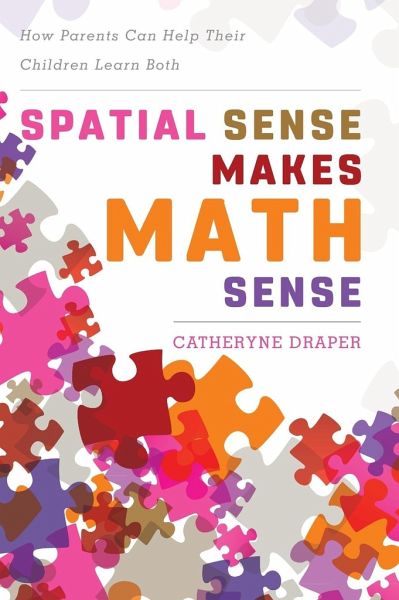
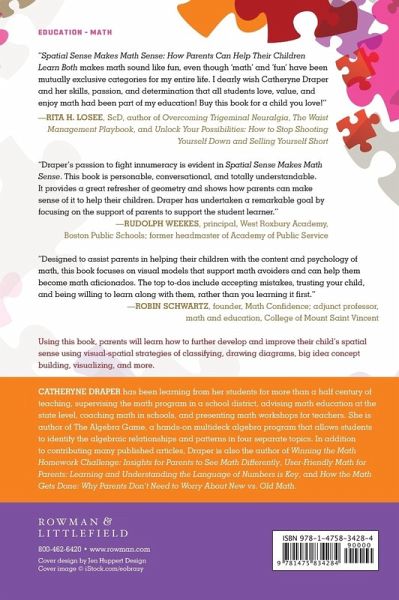
Parents will learn how to further develop and improve their child’s spatial sense using visual-spatial strategies of classifying, drawing diagrams, big idea concept building, visualizing, and more.
Parents will learn how to further develop and improve their child’s spatial sense using visual-spatial strategies of classifying, drawing diagrams, big idea concept building, visualizing, and more.
Catheryne Draper has been learning from her students for over half a century of teaching, supervising the math program in a school district, advising math education at the state level, coaching math in schools, and presenting math workshops for teachers. She is the author of The Algebra Game, a hands-on multi-deck algebra program in four topics covering Linear Graphs, Quadratic Equations, Conic Sections, and Trig Functions that allows students to work together in cooperative groups, or individually, to identify the algebra relationships and patterns in the each topic. In addition to contributing many published articles, Draper is also the author of Winning the Math Homework Challenge: Insights for Parents To See Math Differently,User-Friendly Math for Parents: Learning and Understanding the Language of Numbers is Key, and How the Math Gets Done: Why Parents Don't Need to Worry About New vs. Old Math.
Inhaltsangabe
ForewordPrefaceAcknowledgementsIntroductionPart I. Definition 1. A Perspective on Spatial Sense Permission to Move Freely Compositions and Decompositions of Shapes Symmetry Is Spatial, Not One-Half Keep in Mind 2. The Vocabulary Clues Are in the Words Prefix Power for Polygons and Polyhedra Vocabulary Ancestry Keep in Mind 3. Sorting and Classifying the Symbols of Space Arrangement-Driven Vocabulary Measurement-Driven Vocabulary Mixing the Arrangements and Measurements for Names Keep in Mind Part II. Organization 4. Ribbons, Rolls, and Rulers for the First Dimension Transitioning from Zero Dimension to One Dimension The Rolls of Circumferences and Perimeters Diagonals, Diameters, Radii (Radians), and More Straight PiecesHeights, Altitudes, Apothems, and Legs Keep in Mind 5. Angle Swings and Area Squares in Flatland Angles Are at the Entry Gate to Flatland Areas as Spatial Arrangements Permission to Surround and Rearrange Shapes to Find Areas Keep in Mind 6. Stack and Pour to Fill Volume in Spaceland Polyhedra Nets Make Three Dimensions From Two Dimensions Surface Areas, Polyhedra Nets, and Orange Peels Fill 'er Up for Volume Keep in Mind Part III. Relationships and Patterns7. Similarity and CongruenceSimilarity Allows Stretching and ShrinkingCongruence, Transformations, and TessellationsSymmetry as a Matter of Congruence Keep in Mind 8. Special Spatial, Yet Irrational, Patterns Pi , ?, and 3.141592654. - From Archimedes to Supercomputers Phi , f, and 1.618. - Beauty in the Golden RatioThe Limit of e and2.71826. - A Curious Number with Curious CousinsEccentricitye - A Circle Decider Keep in Mind 9. Shape Changes and Patterns Same Perimeters, Same Areas, Different Polygons Similar Shapes and Side Changes Predict Areas and Perimeters Dots, Vertices, Spaces, and Faces Keep in Mind Part IV. Connections10. The Influential Right Triangle Shadows, Right Triangles, and Proportions The Pythagorean Theorem: A Relationship of Sides Trigonometry: A Relationship Between Sides and Angles Keep in Mind 11. A Circle's NobilityAngles and Triangles Under Circle ControlCircle Relationships and Algebra TransformationsReturn of the Apothems for Polygon Areas Diameters, Diagonals, and Ratios Revisited Keep in Mind 12. From Figures to Scale Models, Then on to Calculus Connections Shapes As Figured Numbers and Algebra Written Geometry Through Keeping Records Triangulation, Scale Models, and Similar Triangles A Gentle Connection to Calculus Keep in Mind Conclusion: What Parents Can Do The Best Strategy is a Team Strategy A Visual-Spatial Parent and Child Story Support Your Child's Strengths Four Possible Math Profiles to Consider Keep in Mind Glossary References About the Author
ForewordPrefaceAcknowledgementsIntroductionPart I. Definition 1. A Perspective on Spatial Sense Permission to Move Freely Compositions and Decompositions of Shapes Symmetry Is Spatial, Not One-Half Keep in Mind 2. The Vocabulary Clues Are in the Words Prefix Power for Polygons and Polyhedra Vocabulary Ancestry Keep in Mind 3. Sorting and Classifying the Symbols of Space Arrangement-Driven Vocabulary Measurement-Driven Vocabulary Mixing the Arrangements and Measurements for Names Keep in Mind Part II. Organization 4. Ribbons, Rolls, and Rulers for the First Dimension Transitioning from Zero Dimension to One Dimension The Rolls of Circumferences and Perimeters Diagonals, Diameters, Radii (Radians), and More Straight PiecesHeights, Altitudes, Apothems, and Legs Keep in Mind 5. Angle Swings and Area Squares in Flatland Angles Are at the Entry Gate to Flatland Areas as Spatial Arrangements Permission to Surround and Rearrange Shapes to Find Areas Keep in Mind 6. Stack and Pour to Fill Volume in Spaceland Polyhedra Nets Make Three Dimensions From Two Dimensions Surface Areas, Polyhedra Nets, and Orange Peels Fill 'er Up for Volume Keep in Mind Part III. Relationships and Patterns7. Similarity and CongruenceSimilarity Allows Stretching and ShrinkingCongruence, Transformations, and TessellationsSymmetry as a Matter of Congruence Keep in Mind 8. Special Spatial, Yet Irrational, Patterns Pi , ?, and 3.141592654. - From Archimedes to Supercomputers Phi , f, and 1.618. - Beauty in the Golden RatioThe Limit of e and2.71826. - A Curious Number with Curious CousinsEccentricitye - A Circle Decider Keep in Mind 9. Shape Changes and Patterns Same Perimeters, Same Areas, Different Polygons Similar Shapes and Side Changes Predict Areas and Perimeters Dots, Vertices, Spaces, and Faces Keep in Mind Part IV. Connections10. The Influential Right Triangle Shadows, Right Triangles, and Proportions The Pythagorean Theorem: A Relationship of Sides Trigonometry: A Relationship Between Sides and Angles Keep in Mind 11. A Circle's NobilityAngles and Triangles Under Circle ControlCircle Relationships and Algebra TransformationsReturn of the Apothems for Polygon Areas Diameters, Diagonals, and Ratios Revisited Keep in Mind 12. From Figures to Scale Models, Then on to Calculus Connections Shapes As Figured Numbers and Algebra Written Geometry Through Keeping Records Triangulation, Scale Models, and Similar Triangles A Gentle Connection to Calculus Keep in Mind Conclusion: What Parents Can Do The Best Strategy is a Team Strategy A Visual-Spatial Parent and Child Story Support Your Child's Strengths Four Possible Math Profiles to Consider Keep in Mind Glossary References About the Author
Es gelten unsere Allgemeinen Geschäftsbedingungen: www.buecher.de/agb
Impressum
www.buecher.de ist ein Internetauftritt der buecher.de internetstores GmbH
Geschäftsführung: Monica Sawhney | Roland Kölbl | Günter Hilger
Sitz der Gesellschaft: Batheyer Straße 115 - 117, 58099 Hagen
Postanschrift: Bürgermeister-Wegele-Str. 12, 86167 Augsburg
Amtsgericht Hagen HRB 13257
Steuernummer: 321/5800/1497
USt-IdNr: DE450055826