
Andere Kunden interessierten sich auch für
 Evolutionary Computing39,99 €
 Theoretical Aspects of Evolutionary Computing113,99 €
 Design by Evolution76,99 €
 Designing Evolutionary Algorithms for Dynamic Environments39,99 €
 Designing Evolutionary Algorithms for Dynamic Environments38,99 €
 Experimental Research in Evolutionary Computation39,99 €
 Experimental Research in Evolutionary Computation38,99 €


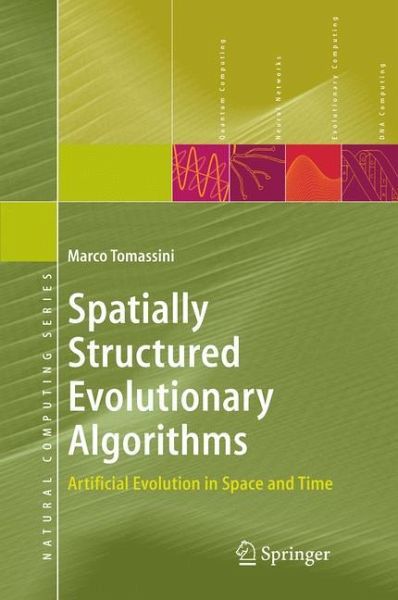
Evolutionary algorithms (EAs) is now a mature problem-solving family of heuristics that has found its way into many important real-life problems and into leading-edge scientific research. Spatially structured EAs have different properties than standard, mixing EAs. By virtue of the structured disposition of the population members they bring about new dynamical features that can be harnessed to solve difficult problems faster and more efficiently. This book describes the state of the art in spatially structured EAs by using graph concepts as a unifying theme. The models, their analysis, and their empirical behavior are presented in detail. Moreover, there is new material on non-standard networked population structures such as small-world networks.
The book should be of interest to advanced undergraduate and graduate students working in evolutionary computation, machine learning, and optimization. It should also be useful to researchers and professionals working in fields where the topological structures of populations and their evolution plays a role.
The book should be of interest to advanced undergraduate and graduate students working in evolutionary computation, machine learning, and optimization. It should also be useful to researchers and professionals working in fields where the topological structures of populations and their evolution plays a role.
From the reviews: "The focus of this very interesting book is on evolutionary heuristic algorithms and in particular those evolutionary algorithms that are 'spatially structured' which exhibit slightly different properties than standard evolutionary algorithms. The book starts with a very useful introduction on graphs and cellular models, where most of the terminology is laid out. ... The book concludes with a detailed list of references and an index." (Efstratios Rappos, Zentralblatt MATH, Vol. 1089 (15), 2006) "The strong points of the book is that it provides many variations in the structure of any EA, thus offering numerous options to consider when implementing an EA. This is very useful for anyone using EAs in practice. The book also contains a wealth of empirical data comparing the performance of these many variations ... . The book is quite comprehensive and contains a wealth of very valuable information for any EA practitioner. The references are also very nice and varied." (Franklin A. Mendivil, Mathematical Reviews, Issue 2007 k)