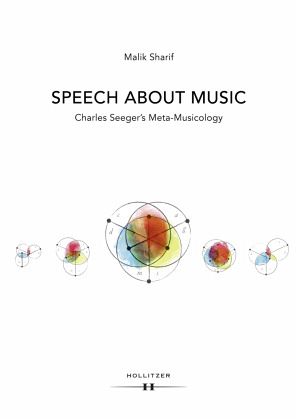
Charles Seeger and Twenty-First-Century MusicologiesThe US-American musicologist, composer, philosopher, inventor, and political activist Charles Seeger (1886-1979) is a key figure in the development of twentieth-century musicology. This publication is the first book-length study of his philosophical theory ofmusicology - his meta-musicology -, which he continuously developed over the course of more than sixty years. The book comprises two main parts: The first part is a historical reconstruction and comparative analysis of Seeger's meta-musicological theory. The second part employs Seeger's…mehr
Charles Seeger and Twenty-First-Century MusicologiesThe US-American musicologist, composer, philosopher, inventor, and political activist Charles Seeger (1886-1979) is a key figure in the development of twentieth-century musicology. This publication is the first book-length study of his philosophical theory ofmusicology - his meta-musicology -, which he continuously developed over the course of more than sixty years. The book comprises two main parts: The first part is a historical reconstruction and comparative analysis of Seeger's meta-musicological theory. The second part employs Seeger's theory as an arsenal of ideas in the discussion of twenty-first century meta-musicological issues, especially regarding the disciplinarity of musicology. Accordingly, this book is both an important contribution to the study of the history of musicology and a critical examination of the timeliness of Seeger's ideas.Hinweis: Dieser Artikel kann nur an eine deutsche Lieferadresse ausgeliefert werden.
Die Herstellerinformationen sind derzeit nicht verfügbar.
Inhaltsangabe
List of FiguresList of AcronymsAcknowledgements1. Introduction1.1 Situating the Author: An Exercise in Scholarly Ref lexivity1.2 Situating the Text: Why Write a Book on Charles Seeger?1.3 The Scope, Aim, Approach, and Content of This Study1.4 Some Remarks on Central Terms and Concepts1.5 Objections and Replies 2. Charles Seeger's Biography2.1 Charles Seeger's Early Life2.2 Professor of Music in Berkeley2.3 The New York Years2.4 Work for National and International Agencies in Washington2.4.1 New Deal Agencies2.4.2 The Inter-American Music Center2.4.3 Scholarly Work during the Washington Years2.5 Researcher in California2.6 Final Years in New England3. Early Meta-Musicology3.1 Meta-Musicology in Berkeley3.2 The Linguocentric Predicament3.3 Outline of a Musicological Agenda3.4 Musicological Disciplinarity3.5 Musicology's Raison d'Être3.6 Earlier and Contemporary Meta-Musicological Positions3.6.1 Friedrich Chrysander3.6.2 Guido Adler3.6.3 Hugo Riemann3.6.4 Waldo S. Pratt3.6.5 Comparative Discussion3.7 Philosophical Foundations 4. Meta-Musicology from the 1930s to the 1950s4.1 Music and Language4.2 Musicology4.2.1 Science and Criticism4.2.2 Systematic Musicology and Historical Musicology4.2.3 Synopsis and Research4.2.4 Pure Musicology and Applied Musicology4.3 Contemporary Meta-Musicological Positions4.3.1 Karl Gustav Fellerer4.3.2 Jacques Handschin4.3.3 Comparative Discussion 5. Toward a Unitary Field Theory for Musicology: Late Meta-Musicology5.1 Seeger and the Rise of Ethnomusicology5.2 Music, Speech, and Other Modes of Communication5.3 Musicology and the Musicological Juncture5.4 Musicological Disciplinarity5.4.1 Music Viewpoint and General Viewpoint5.4.2 Systematic Orientation and Historical Orientation5.4.3 Scientific Method and Critical Method5.4.4 The Center, Periphery, and Neighborhood of Musicology5.5 The Aims and Ends of Musicology5.6 Contemporary Meta-Musicological Debates5.6.1 Criticism versus Positivism5.6.2 Historische Musikwissenschaft versus Systematische Musikwissenschaft 6. A Seegerian Philosophy of Musicology for the Twenty-First Century6.1 Musicology: Basic Premises and Definitions6.2 Musicology as an Ideal Discipline6.3 The State of Music Studies in the Early Twenty-First Century6.4 Musicological Ideals and the Real World 7. Utopias of Twenty-First Century Musicologies7.1 Unidisciplinarity7.2 Interdisciplinarity7.3 Post- and Transdisciplinarity 8. Conclusion: Beyond Meta-Musicology 9. References Cited
Es gelten unsere Allgemeinen Geschäftsbedingungen: www.buecher.de/agb
Impressum
www.buecher.de ist ein Internetauftritt der buecher.de internetstores GmbH
Geschäftsführung: Monica Sawhney | Roland Kölbl | Günter Hilger
Sitz der Gesellschaft: Batheyer Straße 115 - 117, 58099 Hagen
Postanschrift: Bürgermeister-Wegele-Str. 12, 86167 Augsburg
Amtsgericht Hagen HRB 13257
Steuernummer: 321/5800/1497
USt-IdNr: DE450055826