When Peter Robinson published Untitled Deeds in 2004, a number of his readers expressed surprise that the writer who, as early as 1983, had been described as 'the finest poet of his generation' in PN Review and, two decades later in The Reader, 'the finest poet alive', should suddenly emerge from his exile in Japan as an aphorist. What had happened? While the Western world was declaring war on an abstraction, Robinson had been drawing up peace terms with a host of them. Finding weapons of mass destruction in the speechifying of politicians, and the toxicity of pension plan promises, feeling…mehr
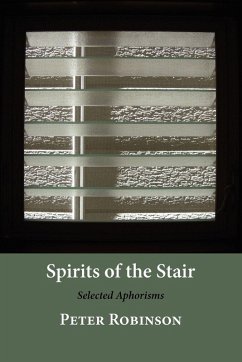
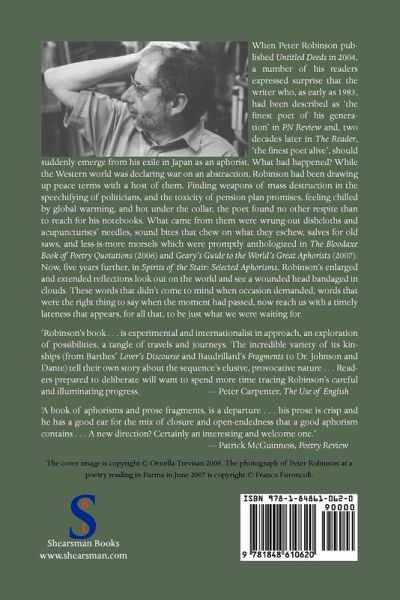
When Peter Robinson published Untitled Deeds in 2004, a number of his readers expressed surprise that the writer who, as early as 1983, had been described as 'the finest poet of his generation' in PN Review and, two decades later in The Reader, 'the finest poet alive', should suddenly emerge from his exile in Japan as an aphorist. What had happened? While the Western world was declaring war on an abstraction, Robinson had been drawing up peace terms with a host of them. Finding weapons of mass destruction in the speechifying of politicians, and the toxicity of pension plan promises, feeling chilled by global warming, and hot under the collar, the poet found no other respite than to reach for his notebooks. What came from them were wrung-out dishcloths and acupuncturists' needles, sound bites that chew on what they eschew, salves for old saws, and less-is-more morsels which were promptly anthologized in The Boodaxe Book of Poetry Quotations (2006) and Geary's Guide to the World's Great Aphorists (2007). Now, five years further, in Spirits of the Stair: Selected Aphorisms, Robinson's enlarged and extended reflections look out on the world and see a wounded head bandaged in clouds. These words that didn't come to mind when occasion demanded, words that were the right thing to say when the moment had passed, now reach us with a timely lateness that appears, for all that, to be just what we were waiting for.
Peter Robinson was born in Salford, Lancashire, in 1953, and grew up mainly in Liverpool. He co-edited the magazines Perfect Bound and Numbers while helping organize various Cambridge Poetry Festivals (1977-1985) and a Poetry International at the South Bank Centre (1988). His many volumes of poetry include a Selected Poems (2003), The Look of Goodbye (2008) and Like the Living End (2013). Buried Music, his latest full collection, will be published in 2015. He was awarded the Cheltenham Prize for This Other Life(1988), while both The Great Friend and Other Translated Poems (2002) and The Returning Sky(2012) were recommendations of the Poetry Book Society, and The Greener Meadow: Selected Poems of Luciano Erba (2007) received the John Florio Prize for translation from the Italian in 2008. Other publications include a collection of aphorisms, Spirits of the Stair(2009), four volumes of literary criticism, the most recent being Poetry & Translation: The Art of the Impossible (2010), a collection of short fiction, Foreigners, Drunks and Babies: Eleven Stories (2013), various edited collections, anthologies, The Complete Poems, Translations & Selected Prose of Bernard Spencer (2011) and The Oxford Handbook of Contemporary British and Irish Poetry (2013). His work is the subject of The Salt Companion to Peter Robinson, ed. Adam Piette and Katy Price (2007), and a new collection of essays on his writings edited by Tom Phillips is in preparation. The literary editor for Two Rivers Press, he is Head of Department and Professor of English and American Literature at the University of Reading.
Es gelten unsere Allgemeinen Geschäftsbedingungen: www.buecher.de/agb
Impressum
www.buecher.de ist ein Internetauftritt der buecher.de internetstores GmbH
Geschäftsführung: Monica Sawhney | Roland Kölbl | Günter Hilger
Sitz der Gesellschaft: Batheyer Straße 115 - 117, 58099 Hagen
Postanschrift: Bürgermeister-Wegele-Str. 12, 86167 Augsburg
Amtsgericht Hagen HRB 13257
Steuernummer: 321/5800/1497
USt-IdNr: DE450055826