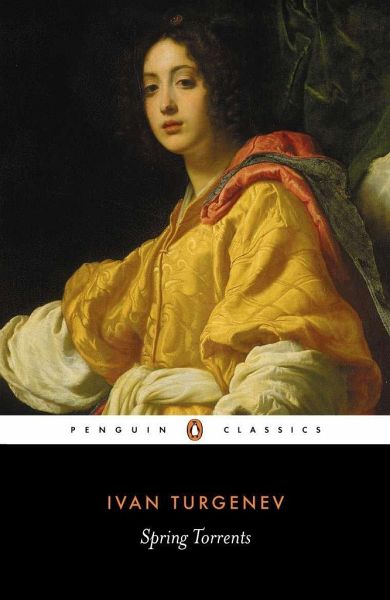
Returning to Russia from Italy, twenty-three-year-old Dimitry Sanin breaks his journey in Frankfurt. There, he encounters the beautiful Gemma Roselli and falls in love. He decides to begin a new life and sell his Russian estates. But when he meets the potential buyer, Madame Polozov, his vulnerability makes him prey for a destructive infatuation.
Returning to Russia from Italy, twenty-three-year-old Dimitry Sanin breaks his journey in Frankfurt. There, he encounters the beautiful Gemma Roselli and falls in love. He decides to begin a new life and sell his Russian estates. But when he meets the potential buyer, Madame Polozov, his vulnerability makes him prey for a destructive infatuation.
Ivan Sergeyevich Turgenev (1818 - 1883) was a Russian novelist, short story writer, poet, playwright, translator and popularizer of Russian literature in the West. His first major publication, a short story collection entitled A Sportsman's Sketches (1852), was a milestone of Russian realism and his novel Fathers and Sons (1862) is regarded as one of the major works of 19th-century fiction. Turgenev's artistic purity made him a favorite of like-minded novelists of the next generation, such as Henry James and Joseph Conrad, both of whom greatly preferred Turgenev to Tolstoy and Dostoyevsky. James, who wrote no fewer than five critical essays on Turgenev's work, claimed that "his merit of form is of the first order" (1873) and praised his "exquisite delicacy", which "makes too many of his rivals appear to hold us, in comparison, by violent means and introduce us, in comparison, to vulgar things" (1896). Vladimir Nabokov, notorious for his casual dismissal of many great writers, praised Turgenev's "plastic musical flowing prose", but criticized his "labored epilogues" and "banal handling of plots". Nabokov stated that Turgenev "is not a great writer, though a pleasant one" and ranked him fourth among nineteenth-century Russian prose writers, behind Tolstoy, Gogol and Anton Chekhov, but ahead of Dostoyevsky. His idealistic ideas about love, specifically the devotion a wife should show her husband, were cynically referred to by characters in Chekhov's "An Anonymous Story".
Es gelten unsere Allgemeinen Geschäftsbedingungen: www.buecher.de/agb
Impressum
www.buecher.de ist ein Internetauftritt der buecher.de internetstores GmbH
Geschäftsführung: Monica Sawhney | Roland Kölbl | Günter Hilger
Sitz der Gesellschaft: Batheyer Straße 115 - 117, 58099 Hagen
Postanschrift: Bürgermeister-Wegele-Str. 12, 86167 Augsburg
Amtsgericht Hagen HRB 13257
Steuernummer: 321/5800/1497
USt-IdNr: DE450055826