
Andere Kunden interessierten sich auch für
 Downton Abbey Script Book Season 316,76 €
 Downton Abbey Script Book Season 113,99 €
 Downton Abbey Script Book Season 215,99 €
 The Hateful Eight11,99 €
 Scripting the Environment76,99 €
 Writing for the Screen42,99 €
 Popular Cinema as Political Theory58,99 €
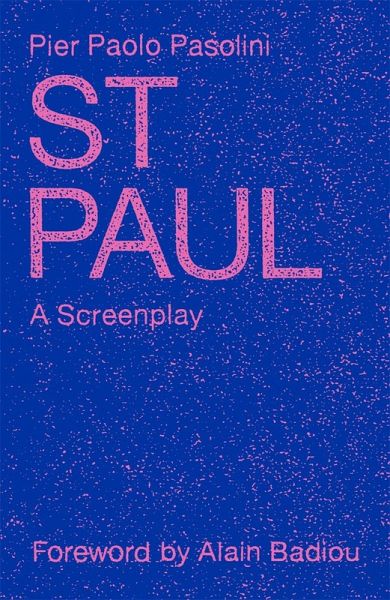
Presented here for the first time in English is a remarkable screenplay about the apostle Paul by Pier Paolo Pasolini, legendary filmmaker, novelist, poet, and radical intellectual activist. Written between the appearance of his renowned film Teorema and the shocking, controversial Salò, or the 120 Days of Sodom, St Paul was deemed too risky for investors. At once a political intervention and cinematic breakthrough, the script forces a revolutionary transformation on the contemporary legacy of Paul. In Pasolini's kaleidoscope, we encounter fascistic movements, resistance fighters, and faltering revolutions, each of which reflects on aspects of the Pauline teachings. From Jerusalem to Wall Street and Greenwich Village, from the rise of SS troops to the death of Martin Luther King, Jr, here- as Alain Badiou writes in the foreword-"Paul's text crosses all these circumstances intact, as if it had foreseen them all."
This is a key addition to the growing debate around St Paul and to the proliferation of literature centred on the current turn to religion in philosophy and critical theory, which embraces contemporary figures such as Alain Badiou, Slavoj Zizek and Giorgio Agamben.
This is a key addition to the growing debate around St Paul and to the proliferation of literature centred on the current turn to religion in philosophy and critical theory, which embraces contemporary figures such as Alain Badiou, Slavoj Zizek and Giorgio Agamben.
Pasolini seems to me indisputably the most remarkable figure to have emerged in Italian arts and letters since the Second World War ... His poetry is an important part of his passionate, proud, historically vulnerable body of work, a work in and with history; and of the tragic itinerary of his sensibility. Susan Sontag