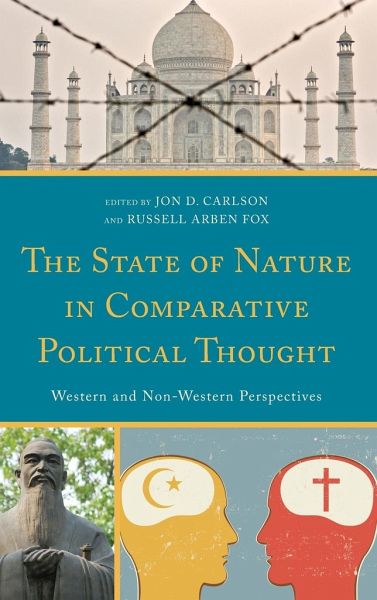
The State of Nature in Comparative Political Thought addresses non-Western conceptions of the "state of nature", revealing how basic questions related to political thought are reflected in Chinese, Islamic, Indic, and other cultural contexts. It contributes to the burgeoning field of comparative political theory, and should be of interest to political theorists, regional specialists, students of globalization, as well as anyone interested in non-Western approaches to basic political questions.
The State of Nature in Comparative Political Thought addresses non-Western conceptions of the "state of nature", revealing how basic questions related to political thought are reflected in Chinese, Islamic, Indic, and other cultural contexts. It contributes to the burgeoning field of comparative political theory, and should be of interest to political theorists, regional specialists, students of globalization, as well as anyone interested in non-Western approaches to basic political questions.
Jon D. Carlson is a lecturer in social sciences, humanities, and arts at the University of California, Merced. His recent works include Myths, State Expansion and the Birth of Globalization and a co-edited volume Maritime Piracy and the Construction of Global Governance. Russell Arben Fox is professor of political science and director of the Political Science Program at Friends University.
Inhaltsangabe
Introduction: Comparative States of Nature Russell Arben Fox Part One: The State of Nature and Applications in Chinese Thought Chapter 1. Self-Transformation and Civil Society: Lockean vs. Confucian Sungmoon Kim, City University of Hong Kong Chapter 2. Han Feizi's Philosophical Psychology: Human Nature, Scarcity, and the NeoDarwinian Consensus Owen Flanagan and Jing Hu, Duke University Chapter 3. The Confucian Tradition, Nature, and Civil Education Russell Arben Fox, Friends University Chapter 4. States of Nature: Counter-Confucianism and the Daoist Encounter with Liberalism Eric Goodfield, American University, Beirut Chapter 5. Mozi, Hobbes, Locke and the State of Nature Al Martinich and Siwing Tsoi, University of Texas Chapter 6. Chinese Sage Kings and the Hobbesian State of Nature: Bridging Comparative Political Thought and International Relations Theory Jon D. Carlson, University of California, Merced Part Two: The State of Nature in Islam, India and Beyond Chapter 7. States of Nature and Islands of Politics: Animality, Death, Colonialism Murad Idris, Penn University, Cornell University Chapter 8. Ibn Khaldoun: Writing from the Margin-'The State of Nature'-To Remain There. Magid Shihade, Birzeit University Chapter 9. The State of Nature and Domesticated Differences in Ancient Indian Political Thought: A Historical-Comparative Approach Stuart Gray, University of California, Santa Barbara, Johns Hopkins University Chapter 10. On Matsyanyaya: The State of Nature in Indian Thought (from Asian Philosophy) David Slakter, University of Central Oklahoma Chapter 11. I'd Rather Just Devolve, Thank You: Enkidu, Gilgamesh, and an Ambiguous State of Nature Stefan Dolgert, Brock University Chapter 12. The Problem of the State of Nature in Medieval Jewish Political Philosophy Abraham Melamed, University of Haifa Chapter 13. The Nature of the State without the State of Nature: Micronesia and Polynesia Michael Stoil, University of Guam Conclusion. States of Nature: Consilience, Syncretism, and Challenges for Comparative Political Thought Jon D. Carlson, University of California, Merced
Introduction: Comparative States of Nature Russell Arben Fox Part One: The State of Nature and Applications in Chinese Thought Chapter 1. Self-Transformation and Civil Society: Lockean vs. Confucian Sungmoon Kim, City University of Hong Kong Chapter 2. Han Feizi's Philosophical Psychology: Human Nature, Scarcity, and the NeoDarwinian Consensus Owen Flanagan and Jing Hu, Duke University Chapter 3. The Confucian Tradition, Nature, and Civil Education Russell Arben Fox, Friends University Chapter 4. States of Nature: Counter-Confucianism and the Daoist Encounter with Liberalism Eric Goodfield, American University, Beirut Chapter 5. Mozi, Hobbes, Locke and the State of Nature Al Martinich and Siwing Tsoi, University of Texas Chapter 6. Chinese Sage Kings and the Hobbesian State of Nature: Bridging Comparative Political Thought and International Relations Theory Jon D. Carlson, University of California, Merced Part Two: The State of Nature in Islam, India and Beyond Chapter 7. States of Nature and Islands of Politics: Animality, Death, Colonialism Murad Idris, Penn University, Cornell University Chapter 8. Ibn Khaldoun: Writing from the Margin-'The State of Nature'-To Remain There. Magid Shihade, Birzeit University Chapter 9. The State of Nature and Domesticated Differences in Ancient Indian Political Thought: A Historical-Comparative Approach Stuart Gray, University of California, Santa Barbara, Johns Hopkins University Chapter 10. On Matsyanyaya: The State of Nature in Indian Thought (from Asian Philosophy) David Slakter, University of Central Oklahoma Chapter 11. I'd Rather Just Devolve, Thank You: Enkidu, Gilgamesh, and an Ambiguous State of Nature Stefan Dolgert, Brock University Chapter 12. The Problem of the State of Nature in Medieval Jewish Political Philosophy Abraham Melamed, University of Haifa Chapter 13. The Nature of the State without the State of Nature: Micronesia and Polynesia Michael Stoil, University of Guam Conclusion. States of Nature: Consilience, Syncretism, and Challenges for Comparative Political Thought Jon D. Carlson, University of California, Merced
Es gelten unsere Allgemeinen Geschäftsbedingungen: www.buecher.de/agb
Impressum
www.buecher.de ist ein Internetauftritt der buecher.de internetstores GmbH
Geschäftsführung: Monica Sawhney | Roland Kölbl | Günter Hilger
Sitz der Gesellschaft: Batheyer Straße 115 - 117, 58099 Hagen
Postanschrift: Bürgermeister-Wegele-Str. 12, 86167 Augsburg
Amtsgericht Hagen HRB 13257
Steuernummer: 321/5800/1497
USt-IdNr: DE450055826