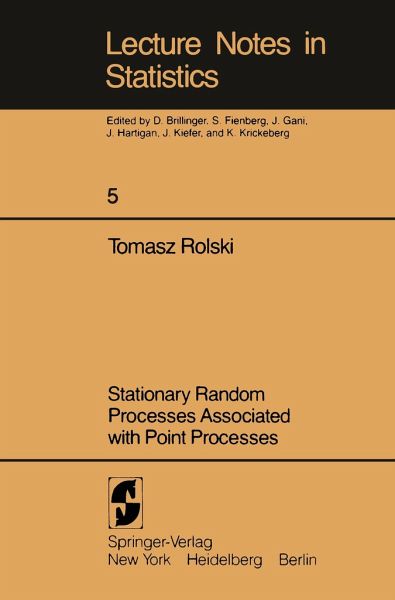
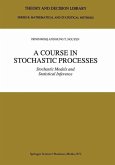
In this set of notes we study a notion of a random process assoc- ted with a point process. The presented theory was inSpired by q- ueing problems. However it seems to be of interest in other branches of applied probability, as for example reliability or dam theory. Using developed tools, we work out known, aswell as new results from queueing or dam theory. Particularly queues which cannot be treated by standard techniques serve as illustrations of the theory. In Chapter 1 the preliminaries are given. We acquaint the reader with the main ideas of these notes, introduce some useful notations,…mehr
In this set of notes we study a notion of a random process assoc- ted with a point process. The presented theory was inSpired by q- ueing problems. However it seems to be of interest in other branches of applied probability, as for example reliability or dam theory. Using developed tools, we work out known, aswell as new results from queueing or dam theory. Particularly queues which cannot be treated by standard techniques serve as illustrations of the theory. In Chapter 1 the preliminaries are given. We acquaint the reader with the main ideas of these notes, introduce some useful notations, concepts and abbreviations. He also recall basic facts from ergodic theory, an important mathematical tool employed in these notes. Finally some basic notions from queues are reviewed. Chapter 2 deals with discrete time theory. It serves two purposes. The first one is to let the reader get acquainted with the main lines of the theory needed in continuous time without being bothered by tech nical details. However the discrete time theory also seems to be of interest itself. There are examples which have no counte~ in continuous time. Chapter 3 deals with continuous time theory. It also contains many basic results from queueing or dam theory. Three applications of the continuous time theory are given in Chapter 4. We show how to use the theory in order to get some useful bounds for the stationary distribution of a random process.
Pawe¿ Lorek obtained his PhD at the University of Wroc¿aw in 2007, where he is currently a professor at the Faculty of Mathematics and Computer Science. His main scientific interests include Markov chains (in particular, the rate of convergence to stationarity and duality-based methods), computer security, and probabilistic aspects of machine learning. Tomasz Rolski obtained his PhD at the University of Wroc¿aw in 1972, where he is currently a professor at the Faculty of Mathematics and Computer Science. He is the author or co-author of about 90 scientific publications and three books in various areas of applied probability. His main mathematical interests include queueing theory, point processes, ruin theory, and life insurance mathematics.
Inhaltsangabe
1 Preliminaries.- 1 Introduction.- 2 Some notations and conventions.- 3 Ergodic theory - discrete parameter.- 4 Ergodic theory - continuous parameter.- 5 Stationary random elements.- 6 Loynes' lemma.- 7 Queues.- Notes.- 2 Discrete time r.p.@ p.p..- 1 Basic concepts.- 2 Construction of stationary processes.- 3 First and second type relations.- 4 Applications in queueing theory.- Notes.- 3 Continuous time r.p.@ m.p.p..- 1 Random process associated with marked point process.- 2 Construction of stationary r.p.@ m.p.p.'s.- 3 Ergodic theorems.- 4 Relations of the first and second type.- 5 A rate conservative principle approach.- Notes.- 4 Miscellaneous examples.- 1 Inequalities and identities.- 2 Kopoci?ska's model.- 3 Equivalence of distributions of embedded chains in the queue size process.- Notes.- 5 Application to single server queues.- 1 Introductory remarks.- 2 Single server queue with periodic input.- 3 Fagging queueing systems.- 4 $$overrightarrow G /overrightarrow G /1$$ queue with work-conserving normal discipline.- 5 Takács relation in G/G/1; FIFO. queues.- 6 Takács relation in GI/GI/1; FIFO queues.- Notes.- References.
1 Preliminaries.- 1 Introduction.- 2 Some notations and conventions.- 3 Ergodic theory - discrete parameter.- 4 Ergodic theory - continuous parameter.- 5 Stationary random elements.- 6 Loynes' lemma.- 7 Queues.- Notes.- 2 Discrete time r.p.@ p.p..- 1 Basic concepts.- 2 Construction of stationary processes.- 3 First and second type relations.- 4 Applications in queueing theory.- Notes.- 3 Continuous time r.p.@ m.p.p..- 1 Random process associated with marked point process.- 2 Construction of stationary r.p.@ m.p.p.'s.- 3 Ergodic theorems.- 4 Relations of the first and second type.- 5 A rate conservative principle approach.- Notes.- 4 Miscellaneous examples.- 1 Inequalities and identities.- 2 Kopoci?ska's model.- 3 Equivalence of distributions of embedded chains in the queue size process.- Notes.- 5 Application to single server queues.- 1 Introductory remarks.- 2 Single server queue with periodic input.- 3 Fagging queueing systems.- 4 $$overrightarrow G /overrightarrow G /1$$ queue with work-conserving normal discipline.- 5 Takács relation in G/G/1; FIFO. queues.- 6 Takács relation in GI/GI/1; FIFO queues.- Notes.- References.
Es gelten unsere Allgemeinen Geschäftsbedingungen: www.buecher.de/agb
Impressum
www.buecher.de ist ein Internetauftritt der buecher.de internetstores GmbH
Geschäftsführung: Monica Sawhney | Roland Kölbl | Günter Hilger
Sitz der Gesellschaft: Batheyer Straße 115 - 117, 58099 Hagen
Postanschrift: Bürgermeister-Wegele-Str. 12, 86167 Augsburg
Amtsgericht Hagen HRB 13257
Steuernummer: 321/5800/1497
USt-IdNr: DE450055826