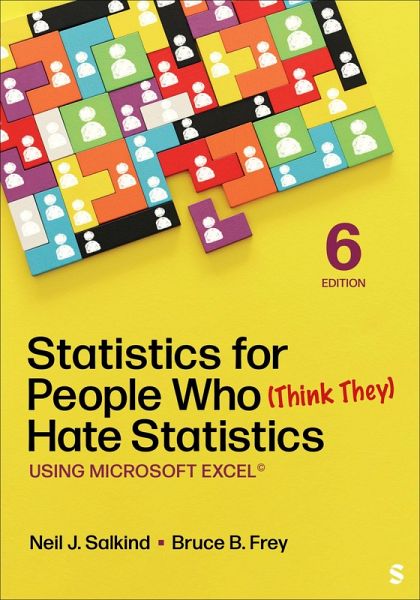
Bruce B. Frey, Neil J. Salkind
Statistics for People Who (Think They) Hate Statistics
Using Microsoft Excel
Versandkostenfrei innerhalb Deutschlands
133,99 €
inkl. MwSt.
Versandkostenfrei*
Erscheint vorauss. 14. April 2026
Melden Sie sich
hier
hier
für den Produktalarm an, um über die Verfügbarkeit des Produkts informiert zu werden.

67 °P sammeln
Bruce B. Frey, Neil J. Salkind
Statistics for People Who (Think They) Hate Statistics
Using Microsoft Excel
- Broschiertes Buch
This Sixth Edition of Salkind and Frey's Statistics for People Who (Think They) Hate Statistics: Using Microsoft Excel, presents an often intimidating and difficult subject in a way that is clear, informative, and personable. This edition notably offers Excel 2025 for use in statistical analysis, including updated graphics and coverage of how to use functions and formulas.
Andere Kunden interessierten sich auch für
") Devora ZackManaging for People Who Hate Managing (16pt Large Print Edition)33,99 €
Devora ZackManaging for People Who Hate Managing (16pt Large Print Edition)33,99 € Chris HackleyQualitative Research in Marketing and Management52,99 €
 David M BojeOrganizational Research53,99 €
 Richard CowleyPractical, Impactful Human Resources for SMEs: For CEOs and HR leaders who do not want to become failed SME statistics15,99 €
 Bruce L. KatcherThe 30 Reasons Employees Hate Their Managers17,99 €
 Nicholas MonkOpen-space Learning50,99 €
 Joe LangfordFocus Groups135,99 €
-
-
-



This Sixth Edition of Salkind and Frey's Statistics for People Who (Think They) Hate Statistics: Using Microsoft Excel, presents an often intimidating and difficult subject in a way that is clear, informative, and personable. This edition notably offers Excel 2025 for use in statistical analysis, including updated graphics and coverage of how to use functions and formulas.
Produktdetails
- Produktdetails
- Verlag: Sage Publications Inc Ebooks
- 6 Revised edition
- Seitenzahl: 496
- Erscheinungstermin: 14. April 2026
- Englisch
- Abmessung: 254mm x 177mm
- ISBN-13: 9781071950579
- ISBN-10: 1071950576
- Artikelnr.: 75664963
- Herstellerkennzeichnung
- Libri GmbH
- Europaallee 1
- 36244 Bad Hersfeld
- gpsr@libri.de
- Verlag: Sage Publications Inc Ebooks
- 6 Revised edition
- Seitenzahl: 496
- Erscheinungstermin: 14. April 2026
- Englisch
- Abmessung: 254mm x 177mm
- ISBN-13: 9781071950579
- ISBN-10: 1071950576
- Artikelnr.: 75664963
- Herstellerkennzeichnung
- Libri GmbH
- Europaallee 1
- 36244 Bad Hersfeld
- gpsr@libri.de
Neil J. Salkind received his PhD in human development from the University of Maryland, and after teaching for 35 years at the University of Kansas, he was Professor Emeritus in the Department of Psychology and Research in Education, where he collaborated with colleagues and work with students. His early interests were in the area of children's cognitive development, and after research in the areas of cognitive style and (what was then known as) hyperactivity, he was a postdoctoral fellow at the University of North Carolina's Bush Center for Child and Family Policy. His work then changed direction to focus on child and family policy, specifically the impact of alternative forms of public support on various child and family outcomes. He delivered more than 150 professional papers and presentations; written more than 100 trade and textbooks; and is the author of Statistics for People Who (Think They) Hate Statistics (SAGE), Theories of Human Development (SAGE), and Exploring Research (Prentice Hall). He has edited several encyclopedias, including the Encyclopedia of Human Development, the Encyclopedia of Measurement and Statistics, and the Encyclopedia of Research Design. He was editor of Child Development Abstracts and Bibliography for 13 years. He lived in Lawrence, Kansas, where he liked to read, swim with the River City Sharks, work as the proprietor and sole employee of big boy press, bake brownies (see www.statisticsforpeople.com for the recipe), and poke around old Volvos and old houses.
Preface
Acknowledgments
About the Authors
Part I: Yippee! I'm in Statistics
Chapter 1: Statistics or Sadistics? It's Up to You
Why Statistics?
Descriptive Statistics and Averages
Computing the Mean
Computing the Median
Computing the Mode
What Am I Doing in a Statistics Class?
Ten Ways to Use This Book (and Learn Statistics at the Same Time!)
About the Book's Features
Summary
List of Key Terms
Activities
Review Questions
Critical Thinking Questions
Chapter 2: What Do Your Data Look Like? Summarizing and Picturing
Distributions
How Much Information Is in Your Variable?
How Much Information Is in Your Variable?
All You Need to Know About Using the Amazing Data Analysis Tools
All You Need to Know About Using the Amazing Data Analysis Tools
Shaping Things Up
Using the Amazing Data Analysis Tools to Create a Histogram
List of Key Terms
Activities
Review Questions
Critical Thinking Questions
Chapter 3: Computing Correlation Coefficients: Ice Cream and Crime
How's Your Relationship?
Computing a Pearson Correlation Coefficient
What's It All Mean?
Ice Cream Causes Crime (Association vs. Causation)
And Now . . . Using Excel's CORREL Function
Creating a Scatterplot
Other Cool Correlations
Parting Ways: A Bit About Partial Correlations
Summary
List of Key Terms
Activities
Review Questions
Critical Thinking Questions
Chapter 4: Reliability and Validity: Tell the Truth, Precisely the Truth
Reliability: Getting It Right the First Time
Different Types of Reliability
Test-Retest Reliability: Time and Time Again
Internal Consistency Reliability: To One's Own Self Be True
Interrater Reliability: Agreeing Not to Disagree
How Big Is Big? Interpreting Reliability Coefficients
Validity: What's the Meaning of Life!?
Validity and Reliability: Really Close Cousins
Summary
List of Key Terms
Activities
Review Questions
Critical Thinking Questions
Chapter 5: The Normal Curve: It's Shaped Like a Bell and It's Everywhere!
Distributions and Probabilities
Area Codes: Areas Under the Normal Curve
The Amazing Super-Informative z Score
Using Excel to Compute z Scores
Fat and Skinny Frequency Distributions
Summary
List of Key Terms
Activities
Review Questions
Critical Thinking Questions
Chapter 6: Hypotheticals and You: Making Guesses
Samples and Populations
The Null Hypothesis
The Research Hypothesis
A Closer Look at Our Two Favorite Hypotheses
What Makes a Good Research Hypothesis?
Summary
List of Key Terms
Activities
Review Questions
Critical Thinking Questions
Part III: Significantly Different: Using Inferential Statistics
Chapter 7: Significance: Not Everything That Can Be Counted Counts
The Concept of Significance
If Only We Were Perfect
Type I or Type II: Errors in Inferential Statistics
Significance Versus Meaningfulness
An Introduction to Inferential Statistics
An Introduction to Tests of Significance
Be Even More Confident
Summary
List of Key Terms
Activities
Review Questions
Critical Thinking Questions
Chapter 8: Single Samples: One Group All Alone
Introduction to the Single-Sample z Test
Computing the z Test Statistic
Using Excel to Perform a z Test t Test
Special Effects: Do They Matter?
Summary
List of Key Terms
Activities
Review Questions
Critical Thinking Questions
Chapter 9: t(ea) for Two: Comparing Two Means
The Classic Group Comparison: Independent t Test
The Classic Group Comparison: Independent t Test
Using Excel to Perform an Independent t Test
One Group Compared to Itself: Paired-Samples t Test
Using Excel to Perform a Paired-Samples t Test
Summary
List of Key Terms
Activities
Review Questions
Critical Thinking Questions
Chapter 10: More Than Two Groups? Analysis of Variance to the Rescue
Different Flavors of Analysis of Variance
Computing the F Test Statistic
Using Excel for One-Way Analysis of Variance
The Effect Size for One-Way ANOVA
Summary
List of Key Terms
Activities
Review Questions
Critical Thinking Questions
Chapter 11: Two (or More) ANOVAs in One: Factorial Analysis of Variance
Factorial Analysis of Variance
A New Flavor of ANOVA
The Main Event: Main Effects in Factorial ANOVA
Even More Interesting: Interaction Effects
Using Excel to Conduct a Factorial Analysis of Variance
Computing the Effect Size for Factorial ANOVA
Summary
List of Key Terms
Activities
Review Questions
Critical Thinking Questions
Chapter 12: Correlation Coefficients and Regression: Can You Relate?
Remember the Correlation Coefficient?
Computing the Test Statistic
Linear Regression
Drawing the World's Best Line (for Your Data)
How Good Is Your Prediction?
Using Excel to Compute the Regression Line
Multiple Regression: The More Predictors the Better? Maybe
Summary
List of Key Terms
Activities
Review Questions
Critical Thinking Questions
Part V: More Statistics! More Tools! More Fun!
Chapter 13: Chi-Square and Some Other Nonparametric Tests: What to Do When
You're Not Normal
Introduction to Nonparametric Statistics
Introduction to the Goodness-of-Fit (One-Sample) Chi-Square
Computing the Goodness-of-Fit Chi-Square Test Statistic
Introduction to the Chi-Square Test of Independence
Using Excel to Perform Chi-Square Tests
Other Nonparametric Tests You Should Know About
Summary
List of Key Terms
Activities
Review Questions
Critical Thinking Questions
Chapter 14: Some Other (Important) Statistical Stuff You Should Know About
Sophisticated Group Comparisons
Sophisticated Group Comparisons
It's Not About What Data Are Mine, It's About What Data Are Mined
Using Chatbots for Statistical Analyses
Summary
List of Key Terms
Appendices: Information Never Ends!
Appendix A: Excel-erate Your Learning
Appendix B: Tables
Appendix C: Data Sets
Appendix D: Answers to Practice Questions
Appendix E: Math: Just the Basics
Appendix F: The 10 Commandments of Data Collection
Appendix G: The Reward: The Brownie Recipe
Acknowledgments
About the Authors
Part I: Yippee! I'm in Statistics
Chapter 1: Statistics or Sadistics? It's Up to You
Why Statistics?
Descriptive Statistics and Averages
Computing the Mean
Computing the Median
Computing the Mode
What Am I Doing in a Statistics Class?
Ten Ways to Use This Book (and Learn Statistics at the Same Time!)
About the Book's Features
Summary
List of Key Terms
Activities
Review Questions
Critical Thinking Questions
Chapter 2: What Do Your Data Look Like? Summarizing and Picturing
Distributions
How Much Information Is in Your Variable?
How Much Information Is in Your Variable?
All You Need to Know About Using the Amazing Data Analysis Tools
All You Need to Know About Using the Amazing Data Analysis Tools
Shaping Things Up
Using the Amazing Data Analysis Tools to Create a Histogram
List of Key Terms
Activities
Review Questions
Critical Thinking Questions
Chapter 3: Computing Correlation Coefficients: Ice Cream and Crime
How's Your Relationship?
Computing a Pearson Correlation Coefficient
What's It All Mean?
Ice Cream Causes Crime (Association vs. Causation)
And Now . . . Using Excel's CORREL Function
Creating a Scatterplot
Other Cool Correlations
Parting Ways: A Bit About Partial Correlations
Summary
List of Key Terms
Activities
Review Questions
Critical Thinking Questions
Chapter 4: Reliability and Validity: Tell the Truth, Precisely the Truth
Reliability: Getting It Right the First Time
Different Types of Reliability
Test-Retest Reliability: Time and Time Again
Internal Consistency Reliability: To One's Own Self Be True
Interrater Reliability: Agreeing Not to Disagree
How Big Is Big? Interpreting Reliability Coefficients
Validity: What's the Meaning of Life!?
Validity and Reliability: Really Close Cousins
Summary
List of Key Terms
Activities
Review Questions
Critical Thinking Questions
Chapter 5: The Normal Curve: It's Shaped Like a Bell and It's Everywhere!
Distributions and Probabilities
Area Codes: Areas Under the Normal Curve
The Amazing Super-Informative z Score
Using Excel to Compute z Scores
Fat and Skinny Frequency Distributions
Summary
List of Key Terms
Activities
Review Questions
Critical Thinking Questions
Chapter 6: Hypotheticals and You: Making Guesses
Samples and Populations
The Null Hypothesis
The Research Hypothesis
A Closer Look at Our Two Favorite Hypotheses
What Makes a Good Research Hypothesis?
Summary
List of Key Terms
Activities
Review Questions
Critical Thinking Questions
Part III: Significantly Different: Using Inferential Statistics
Chapter 7: Significance: Not Everything That Can Be Counted Counts
The Concept of Significance
If Only We Were Perfect
Type I or Type II: Errors in Inferential Statistics
Significance Versus Meaningfulness
An Introduction to Inferential Statistics
An Introduction to Tests of Significance
Be Even More Confident
Summary
List of Key Terms
Activities
Review Questions
Critical Thinking Questions
Chapter 8: Single Samples: One Group All Alone
Introduction to the Single-Sample z Test
Computing the z Test Statistic
Using Excel to Perform a z Test t Test
Special Effects: Do They Matter?
Summary
List of Key Terms
Activities
Review Questions
Critical Thinking Questions
Chapter 9: t(ea) for Two: Comparing Two Means
The Classic Group Comparison: Independent t Test
The Classic Group Comparison: Independent t Test
Using Excel to Perform an Independent t Test
One Group Compared to Itself: Paired-Samples t Test
Using Excel to Perform a Paired-Samples t Test
Summary
List of Key Terms
Activities
Review Questions
Critical Thinking Questions
Chapter 10: More Than Two Groups? Analysis of Variance to the Rescue
Different Flavors of Analysis of Variance
Computing the F Test Statistic
Using Excel for One-Way Analysis of Variance
The Effect Size for One-Way ANOVA
Summary
List of Key Terms
Activities
Review Questions
Critical Thinking Questions
Chapter 11: Two (or More) ANOVAs in One: Factorial Analysis of Variance
Factorial Analysis of Variance
A New Flavor of ANOVA
The Main Event: Main Effects in Factorial ANOVA
Even More Interesting: Interaction Effects
Using Excel to Conduct a Factorial Analysis of Variance
Computing the Effect Size for Factorial ANOVA
Summary
List of Key Terms
Activities
Review Questions
Critical Thinking Questions
Chapter 12: Correlation Coefficients and Regression: Can You Relate?
Remember the Correlation Coefficient?
Computing the Test Statistic
Linear Regression
Drawing the World's Best Line (for Your Data)
How Good Is Your Prediction?
Using Excel to Compute the Regression Line
Multiple Regression: The More Predictors the Better? Maybe
Summary
List of Key Terms
Activities
Review Questions
Critical Thinking Questions
Part V: More Statistics! More Tools! More Fun!
Chapter 13: Chi-Square and Some Other Nonparametric Tests: What to Do When
You're Not Normal
Introduction to Nonparametric Statistics
Introduction to the Goodness-of-Fit (One-Sample) Chi-Square
Computing the Goodness-of-Fit Chi-Square Test Statistic
Introduction to the Chi-Square Test of Independence
Using Excel to Perform Chi-Square Tests
Other Nonparametric Tests You Should Know About
Summary
List of Key Terms
Activities
Review Questions
Critical Thinking Questions
Chapter 14: Some Other (Important) Statistical Stuff You Should Know About
Sophisticated Group Comparisons
Sophisticated Group Comparisons
It's Not About What Data Are Mine, It's About What Data Are Mined
Using Chatbots for Statistical Analyses
Summary
List of Key Terms
Appendices: Information Never Ends!
Appendix A: Excel-erate Your Learning
Appendix B: Tables
Appendix C: Data Sets
Appendix D: Answers to Practice Questions
Appendix E: Math: Just the Basics
Appendix F: The 10 Commandments of Data Collection
Appendix G: The Reward: The Brownie Recipe
Preface
Acknowledgments
About the Authors
Part I: Yippee! I'm in Statistics
Chapter 1: Statistics or Sadistics? It's Up to You
Why Statistics?
Descriptive Statistics and Averages
Computing the Mean
Computing the Median
Computing the Mode
What Am I Doing in a Statistics Class?
Ten Ways to Use This Book (and Learn Statistics at the Same Time!)
About the Book's Features
Summary
List of Key Terms
Activities
Review Questions
Critical Thinking Questions
Chapter 2: What Do Your Data Look Like? Summarizing and Picturing
Distributions
How Much Information Is in Your Variable?
How Much Information Is in Your Variable?
All You Need to Know About Using the Amazing Data Analysis Tools
All You Need to Know About Using the Amazing Data Analysis Tools
Shaping Things Up
Using the Amazing Data Analysis Tools to Create a Histogram
List of Key Terms
Activities
Review Questions
Critical Thinking Questions
Chapter 3: Computing Correlation Coefficients: Ice Cream and Crime
How's Your Relationship?
Computing a Pearson Correlation Coefficient
What's It All Mean?
Ice Cream Causes Crime (Association vs. Causation)
And Now . . . Using Excel's CORREL Function
Creating a Scatterplot
Other Cool Correlations
Parting Ways: A Bit About Partial Correlations
Summary
List of Key Terms
Activities
Review Questions
Critical Thinking Questions
Chapter 4: Reliability and Validity: Tell the Truth, Precisely the Truth
Reliability: Getting It Right the First Time
Different Types of Reliability
Test-Retest Reliability: Time and Time Again
Internal Consistency Reliability: To One's Own Self Be True
Interrater Reliability: Agreeing Not to Disagree
How Big Is Big? Interpreting Reliability Coefficients
Validity: What's the Meaning of Life!?
Validity and Reliability: Really Close Cousins
Summary
List of Key Terms
Activities
Review Questions
Critical Thinking Questions
Chapter 5: The Normal Curve: It's Shaped Like a Bell and It's Everywhere!
Distributions and Probabilities
Area Codes: Areas Under the Normal Curve
The Amazing Super-Informative z Score
Using Excel to Compute z Scores
Fat and Skinny Frequency Distributions
Summary
List of Key Terms
Activities
Review Questions
Critical Thinking Questions
Chapter 6: Hypotheticals and You: Making Guesses
Samples and Populations
The Null Hypothesis
The Research Hypothesis
A Closer Look at Our Two Favorite Hypotheses
What Makes a Good Research Hypothesis?
Summary
List of Key Terms
Activities
Review Questions
Critical Thinking Questions
Part III: Significantly Different: Using Inferential Statistics
Chapter 7: Significance: Not Everything That Can Be Counted Counts
The Concept of Significance
If Only We Were Perfect
Type I or Type II: Errors in Inferential Statistics
Significance Versus Meaningfulness
An Introduction to Inferential Statistics
An Introduction to Tests of Significance
Be Even More Confident
Summary
List of Key Terms
Activities
Review Questions
Critical Thinking Questions
Chapter 8: Single Samples: One Group All Alone
Introduction to the Single-Sample z Test
Computing the z Test Statistic
Using Excel to Perform a z Test t Test
Special Effects: Do They Matter?
Summary
List of Key Terms
Activities
Review Questions
Critical Thinking Questions
Chapter 9: t(ea) for Two: Comparing Two Means
The Classic Group Comparison: Independent t Test
The Classic Group Comparison: Independent t Test
Using Excel to Perform an Independent t Test
One Group Compared to Itself: Paired-Samples t Test
Using Excel to Perform a Paired-Samples t Test
Summary
List of Key Terms
Activities
Review Questions
Critical Thinking Questions
Chapter 10: More Than Two Groups? Analysis of Variance to the Rescue
Different Flavors of Analysis of Variance
Computing the F Test Statistic
Using Excel for One-Way Analysis of Variance
The Effect Size for One-Way ANOVA
Summary
List of Key Terms
Activities
Review Questions
Critical Thinking Questions
Chapter 11: Two (or More) ANOVAs in One: Factorial Analysis of Variance
Factorial Analysis of Variance
A New Flavor of ANOVA
The Main Event: Main Effects in Factorial ANOVA
Even More Interesting: Interaction Effects
Using Excel to Conduct a Factorial Analysis of Variance
Computing the Effect Size for Factorial ANOVA
Summary
List of Key Terms
Activities
Review Questions
Critical Thinking Questions
Chapter 12: Correlation Coefficients and Regression: Can You Relate?
Remember the Correlation Coefficient?
Computing the Test Statistic
Linear Regression
Drawing the World's Best Line (for Your Data)
How Good Is Your Prediction?
Using Excel to Compute the Regression Line
Multiple Regression: The More Predictors the Better? Maybe
Summary
List of Key Terms
Activities
Review Questions
Critical Thinking Questions
Part V: More Statistics! More Tools! More Fun!
Chapter 13: Chi-Square and Some Other Nonparametric Tests: What to Do When
You're Not Normal
Introduction to Nonparametric Statistics
Introduction to the Goodness-of-Fit (One-Sample) Chi-Square
Computing the Goodness-of-Fit Chi-Square Test Statistic
Introduction to the Chi-Square Test of Independence
Using Excel to Perform Chi-Square Tests
Other Nonparametric Tests You Should Know About
Summary
List of Key Terms
Activities
Review Questions
Critical Thinking Questions
Chapter 14: Some Other (Important) Statistical Stuff You Should Know About
Sophisticated Group Comparisons
Sophisticated Group Comparisons
It's Not About What Data Are Mine, It's About What Data Are Mined
Using Chatbots for Statistical Analyses
Summary
List of Key Terms
Appendices: Information Never Ends!
Appendix A: Excel-erate Your Learning
Appendix B: Tables
Appendix C: Data Sets
Appendix D: Answers to Practice Questions
Appendix E: Math: Just the Basics
Appendix F: The 10 Commandments of Data Collection
Appendix G: The Reward: The Brownie Recipe
Acknowledgments
About the Authors
Part I: Yippee! I'm in Statistics
Chapter 1: Statistics or Sadistics? It's Up to You
Why Statistics?
Descriptive Statistics and Averages
Computing the Mean
Computing the Median
Computing the Mode
What Am I Doing in a Statistics Class?
Ten Ways to Use This Book (and Learn Statistics at the Same Time!)
About the Book's Features
Summary
List of Key Terms
Activities
Review Questions
Critical Thinking Questions
Chapter 2: What Do Your Data Look Like? Summarizing and Picturing
Distributions
How Much Information Is in Your Variable?
How Much Information Is in Your Variable?
All You Need to Know About Using the Amazing Data Analysis Tools
All You Need to Know About Using the Amazing Data Analysis Tools
Shaping Things Up
Using the Amazing Data Analysis Tools to Create a Histogram
List of Key Terms
Activities
Review Questions
Critical Thinking Questions
Chapter 3: Computing Correlation Coefficients: Ice Cream and Crime
How's Your Relationship?
Computing a Pearson Correlation Coefficient
What's It All Mean?
Ice Cream Causes Crime (Association vs. Causation)
And Now . . . Using Excel's CORREL Function
Creating a Scatterplot
Other Cool Correlations
Parting Ways: A Bit About Partial Correlations
Summary
List of Key Terms
Activities
Review Questions
Critical Thinking Questions
Chapter 4: Reliability and Validity: Tell the Truth, Precisely the Truth
Reliability: Getting It Right the First Time
Different Types of Reliability
Test-Retest Reliability: Time and Time Again
Internal Consistency Reliability: To One's Own Self Be True
Interrater Reliability: Agreeing Not to Disagree
How Big Is Big? Interpreting Reliability Coefficients
Validity: What's the Meaning of Life!?
Validity and Reliability: Really Close Cousins
Summary
List of Key Terms
Activities
Review Questions
Critical Thinking Questions
Chapter 5: The Normal Curve: It's Shaped Like a Bell and It's Everywhere!
Distributions and Probabilities
Area Codes: Areas Under the Normal Curve
The Amazing Super-Informative z Score
Using Excel to Compute z Scores
Fat and Skinny Frequency Distributions
Summary
List of Key Terms
Activities
Review Questions
Critical Thinking Questions
Chapter 6: Hypotheticals and You: Making Guesses
Samples and Populations
The Null Hypothesis
The Research Hypothesis
A Closer Look at Our Two Favorite Hypotheses
What Makes a Good Research Hypothesis?
Summary
List of Key Terms
Activities
Review Questions
Critical Thinking Questions
Part III: Significantly Different: Using Inferential Statistics
Chapter 7: Significance: Not Everything That Can Be Counted Counts
The Concept of Significance
If Only We Were Perfect
Type I or Type II: Errors in Inferential Statistics
Significance Versus Meaningfulness
An Introduction to Inferential Statistics
An Introduction to Tests of Significance
Be Even More Confident
Summary
List of Key Terms
Activities
Review Questions
Critical Thinking Questions
Chapter 8: Single Samples: One Group All Alone
Introduction to the Single-Sample z Test
Computing the z Test Statistic
Using Excel to Perform a z Test t Test
Special Effects: Do They Matter?
Summary
List of Key Terms
Activities
Review Questions
Critical Thinking Questions
Chapter 9: t(ea) for Two: Comparing Two Means
The Classic Group Comparison: Independent t Test
The Classic Group Comparison: Independent t Test
Using Excel to Perform an Independent t Test
One Group Compared to Itself: Paired-Samples t Test
Using Excel to Perform a Paired-Samples t Test
Summary
List of Key Terms
Activities
Review Questions
Critical Thinking Questions
Chapter 10: More Than Two Groups? Analysis of Variance to the Rescue
Different Flavors of Analysis of Variance
Computing the F Test Statistic
Using Excel for One-Way Analysis of Variance
The Effect Size for One-Way ANOVA
Summary
List of Key Terms
Activities
Review Questions
Critical Thinking Questions
Chapter 11: Two (or More) ANOVAs in One: Factorial Analysis of Variance
Factorial Analysis of Variance
A New Flavor of ANOVA
The Main Event: Main Effects in Factorial ANOVA
Even More Interesting: Interaction Effects
Using Excel to Conduct a Factorial Analysis of Variance
Computing the Effect Size for Factorial ANOVA
Summary
List of Key Terms
Activities
Review Questions
Critical Thinking Questions
Chapter 12: Correlation Coefficients and Regression: Can You Relate?
Remember the Correlation Coefficient?
Computing the Test Statistic
Linear Regression
Drawing the World's Best Line (for Your Data)
How Good Is Your Prediction?
Using Excel to Compute the Regression Line
Multiple Regression: The More Predictors the Better? Maybe
Summary
List of Key Terms
Activities
Review Questions
Critical Thinking Questions
Part V: More Statistics! More Tools! More Fun!
Chapter 13: Chi-Square and Some Other Nonparametric Tests: What to Do When
You're Not Normal
Introduction to Nonparametric Statistics
Introduction to the Goodness-of-Fit (One-Sample) Chi-Square
Computing the Goodness-of-Fit Chi-Square Test Statistic
Introduction to the Chi-Square Test of Independence
Using Excel to Perform Chi-Square Tests
Other Nonparametric Tests You Should Know About
Summary
List of Key Terms
Activities
Review Questions
Critical Thinking Questions
Chapter 14: Some Other (Important) Statistical Stuff You Should Know About
Sophisticated Group Comparisons
Sophisticated Group Comparisons
It's Not About What Data Are Mine, It's About What Data Are Mined
Using Chatbots for Statistical Analyses
Summary
List of Key Terms
Appendices: Information Never Ends!
Appendix A: Excel-erate Your Learning
Appendix B: Tables
Appendix C: Data Sets
Appendix D: Answers to Practice Questions
Appendix E: Math: Just the Basics
Appendix F: The 10 Commandments of Data Collection
Appendix G: The Reward: The Brownie Recipe