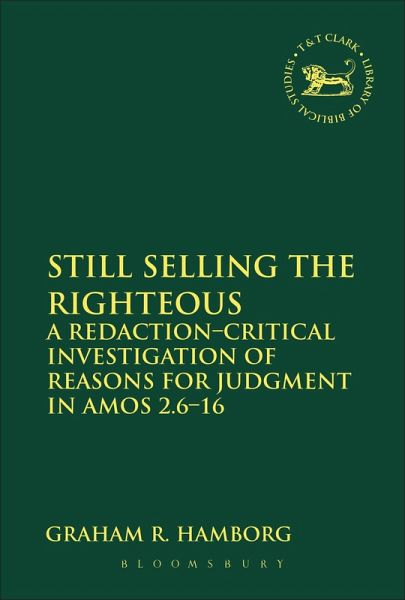
This redaction-critical study interprets the reasons for judgment in Amos 2.6-16 in the literary context of each of the redactional compositions which, it is argued, underlie the Amos-text. It is proposed that the Amos-text is both a theological work and a tractate of social criticism. In earlier redactional compositions the dominant reasons for judgment concern mistreatment of the weak. In the later redactional compositions these are overshadowed, in terms of length of text, by more theological reasons for judgment; however, these strengthen, rather than weaken, the force of the older reasons for judgment.…mehr
This redaction-critical study interprets the reasons for judgment in Amos 2.6-16 in the literary context of each of the redactional compositions which, it is argued, underlie the Amos-text. It is proposed that the Amos-text is both a theological work and a tractate of social criticism. In earlier redactional compositions the dominant reasons for judgment concern mistreatment of the weak. In the later redactional compositions these are overshadowed, in terms of length of text, by more theological reasons for judgment; however, these strengthen, rather than weaken, the force of the older reasons for judgment.
Preface Works Referred to by Author's Name Only Abbreviations Introduction 1. A Redaction-critical Study: Methodology and Terminology 2. The Redactional Compositions Underlying the Amos-text 3. The Coherence of the Redactional Compositions Underlying the Amos-text 4. The Relationship of Amos 2.8 to Exodus 22.5-26 (26-27) and Deuteronomy 24.10-18 5. The Presence of Election Traditions in Amos 2.9-12 6. Semantic Change in the Terms 'Needy,' 'Poor' and 'Afflicted' 7. Interpretations of the Reasons for Judgment in Amos 2.6-16 in the Redactional Compositions Underlying the Amos-text 8. Summary and Conclusions Bibliography Index of References Index of Authors
Es gelten unsere Allgemeinen Geschäftsbedingungen: www.buecher.de/agb
Impressum
www.buecher.de ist ein Internetauftritt der buecher.de internetstores GmbH
Geschäftsführung: Monica Sawhney | Roland Kölbl | Günter Hilger
Sitz der Gesellschaft: Batheyer Straße 115 - 117, 58099 Hagen
Postanschrift: Bürgermeister-Wegele-Str. 12, 86167 Augsburg
Amtsgericht Hagen HRB 13257
Steuernummer: 321/5800/1497
USt-IdNr: DE450055826