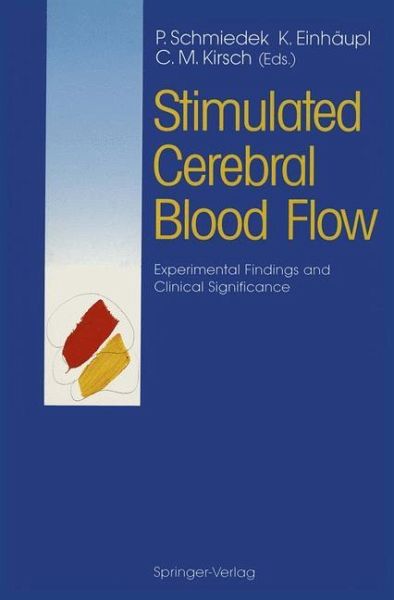
Stimulated Cerebral Blood Flow
Experimental Findings and Clinical Significance
Herausgegeben von Schmiedek, Peter; Einhäupl, Karl; Kirsch, Carl-Martin
Stimulated Cerebral Blood Flow
Experimental Findings and Clinical Significance
Herausgegeben von Schmiedek, Peter; Einhäupl, Karl; Kirsch, Carl-Martin
- Broschiertes Buch
- Merkliste
- Auf die Merkliste
- Bewerten Bewerten
- Teilen
- Produkt teilen
- Produkterinnerung
- Produkterinnerung
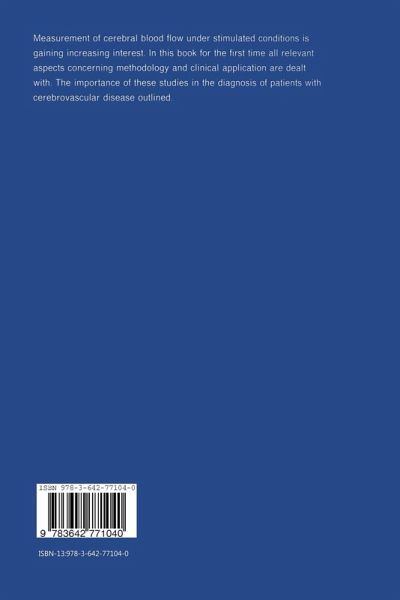
Das vorliegende Buch enth{lt die Beitr{ge eines internatio- nalen Symposiumszum Thema "Stimulierte Hirndurchblutung". Vorgestellt werden zun{chst neue Erkenntnisse zur Regulation der Hinrdurchblutung. Im 2. Abschnitt kommen verschiedene Methoden zur Messung der Hirndurchblutung zur Sprache, die sowohl unter experimentellen als auch unter klinischen Be- dingungengetestet wurden. Es folgt ein Abschnitt, der ver- schiedene M glichkeiten zur Stimulation der Hirndurchblutung aufzeigt. Im letzten Abschnitt wird aufdie Bedeutung der stimulierten Hirndurchblutungsmessung zur Bestimmung der ce-…mehr
Andere Kunden interessierten sich auch für
Cerebral Ischemia and Calcium77,99 €
Monitoring of Cerebral Blood Flow and Metabolism in Intensive Care39,99 €
E. FreyeCerebral Monitoring in the Operating Room and the Intensive Care Unit167,99 €
Enno FreyeCerebral Monitoring in the Operating Room and the Intensive Care Unit77,99 €
Michael R. Pinsky (ed.)Cerebral Blood Flow38,99 €
Imaging of the Brain in Psychiatry and Related Fields77,99 €
Werner HackeCerebral Ischemia38,99 €-
-
-
Das vorliegende Buch enth{lt die Beitr{ge eines internatio-
nalen Symposiumszum Thema "Stimulierte Hirndurchblutung".
Vorgestellt werden zun{chst neue Erkenntnisse zur Regulation
der Hinrdurchblutung. Im 2. Abschnitt kommen verschiedene
Methoden zur Messung der Hirndurchblutung zur Sprache, die
sowohl unter experimentellen als auch unter klinischen Be-
dingungengetestet wurden. Es folgt ein Abschnitt, der ver-
schiedene M glichkeiten zur Stimulation der Hirndurchblutung
aufzeigt. Im letzten Abschnitt wird aufdie Bedeutung der
stimulierten Hirndurchblutungsmessung zur Bestimmung der ce-
rebrovascul{ren Reservekapazit{ten hingewiesen. Dieser Para-
meter hat nach den vorliegenden Untersuchungen klinisch-
praktische Bedeutung, beispielsweise f}r die Indikations-
stellung bei cerebrovascul{ren Eingriffen zur Isch{mie-Pro-
phylaxe.
nalen Symposiumszum Thema "Stimulierte Hirndurchblutung".
Vorgestellt werden zun{chst neue Erkenntnisse zur Regulation
der Hinrdurchblutung. Im 2. Abschnitt kommen verschiedene
Methoden zur Messung der Hirndurchblutung zur Sprache, die
sowohl unter experimentellen als auch unter klinischen Be-
dingungengetestet wurden. Es folgt ein Abschnitt, der ver-
schiedene M glichkeiten zur Stimulation der Hirndurchblutung
aufzeigt. Im letzten Abschnitt wird aufdie Bedeutung der
stimulierten Hirndurchblutungsmessung zur Bestimmung der ce-
rebrovascul{ren Reservekapazit{ten hingewiesen. Dieser Para-
meter hat nach den vorliegenden Untersuchungen klinisch-
praktische Bedeutung, beispielsweise f}r die Indikations-
stellung bei cerebrovascul{ren Eingriffen zur Isch{mie-Pro-
phylaxe.
Produktdetails
- Produktdetails
- Verlag: Springer, Berlin
- Seitenzahl: 296
- Erscheinungstermin: 6. Dezember 2011
- Englisch
- Abmessung: 235mm x 155mm x 17mm
- Gewicht: 451g
- ISBN-13: 9783642771040
- ISBN-10: 3642771041
- Artikelnr.: 36115639
- Herstellerkennzeichnung
- Springer-Verlag GmbH
- Tiergartenstr. 17
- 69121 Heidelberg
- ProductSafety@springernature.com
- Verlag: Springer, Berlin
- Seitenzahl: 296
- Erscheinungstermin: 6. Dezember 2011
- Englisch
- Abmessung: 235mm x 155mm x 17mm
- Gewicht: 451g
- ISBN-13: 9783642771040
- ISBN-10: 3642771041
- Artikelnr.: 36115639
- Herstellerkennzeichnung
- Springer-Verlag GmbH
- Tiergartenstr. 17
- 69121 Heidelberg
- ProductSafety@springernature.com
1: Regulation of Cerebral Blood Flow.- Regulation of Cerebral Blood Flow: A Brief Review.- Capillary Perfusion in the Brain.- Intrinsic and Extrinsic Neural Regulation of the Cerebral Circulation.- Endothelium-Dependent Relaxations and Concentrations: Their Physiology in the Cerebral Arteries and Pathology in Experimental Cerebral Vasospasm.- Mechanisms of Cerebral Vasodilatation During Neuronal Activation by Bicuculline: A Review.- Postischemic Hyperperfusion and Outcome: An Experimental Study.- 2: Methods for the Measurement of Cerebral Blood Flow.- Erythrocyte Flow in Cerebral Capillaries Under Resting and Stimulated Conditions.- Continuous Measurement of Acetazolamide Stimulated Cerebral Blood Flow by Laser Doppler Flowmetry.- Transcranial Doppler Ultrasound and Regional Cerebral Blood Flow Assessment of Cerebral Hemodynamics: The Acetazolamide Test.- Continuous Monitoring of Cortical Blood Flow and Intracranial Pressure in Severe Cerebral Trauma.- Role of Cerebral Blood Flow Imaging in the Evaluation of Subarachnoid Hemorrhage and Intracranial Arteriovenous Malformations.- Hemodynamic Assessment of Carotid Artery Obstructive Lesions: Comparison of PET and SPECT.- Cerebral Blood Flow to Cerebral Blood Volume Relationship as a Correlate to Cerebral Perfusion Reserve.- Positron Emission Tomography Activation Studies in Neurological Patients.- 3: Stimulation of Cerebral Blood Flow.- Methods for Manipulation of Regional Brain Perfusion, Intracranial Artery Diameter, and Cerebral Blood Volume.- Carbon Dioxide and Oxygen Reactivity in Cerebral Circulation.- Noninvasive Testing of Vasomotor Reserve.- Identification of Hemodynamic Patients for EC-IC Bypass Surgery.- Effect of Blood Pressure on Cerebral Blood Flow and Infarct Size: Hemodynamic Considerations.- Effects of Acetazolamide on EEG and Intracranial Pressure.- Mental Activity and Changes in Cerebral Blood Flow Evaluated by Transcranial Doppler Sonography.- 4: Clinical Application of Stimulated Cerebral Blood Flow Studies.- Natural History of Patients Defined by Assessment of Cerebral Blood Flow Reserves.- Aspects of Cerebrovascular Autoregulation Following Subarachnoid Haemorrhage.- Doppler CO2 Test in Internal Carotid Artery Occlusions: Prospective and Retrospective Results.- Changes in CBF After Carotid Endarterectomy: Follow-up in Neurologically Asymptomatic Patients.- Effect od Stenosis and Endarterectomy on Internal Carotid Artery Blood Flow.- Cerebrovascular Reserve Capacity Measured with 133-Xenon Dynamic SPECT Before and After Carotid Endarterectomy.- Extra-Intracranial Bypass Surgery in Patients with Hemodynamic Cerebral Ischemia.- Follow-up Studies of Cerebrovascular Reserve Capacity in Patients with Cerebrovascular Disease.