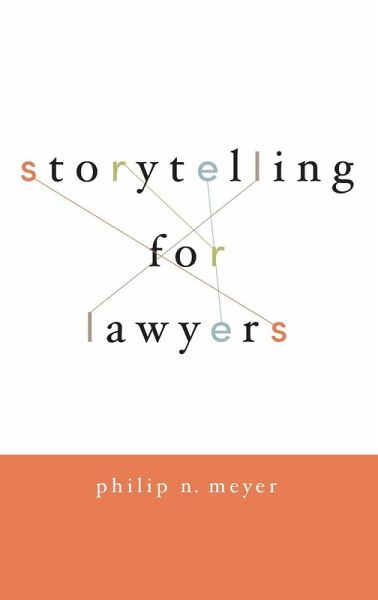
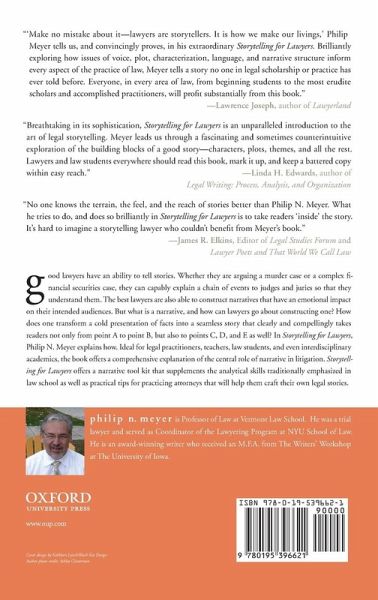
Good lawyers have an ability to tell stories. Whether they are arguing a murder case or a complex financial securities case, they can capably explain a chain of events to judges and juries so that they understand them. The best lawyers are also able to construct narratives that have an emotional impact on their intended audiences. But what is a narrative, and how can lawyers go about constructing one? In Storytelling for Lawyers, Philip Meyer explains how.
Good lawyers have an ability to tell stories. Whether they are arguing a murder case or a complex financial securities case, they can capably explain a chain of events to judges and juries so that they understand them. The best lawyers are also able to construct narratives that have an emotional impact on their intended audiences. But what is a narrative, and how can lawyers go about constructing one? In Storytelling for Lawyers, Philip Meyer explains how.
Philip N. Meyer is Professor of Law at Vermont Law School.
Inhaltsangabe
* Chapter 1 - Introduction * I. Lawyers are Storytellers * II. Legal Arguments are Stories in Disguise * III. The Parts of a Story * IV. Movies and Closing Arguments * Chapter 2 - Plotting I: The Basics * I. What is Plot? * II. Plot Structure in Two Movies * Chapter 3 - Plotting II: Plot Structure in a Closing Argument to a Jury in a * Complex Torts Case * I. The "Back Story " * II. Annotated Excerpts from Spence's Closing Argument on Behalf of Karen * Silkwood * III. Concluding Observations * Chapter 4 - Character Lessons: Character, Character Development, and * Characterization * I. Introduction: Why Emphasize Movie Characters in Legal Storytelling? * II. What is Character, and Why Is It Important to Legal Storytellers? * III. Flat and Round Characters and Static and Changing * Characters-High Noon Revisited * IV. Techniques of Character Development and Characterization-Excerpts * from Tobias Wolff's This Boy's Life * Chapter 5 - Characters, Character Development, and Characterization in a * Closing Argument to a Jury in a Complex Criminal Case * I. The "Back Story " * II. Excerpts from the Opening: Act I- "The Setup " and "Confrontation " * III. Concluding Observations * Chapter 6 - Style Matters: How to Use Voice, Point of View, Details and * Images, Rhythms of Language, Scene and Summary, and Quotations and * Transcripts in Effective Legal Storytelling * I. Back Story: Grading Law School Examinations * II. Preliminary Note: "Voice " and "Style " * III. Voice and Rhythm: "Staying on the Surface " * IV. The Use of Scene and Summary: "Showing and Telling " * V. Telling in Different Voices * VI. Perspective or Point of View * VII. Several Functions of Perspective: How Does Perspective (Point of View) * Work, and What Work Does it Do? * VIII. Concluding Observations * Chapter 7 - A Sense of Place: Settings, Descriptions and Environments * I. Introduction * II. Dangerous Territory: Contrasting Settings Evoking Danger and Instability in * Joan Didion's "The White Album " and the Judicial Opinion in a Rape Case * III. More Dangerous Places Where Bad Things Happen: Use of Physical * Descriptions and Factual Details to Create Complex Environments in W.G. * Sebald's The Emigrants and the Petitioners' Briefs in Two Coerced Confession * Cases * IV. Settings and Environment as Villains and Villainy in the Mitigation Stories * of Kathryn Harrison's While They Slept and the Petitioner's Brief in * Eddings v. Oklahoma * V. Concluding Observations * Chapter 8 - Narrative Time: A Brief Exploration * I. Introduction * II. The Ordering of Discourse Time * III. Concluding Observations * Chapter 9 - Final Observations: Beginnings and Endings
* Chapter 1 - Introduction * I. Lawyers are Storytellers * II. Legal Arguments are Stories in Disguise * III. The Parts of a Story * IV. Movies and Closing Arguments * Chapter 2 - Plotting I: The Basics * I. What is Plot? * II. Plot Structure in Two Movies * Chapter 3 - Plotting II: Plot Structure in a Closing Argument to a Jury in a * Complex Torts Case * I. The "Back Story " * II. Annotated Excerpts from Spence's Closing Argument on Behalf of Karen * Silkwood * III. Concluding Observations * Chapter 4 - Character Lessons: Character, Character Development, and * Characterization * I. Introduction: Why Emphasize Movie Characters in Legal Storytelling? * II. What is Character, and Why Is It Important to Legal Storytellers? * III. Flat and Round Characters and Static and Changing * Characters-High Noon Revisited * IV. Techniques of Character Development and Characterization-Excerpts * from Tobias Wolff's This Boy's Life * Chapter 5 - Characters, Character Development, and Characterization in a * Closing Argument to a Jury in a Complex Criminal Case * I. The "Back Story " * II. Excerpts from the Opening: Act I- "The Setup " and "Confrontation " * III. Concluding Observations * Chapter 6 - Style Matters: How to Use Voice, Point of View, Details and * Images, Rhythms of Language, Scene and Summary, and Quotations and * Transcripts in Effective Legal Storytelling * I. Back Story: Grading Law School Examinations * II. Preliminary Note: "Voice " and "Style " * III. Voice and Rhythm: "Staying on the Surface " * IV. The Use of Scene and Summary: "Showing and Telling " * V. Telling in Different Voices * VI. Perspective or Point of View * VII. Several Functions of Perspective: How Does Perspective (Point of View) * Work, and What Work Does it Do? * VIII. Concluding Observations * Chapter 7 - A Sense of Place: Settings, Descriptions and Environments * I. Introduction * II. Dangerous Territory: Contrasting Settings Evoking Danger and Instability in * Joan Didion's "The White Album " and the Judicial Opinion in a Rape Case * III. More Dangerous Places Where Bad Things Happen: Use of Physical * Descriptions and Factual Details to Create Complex Environments in W.G. * Sebald's The Emigrants and the Petitioners' Briefs in Two Coerced Confession * Cases * IV. Settings and Environment as Villains and Villainy in the Mitigation Stories * of Kathryn Harrison's While They Slept and the Petitioner's Brief in * Eddings v. Oklahoma * V. Concluding Observations * Chapter 8 - Narrative Time: A Brief Exploration * I. Introduction * II. The Ordering of Discourse Time * III. Concluding Observations * Chapter 9 - Final Observations: Beginnings and Endings
Es gelten unsere Allgemeinen Geschäftsbedingungen: www.buecher.de/agb
Impressum
www.buecher.de ist ein Internetauftritt der buecher.de internetstores GmbH
Geschäftsführung: Monica Sawhney | Roland Kölbl | Günter Hilger
Sitz der Gesellschaft: Batheyer Straße 115 - 117, 58099 Hagen
Postanschrift: Bürgermeister-Wegele-Str. 12, 86167 Augsburg
Amtsgericht Hagen HRB 13257
Steuernummer: 321/5800/1497
USt-IdNr: DE450055826