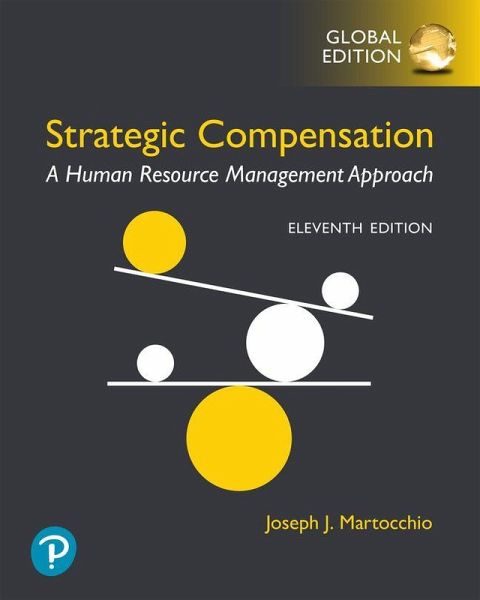
Strategic Compensation demonstrates the art and science of compensation practice and its role in a company's competitive advantage. It focuses on compensation context, criteria, design and challenges along with employee benefits at home and around the world. Through targeted activities and supporting course material, you'll build a solid foundation in the subject. The 11th Edition features evolving compensation practices, statistics and business professionals' perspectives. You'll gain the knowledge and skills needed to become a successful compensation professional in the field.
Strategic Compensation demonstrates the art and science of compensation practice and its role in a company's competitive advantage. It focuses on compensation context, criteria, design and challenges along with employee benefits at home and around the world. Through targeted activities and supporting course material, you'll build a solid foundation in the subject.
The 11th Edition features evolving compensation practices, statistics and business professionals' perspectives. You'll gain the knowledge and skills needed to become a successful compensation professional in the field.
About our author Joseph J. Martocchio's interest in the HR management field began while he was a junior at Babson College and in compensation, particularly, while he was a first-year graduate student at Michigan State University. He found himself wanting to practice in the field as well as to become a university professor and researcher. He pursued both professional desires starting with employment at Cameron and Colby (a reinsurance company) in Boston and General Electric's Aerospace business group in Valley Forge, Pennsylvania. Martocchio advanced his education in the human resource management (HRM) field by earning a master's degree and PhD degree at Michigan State University. His master's degree enabled him to build an even stronger foundation in practice, and his doctoral degree provided him with the skills to conduct scholarly research and teach college-level courses. Since earning his graduate degrees, he has been a professor in the School of Labor and Employment Relations at the University of Illinois, UrbanaChampaign, and assumed administrative roles as a Provost Fellow, Associate Dean for Academic Affairs, and Interim Dean. All the while, he has taught a variety of courses in the HRM field. These include compensation systems, employee benefits, employment systems (HRM and labor relations), HR planning and staffing, and statistics. He also teaches the compensation and statistics courses online. For many years, he served as the faculty advisor to the student chapter of the Society for Human Resource Management at the University of Illinois during which time students earned Merit Awards and Superior Merit awards on multiple occasions. As a researcher, Martocchio has studied a variety of topics that include employee absenteeism, employee training and development, compensation systems, employee benefits, and generational diversity. His work appears in leading scholarly journals such as Academy of Management Journal, Academy of Management Review, Journal of Applied Psychology, Journal of Management , and Personnel Psychology. Martocchio received the Ernest J. McCormick Award for Distinguished Early Career Contributions from the Society for Industrial and Organizational Psychology (SIOP), and he was subsequently elected as a Fellow in both the American Psychological Association and SIOP. Following the attainment of this recognition, he served as the Chair of the HR Division of the Academy of Management as well as in various other leadership roles within that organization. In 2018, a study in the Academy of Management Learning and Education revealed that Martocchio is in the top 1% of the most influential HRM authors out of a total of 9,744. Besides writing scholarly articles and Strategic Compensation: A Human Resource Management Approach, he has 2 additional sole-authored textbooks: Human Resource Management (Pearson Higher Education), 15th edition, and Employee Benefits: A Primer for Human Resource Professionals (McGraw-Hill), 7th edition.
Inhaltsangabe
PART 1: SETTING THE STAGE FOR STRATEGIC COMPENSATION 1. Strategic Compensation: A Component of Human Resource Systems 2. Contextual Influences on Compensation Practice PART 2: BASES FOR PAY 1. Traditional Bases for Pay: Seniority and Merit 2. Incentive Pay 3. Person-Focused Pay PART 3: DESIGNING COMPENSATION SYSTEMS 4. Building Internally Consistent Compensation Systems 5. Building Market-Competitive Compensation Systems 6. Building Pay Structures that Recognize Employee Contributions PART 4: EMPLOYEE BENEFITS 7. Discretionary Benefits 8. Legally Required Benefits PART 5: CONTEMPORARY STRATEGIC COMPENSATION CHALLENGES 9. Compensating Executives 10. Contingent Workers, Remote Work and Flexible Work Schedule Arrangements PART 6: COMPENSATION ISSUES AROUND THE WORLD 11. Compensating Expatriates 12. Pay and Benefits outside the United States
PART 1: SETTING THE STAGE FOR STRATEGIC COMPENSATION 1. Strategic Compensation: A Component of Human Resource Systems 2. Contextual Influences on Compensation Practice PART 2: BASES FOR PAY 1. Traditional Bases for Pay: Seniority and Merit 2. Incentive Pay 3. Person-Focused Pay PART 3: DESIGNING COMPENSATION SYSTEMS 4. Building Internally Consistent Compensation Systems 5. Building Market-Competitive Compensation Systems 6. Building Pay Structures that Recognize Employee Contributions PART 4: EMPLOYEE BENEFITS 7. Discretionary Benefits 8. Legally Required Benefits PART 5: CONTEMPORARY STRATEGIC COMPENSATION CHALLENGES 9. Compensating Executives 10. Contingent Workers, Remote Work and Flexible Work Schedule Arrangements PART 6: COMPENSATION ISSUES AROUND THE WORLD 11. Compensating Expatriates 12. Pay and Benefits outside the United States
Es gelten unsere Allgemeinen Geschäftsbedingungen: www.buecher.de/agb
Impressum
www.buecher.de ist ein Internetauftritt der buecher.de internetstores GmbH
Geschäftsführung: Monica Sawhney | Roland Kölbl | Günter Hilger
Sitz der Gesellschaft: Batheyer Straße 115 - 117, 58099 Hagen
Postanschrift: Bürgermeister-Wegele-Str. 12, 86167 Augsburg
Amtsgericht Hagen HRB 13257
Steuernummer: 321/5800/1497
USt-IdNr: DE450055826