
Andere Kunden interessierten sich auch für
 Procurement17,99 €
 Sourcing to Support the Green Initiative17,99 €
 Professional Advancements and Management Trends in the IT Sector162,99 €
 Sourcing Unique Components in the Electro-Mechanical Engineering Industry from Chinese Suppliers47,95 €
 Creating Value Through Ethical Sourcing of Natural Resources33,99 €
 A Comparison of Sourcing Strategies in the Apparel Industry. Case Study of the H&M Group and Inditex18,95 €
") 42 Rules for Sourcing and Manufacturing in China (2nd Edition)19,99 €
42 Rules for Sourcing and Manufacturing in China (2nd Edition)19,99 €







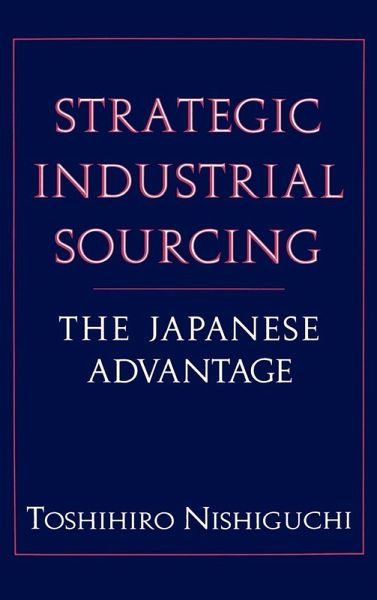
Japanese industrial firms have developed a system of subcontracting with suppliers that has played a major role in their world-wide success. This book explores the historical evolution of subcontracting in Japan and analyses it in current practice. It develops a theory of 'strategic dualism' that after nearly six decades of evolution is a new mode of contractual relations, based on principles of problem-solving collaborative manufacturing. This new form of contractual relations is supported by a range of institutional arrangements that drive prime contractors and subcontractors towards continuous improvement in product quality and cost reduction. It argues that this system is possible in a range of cultures different from Japan.
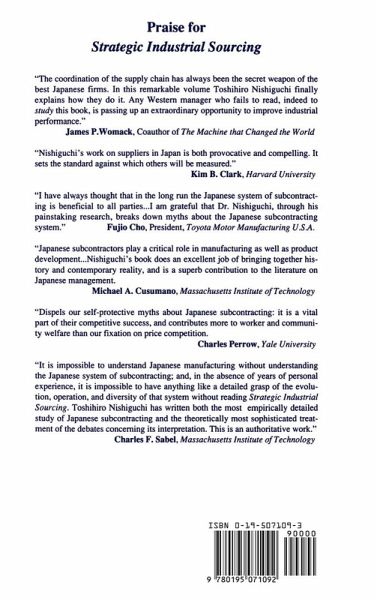
Why is it that Japanese manufacturers can produce such a great variety of goods with breathtaking speed and quality while outsourcing so extensively? Strategic Industrial Sourcing provides the first comprehensive look at the evolution of a powerful system of supplier relations in Japan. Indeed, supplier relations are at the heart of world-class manufacturing in Japan's two most successful industries, automobiles and electronics. Through a path-breaking exploration of the historical and current practices of subcontracting in Japan as well as other advanced economies, Toshihiro Nishiguchi reveals the shortcomings of existing theories of contractual relations. A wealth of evidence shows that current Japanese sub-contracting practices are a product of complex interactions among socioeconomic, political, technological, and firm-level strategic factors. Taking issue with conventional thinking, this book questions the notion that the practices that have made Japanese firms successful are a direct result of national culture. Rather, it is argued that those practices amount to a new paradigm of collaborative manufacturing that can be adopted by firms in other industrial societies. A product of more than eight years of research, hundreds of field visits, and more than one thousand interviews with managers of firms in fourteen countries including Japan, the United States, and Britain, this book brings original insight to the historical, institutional, and economic development of a unique manufacturing system that has enabled Japanese firms to outperform their competitors in key markets. Based on principles of inter-firm collaboration and mutual problem solving, this revolutionary system, analyzedin depth in the automobile and electronics industries, drives core firms and their subcontractors toward continuous improvement in product quality, cost control, and technological excellence. Strategic Industrial Sourcing reveals the compelling logic behind these relatio
Why is it that Japanese manufacturers can produce such a great variety of goods with breathtaking speed and quality while outsourcing so extensively? Strategic Industrial Sourcing provides the first comprehensive look at the evolution of a powerful system of supplier relations in Japan. Indeed, supplier relations are at the heart of world-class manufacturing in Japan's two most successful industries, automobiles and electronics. Through a path-breaking exploration of the historical and current practices of subcontracting in Japan as well as other advanced economies, Toshihiro Nishiguchi reveals the shortcomings of existing theories of contractual relations. A wealth of evidence shows that current Japanese sub-contracting practices are a product of complex interactions among socioeconomic, political, technological, and firm-level strategic factors. Taking issue with conventional thinking, this book questions the notion that the practices that have made Japanese firms successful are a direct result of national culture. Rather, it is argued that those practices amount to a new paradigm of collaborative manufacturing that can be adopted by firms in other industrial societies. A product of more than eight years of research, hundreds of field visits, and more than one thousand interviews with managers of firms in fourteen countries including Japan, the United States, and Britain, this book brings original insight to the historical, institutional, and economic development of a unique manufacturing system that has enabled Japanese firms to outperform their competitors in key markets. Based on principles of inter-firm collaboration and mutual problem solving, this revolutionary system, analyzedin depth in the automobile and electronics industries, drives core firms and their subcontractors toward continuous improvement in product quality, cost control, and technological excellence. Strategic Industrial Sourcing reveals the compelling logic behind these relatio