
Marcos Ancelovici, Pascale Dufour, Didier Chabanet, Clément Desbos, Hanspeter KriesiFrom the Indignados to Occupy
Street Politics in the Age of Austerity
From the Indignados to Occupy
Herausgeber: Ancelovici, Marcos; Dufour, Pascale
Marcos Ancelovici, Pascale Dufour, Didier Chabanet, Clément Desbos, Hanspeter KriesiFrom the Indignados to Occupy
Street Politics in the Age of Austerity
From the Indignados to Occupy
Herausgeber: Ancelovici, Marcos; Dufour, Pascale
- Gebundenes Buch
- Merkliste
- Auf die Merkliste
- Bewerten Bewerten
- Teilen
- Produkt teilen
- Produkterinnerung
- Produkterinnerung
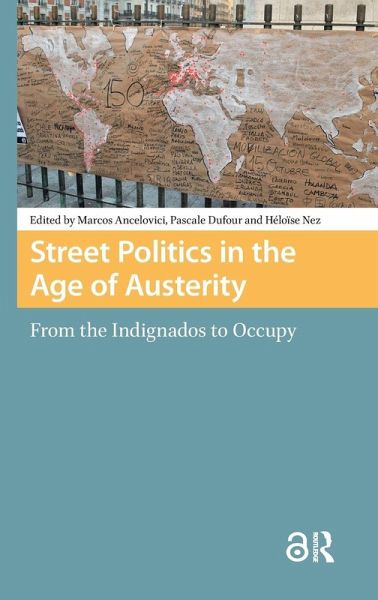
This collection is designed to offer a comparative analysis of street-level protest movements, setting them in international, socio-economic, and cross-cultural perspective in order to help us understand why movements emerge, what they do, how they spread, and how they fit into both local and worldwide historical contexts.
Andere Kunden interessierten sich auch für
 Anthony KevinsExpanding Welfare in an Age of Austerity132,99 €
 Gary MattsonAmerican Hometown Renewal264,99 €
 Alex GottesmanPolitics and the Street in Democratic Athens41,99 €
 Michael T. HeaneyParty in the Street115,99 €
 Alex GottesmanPolitics and the Street in Democratic Athens109,99 €
 Informal Urban Street Markets185,99 €
 Social Policies in Times of Austerity and Populism172,99 €
-
-
-







This collection is designed to offer a comparative analysis of street-level protest movements, setting them in international, socio-economic, and cross-cultural perspective in order to help us understand why movements emerge, what they do, how they spread, and how they fit into both local and worldwide historical contexts.
Produktdetails
- Produktdetails
- Verlag: Routledge
- Seitenzahl: 314
- Erscheinungstermin: 16. Juni 2016
- Englisch
- Abmessung: 240mm x 161mm x 21mm
- Gewicht: 637g
- ISBN-13: 9789089647634
- ISBN-10: 9089647635
- Artikelnr.: 43774596
- Herstellerkennzeichnung
- Libri GmbH
- Europaallee 1
- 36244 Bad Hersfeld
- gpsr@libri.de
- Verlag: Routledge
- Seitenzahl: 314
- Erscheinungstermin: 16. Juni 2016
- Englisch
- Abmessung: 240mm x 161mm x 21mm
- Gewicht: 637g
- ISBN-13: 9789089647634
- ISBN-10: 9089647635
- Artikelnr.: 43774596
- Herstellerkennzeichnung
- Libri GmbH
- Europaallee 1
- 36244 Bad Hersfeld
- gpsr@libri.de
Marcos Ancelovici is Professor of Sociology at the Université du Québec à Montréal (UQAM). He has won the 2008 Georges Lavau Dissertation Award and the 2013 Frank L. Wilson Best Paper Award, both from the American Political Science Association. In 2009-10, he was a Junior Fellow in the Successful Societies Program of the Canadian Institute for Advanced Research (CIFAR). He works on social movements, labor politics, globalization, and the sociology of Pierre Bourdieu, and is currently studying anti-austerity protests in France and Spain. He has published numerous articles and book chapters on social movements and labor politics. Pascale Dufour is Associate Professor of Political Science at University of Montreal and Director of the Research Center on Politics and social development (www.cpds.umontreal.ca). She works on social movements and collective action in comparative perspective. Her emerging research examines student 2012 mobilizations in Quebec (Canada). Her work has been published in Research in Social Movement, Conflict and Change, European Political Science review, Social Movement Studies, French Politics, Canadian Journal of Political Science, Canadian Journal of Sociology, Mobilization, and Social Science Quarterly. Her last book was published in 2013, Trois espaces de protestation mondiale. France, Canada, Québec, Montreal: PUM. Héloïse Nez (PhD in Sociology, Université de Paris 8/Universidad Autónoma de Barcelona) is Assistant Professor (Maître de conferences) of Sociology at the Université de Tours (France), Researcher in the UMR CITERES (Cities, Territories, Environment and Societies) and Associate Researcher in the Center for the Study of Social Movements in Paris (CEMS-EHESS). The main topics of her research are social movements, participatory democracy, and citizen competence Among her last publications: Savoirs citoyens et démocratie urbaine (ed. with A. Deboulet), Presses Universitaires de Rennes, 2013; The struggle for a voice: associations versus citizens in participatory budgeting (with E. Ganuza and E. Morales), International Journal of Urban and Regional Research, published online (Early View) in 2013; Délibérer au sein d'un mouvement social. Ethnographie des assemblées des Indignés à Madrid, Participations, 3, 2012, 79-101.
Chapter 1: Introduction. From the Indignad@s to Occupy : Prospects for
Comparison (Dufour, Nez, Ancelovici) The introduction of the book explains
our collective positioning regarding the object of analysis (the recent
emergence of protest in Europe and North America). We argue that from a
comparative perspective, it is possible to consider these protests as
equivalent units of analysis (they have sufficient commonalities) but not
necessarily as belonging to a single or common wave or cycle. This is an
empirical question addressed by individual chapters. The framework
introduced here highlights both similarities at a certain level of
comparison and differences in the empirical development of protests. This
chapter is divided into two main sections. We begin by surveying the
growing body of literature on the 2011-12 protests. This section represents
a strong contribution to the literature as it surveys more than 150
academic references published in the last 3 years. We then propose to
define this new family of protests on the basis of three dimensions: a
political economy, a constitutive tension with representative democracy,
and specific modes of action (at least in the initial phases of the
protest). Each chapter of the book addresses (with various levels of
detail) these three dimensions. We also incorporate the issue of diffusion
as a transversal process that cuts across cases and informs the
comparisons. Finally, we briefly present the layout of the book. PART 1:
HOW STRUCTURAL FACTORS SHAPE MOBILIZATION Chapter 2: Chapter 2: The Crisis
and Its Victims: Austerity and Spaces for Protest? (George Ross) The huge
economic crisis that followed the collapse of Lehman Brothers in 2008
spread rapidly throughout the global financial sector and severely damaged
real economies everywhere. The wealthy market societies of North America
and Europe were hit very hard. Crises that do such widespread damage are
rare, but when they do occur they rapidly dislocate the structures of
peoples' lives, create confusion and uncertainty for them, challenge
identities, and cause great desperation. Mapping such disorienting changes
does not allow us to predict how those experiencing them will respond, but
it is safe to say that such radical disruptions cab lead some to rebel,
protest, and mobilize in social movements. This chapter will review the
evolution of the present economic crisis in its American Wall Street
manifestations and its later transmogrification into the Euro-zone crisis
with the goal first of outlining the socioeconomic structural effects of
the crises to specify those social groups most dislocated by the crises'
impacts. Chapter 3: Mobilization of Protest in the Age of Austerity
(Hanspeter Kriesi) Taking the mobilization of protest in the age of
austerity as the point of reference, this chapter aims at linking the two
worlds of social movements and political parties, with the experience of
protest mobilization in three countries: Greece, Spain and the US. These
three cases show that movements are linked to national political contexts.
Thus, in all three countries, the target of the mobilization was the
incumbent government, and this government was a centre-left one. But they
were challenged for quite different reasons and the forces in opposition
that benefited from the mobilization were quite different, too. However,
and this is the point all three cases share, the mobilizations have had a
tremendous impact on electoral politics, the party system, and the
political process more generally. Electoral choices and protest,
mobilization by political parties and social movements are part and parcel
of one and the same process of political interest intermediation that
continuously links the different forms of interests articulation, in the
various channels and arenas of the political system. Chapter 4: The Spanish
Indignados and Israel's Social Justice Movement: The Role of Political
Cleavages in Two Extensive Protests.
Comparison (Dufour, Nez, Ancelovici) The introduction of the book explains
our collective positioning regarding the object of analysis (the recent
emergence of protest in Europe and North America). We argue that from a
comparative perspective, it is possible to consider these protests as
equivalent units of analysis (they have sufficient commonalities) but not
necessarily as belonging to a single or common wave or cycle. This is an
empirical question addressed by individual chapters. The framework
introduced here highlights both similarities at a certain level of
comparison and differences in the empirical development of protests. This
chapter is divided into two main sections. We begin by surveying the
growing body of literature on the 2011-12 protests. This section represents
a strong contribution to the literature as it surveys more than 150
academic references published in the last 3 years. We then propose to
define this new family of protests on the basis of three dimensions: a
political economy, a constitutive tension with representative democracy,
and specific modes of action (at least in the initial phases of the
protest). Each chapter of the book addresses (with various levels of
detail) these three dimensions. We also incorporate the issue of diffusion
as a transversal process that cuts across cases and informs the
comparisons. Finally, we briefly present the layout of the book. PART 1:
HOW STRUCTURAL FACTORS SHAPE MOBILIZATION Chapter 2: Chapter 2: The Crisis
and Its Victims: Austerity and Spaces for Protest? (George Ross) The huge
economic crisis that followed the collapse of Lehman Brothers in 2008
spread rapidly throughout the global financial sector and severely damaged
real economies everywhere. The wealthy market societies of North America
and Europe were hit very hard. Crises that do such widespread damage are
rare, but when they do occur they rapidly dislocate the structures of
peoples' lives, create confusion and uncertainty for them, challenge
identities, and cause great desperation. Mapping such disorienting changes
does not allow us to predict how those experiencing them will respond, but
it is safe to say that such radical disruptions cab lead some to rebel,
protest, and mobilize in social movements. This chapter will review the
evolution of the present economic crisis in its American Wall Street
manifestations and its later transmogrification into the Euro-zone crisis
with the goal first of outlining the socioeconomic structural effects of
the crises to specify those social groups most dislocated by the crises'
impacts. Chapter 3: Mobilization of Protest in the Age of Austerity
(Hanspeter Kriesi) Taking the mobilization of protest in the age of
austerity as the point of reference, this chapter aims at linking the two
worlds of social movements and political parties, with the experience of
protest mobilization in three countries: Greece, Spain and the US. These
three cases show that movements are linked to national political contexts.
Thus, in all three countries, the target of the mobilization was the
incumbent government, and this government was a centre-left one. But they
were challenged for quite different reasons and the forces in opposition
that benefited from the mobilization were quite different, too. However,
and this is the point all three cases share, the mobilizations have had a
tremendous impact on electoral politics, the party system, and the
political process more generally. Electoral choices and protest,
mobilization by political parties and social movements are part and parcel
of one and the same process of political interest intermediation that
continuously links the different forms of interests articulation, in the
various channels and arenas of the political system. Chapter 4: The Spanish
Indignados and Israel's Social Justice Movement: The Role of Political
Cleavages in Two Extensive Protests.
Chapter 1: Introduction. From the Indignad@s to Occupy : Prospects for
Comparison (Dufour, Nez, Ancelovici) The introduction of the book explains
our collective positioning regarding the object of analysis (the recent
emergence of protest in Europe and North America). We argue that from a
comparative perspective, it is possible to consider these protests as
equivalent units of analysis (they have sufficient commonalities) but not
necessarily as belonging to a single or common wave or cycle. This is an
empirical question addressed by individual chapters. The framework
introduced here highlights both similarities at a certain level of
comparison and differences in the empirical development of protests. This
chapter is divided into two main sections. We begin by surveying the
growing body of literature on the 2011-12 protests. This section represents
a strong contribution to the literature as it surveys more than 150
academic references published in the last 3 years. We then propose to
define this new family of protests on the basis of three dimensions: a
political economy, a constitutive tension with representative democracy,
and specific modes of action (at least in the initial phases of the
protest). Each chapter of the book addresses (with various levels of
detail) these three dimensions. We also incorporate the issue of diffusion
as a transversal process that cuts across cases and informs the
comparisons. Finally, we briefly present the layout of the book. PART 1:
HOW STRUCTURAL FACTORS SHAPE MOBILIZATION Chapter 2: Chapter 2: The Crisis
and Its Victims: Austerity and Spaces for Protest? (George Ross) The huge
economic crisis that followed the collapse of Lehman Brothers in 2008
spread rapidly throughout the global financial sector and severely damaged
real economies everywhere. The wealthy market societies of North America
and Europe were hit very hard. Crises that do such widespread damage are
rare, but when they do occur they rapidly dislocate the structures of
peoples' lives, create confusion and uncertainty for them, challenge
identities, and cause great desperation. Mapping such disorienting changes
does not allow us to predict how those experiencing them will respond, but
it is safe to say that such radical disruptions cab lead some to rebel,
protest, and mobilize in social movements. This chapter will review the
evolution of the present economic crisis in its American Wall Street
manifestations and its later transmogrification into the Euro-zone crisis
with the goal first of outlining the socioeconomic structural effects of
the crises to specify those social groups most dislocated by the crises'
impacts. Chapter 3: Mobilization of Protest in the Age of Austerity
(Hanspeter Kriesi) Taking the mobilization of protest in the age of
austerity as the point of reference, this chapter aims at linking the two
worlds of social movements and political parties, with the experience of
protest mobilization in three countries: Greece, Spain and the US. These
three cases show that movements are linked to national political contexts.
Thus, in all three countries, the target of the mobilization was the
incumbent government, and this government was a centre-left one. But they
were challenged for quite different reasons and the forces in opposition
that benefited from the mobilization were quite different, too. However,
and this is the point all three cases share, the mobilizations have had a
tremendous impact on electoral politics, the party system, and the
political process more generally. Electoral choices and protest,
mobilization by political parties and social movements are part and parcel
of one and the same process of political interest intermediation that
continuously links the different forms of interests articulation, in the
various channels and arenas of the political system. Chapter 4: The Spanish
Indignados and Israel's Social Justice Movement: The Role of Political
Cleavages in Two Extensive Protests.
Comparison (Dufour, Nez, Ancelovici) The introduction of the book explains
our collective positioning regarding the object of analysis (the recent
emergence of protest in Europe and North America). We argue that from a
comparative perspective, it is possible to consider these protests as
equivalent units of analysis (they have sufficient commonalities) but not
necessarily as belonging to a single or common wave or cycle. This is an
empirical question addressed by individual chapters. The framework
introduced here highlights both similarities at a certain level of
comparison and differences in the empirical development of protests. This
chapter is divided into two main sections. We begin by surveying the
growing body of literature on the 2011-12 protests. This section represents
a strong contribution to the literature as it surveys more than 150
academic references published in the last 3 years. We then propose to
define this new family of protests on the basis of three dimensions: a
political economy, a constitutive tension with representative democracy,
and specific modes of action (at least in the initial phases of the
protest). Each chapter of the book addresses (with various levels of
detail) these three dimensions. We also incorporate the issue of diffusion
as a transversal process that cuts across cases and informs the
comparisons. Finally, we briefly present the layout of the book. PART 1:
HOW STRUCTURAL FACTORS SHAPE MOBILIZATION Chapter 2: Chapter 2: The Crisis
and Its Victims: Austerity and Spaces for Protest? (George Ross) The huge
economic crisis that followed the collapse of Lehman Brothers in 2008
spread rapidly throughout the global financial sector and severely damaged
real economies everywhere. The wealthy market societies of North America
and Europe were hit very hard. Crises that do such widespread damage are
rare, but when they do occur they rapidly dislocate the structures of
peoples' lives, create confusion and uncertainty for them, challenge
identities, and cause great desperation. Mapping such disorienting changes
does not allow us to predict how those experiencing them will respond, but
it is safe to say that such radical disruptions cab lead some to rebel,
protest, and mobilize in social movements. This chapter will review the
evolution of the present economic crisis in its American Wall Street
manifestations and its later transmogrification into the Euro-zone crisis
with the goal first of outlining the socioeconomic structural effects of
the crises to specify those social groups most dislocated by the crises'
impacts. Chapter 3: Mobilization of Protest in the Age of Austerity
(Hanspeter Kriesi) Taking the mobilization of protest in the age of
austerity as the point of reference, this chapter aims at linking the two
worlds of social movements and political parties, with the experience of
protest mobilization in three countries: Greece, Spain and the US. These
three cases show that movements are linked to national political contexts.
Thus, in all three countries, the target of the mobilization was the
incumbent government, and this government was a centre-left one. But they
were challenged for quite different reasons and the forces in opposition
that benefited from the mobilization were quite different, too. However,
and this is the point all three cases share, the mobilizations have had a
tremendous impact on electoral politics, the party system, and the
political process more generally. Electoral choices and protest,
mobilization by political parties and social movements are part and parcel
of one and the same process of political interest intermediation that
continuously links the different forms of interests articulation, in the
various channels and arenas of the political system. Chapter 4: The Spanish
Indignados and Israel's Social Justice Movement: The Role of Political
Cleavages in Two Extensive Protests.