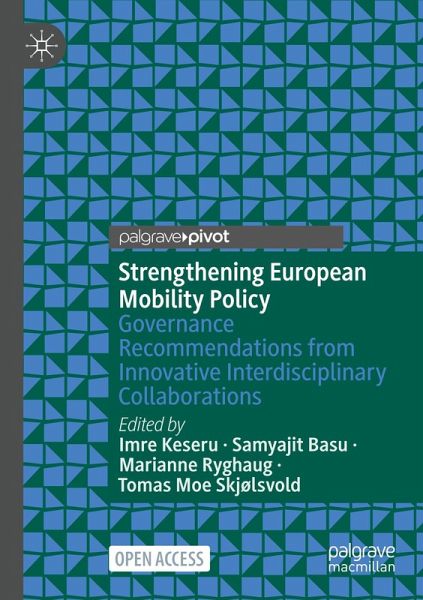
This open access book showcases innovative collaborations between the Social Sciences and Humanities (SSH) and Science, Technology, Engineering, and Mathematics (STEM) disciplines to benefit European mobility policy. Each chapter has been researched by a team encompassing both social and technical expertise. The book presents nine policy recommendations aimed at enhancing mobility and logistics. It will interest anyone involved in researching, developing, implementing, or evaluating mobility and logistics policy at local, national, or international levels. It is also valuable for those…mehr
This open access book showcases innovative collaborations between the Social Sciences and Humanities (SSH) and Science, Technology, Engineering, and Mathematics (STEM) disciplines to benefit European mobility policy. Each chapter has been researched by a team encompassing both social and technical expertise. The book presents nine policy recommendations aimed at enhancing mobility and logistics.
It will interest anyone involved in researching, developing, implementing, or evaluating mobility and logistics policy at local, national, or international levels. It is also valuable for those seeking to expand the use of interdisciplinary research to achieve sustainability goals.
Part of a three-volume collection covering climate, energy, and mobility policy.
Imre Keseru is an Assistant Professor of Urban Mobility and Deputy Director at the Mobilise Mobility and Logistics Research Group, part of the House of Sustainable Transitions at the Vrije Universitet Brussel, Belgium and lead editor of this book. Samyajit Basu, is a Senior Researcher at the Mobilise Mobility and Logistics Research Group, part of the House of Sustainable Transitions at the Vrije Universitet Brussel, Belgium and co-editor of this book. Marianne Ryghaug is Professor of Science and Technology Studies at NTNU and senior researcher at SINTEF and co-editor of this book.
Inhaltsangabe
Part 1: The role of public policy in supporting sustainable mobility transitions.- Chapter 1. Introduction (Imre Keseru, Samyajit Basu, Marianne Ryghaug, Tomas Moe Skjølsvold).- Chapter 2. Evaluating Public Policies for Sustainable Mobility: A review through some interdisciplinary methodologies and procedures (Francisco Alonso, Mireia Faus, Sergio A. Useche, José Luis Velarte, Mónica Alonso).- Chapter 3: Enhancing Policy Coordination of Schooling and Transport for Net-Zero (Joshua Lait, Femke Nijsse, Stewart Barr, David Hall, Catherine Butler, Antonio Olmedo, Cormac Lynch).- Chapter 4. Improving Social Justice, Environmental Integrity, and Geopolitical Resilience in EU Electric Mobility Transition (Aleksandra Lis-Plesi ska, Nathalie Ortar, Rafä Szymanowski, Marek W. Jaskólski, Aleksandra Parteka, Christine Buisson).- Part II: The potential of the transformation of transport services and vehicle technologies to contribute to the transition.- Chapter 5. Promoting sustainable urban mobility through implementation of electric buses: a case study of Ostrava (Marek Krumnikl, Adam ervenka, Filip Lapuník, Lubo Mikula).- Chapter 6. Improving rural quality of life by combining public transportation with demand responsive transport systems (József Pál Lieszkovszky, Dániel Tordai - Dániel Hörcher - Tamás Fleischer - András Munkácsy).- Chapter 7. Providing state-supported financial incentives and benefits for vehicle insurance policies using telematics (Virginia Petraki, Apostolos Ziakopoulos, Evangelia Fragkiadaki, Nikolaos Karouzakis, Konstantinos Kakavoulis, George Yannis).- Part III: New methods and tools to support participatory planning.- Chapter 8. Assessing Mobility Policy with AI-Driven Analysis of User-Generated Content (Floriano Tori, Charlotte van Vessem, Juliana Betancur Arenas, Vincent Ginis).- Chapter 9. Enabling Inclusive Urban Transport Planning through Civic Artificial Intelligence (Dimitris Michailidis, Kristina Khutsishvili, Konstantinos Konstantis, Aristotle Tympas, Imad Antoine Ibrahim, Sennay Ghebreab).- Chapter 10. Facilitating sustainable logistics policy development using multicriteria satisfaction analysis: A case of preference mapping for cargo bike last-mile delivery(He Huang, Xu Zhang, Salvatore Corrente, Sajid Siraj, Maja Kiba-Janiak).- Chapter 11. Conclusion: Recommendations for future interdisciplinary collaborations within transport and mobility (Marianne Ryghaug, Tomas Moe Skjølsvold, Imre Keseru, Samyajit Basu).- Afterword 1. From many hands problem to unconscious assumptions: Transforming our governance systems (Milo N. Mladenovi ).- Afterword 2. What (About) Now? Complexities, Omissions and Taking Transitions Seriously (Debbie Hopkins).- Afterword 3. Cities in Transition (Lucian Zagan).- Afterword 4. Roberta Dall'Olio: Sustainable mobility and systemic change: the power of collaborative governance ( Oliver Greenfield).
Part 1: The role of public policy in supporting sustainable mobility transitions.- Chapter 1. Introduction (Imre Keseru, Samyajit Basu, Marianne Ryghaug, Tomas Moe Skjølsvold).- Chapter 2. Evaluating Public Policies for Sustainable Mobility: A review through some interdisciplinary methodologies and procedures (Francisco Alonso, Mireia Faus, Sergio A. Useche, José Luis Velarte, Mónica Alonso).- Chapter 3: Enhancing Policy Coordination of Schooling and Transport for Net-Zero (Joshua Lait, Femke Nijsse, Stewart Barr, David Hall, Catherine Butler, Antonio Olmedo, Cormac Lynch).- Chapter 4. Improving Social Justice, Environmental Integrity, and Geopolitical Resilience in EU Electric Mobility Transition (Aleksandra Lis-Plesi ska, Nathalie Ortar, Rafä Szymanowski, Marek W. Jaskólski, Aleksandra Parteka, Christine Buisson).- Part II: The potential of the transformation of transport services and vehicle technologies to contribute to the transition.- Chapter 5. Promoting sustainable urban mobility through implementation of electric buses: a case study of Ostrava (Marek Krumnikl, Adam ervenka, Filip Lapuník, Lubo Mikula).- Chapter 6. Improving rural quality of life by combining public transportation with demand responsive transport systems (József Pál Lieszkovszky, Dániel Tordai - Dániel Hörcher - Tamás Fleischer - András Munkácsy).- Chapter 7. Providing state-supported financial incentives and benefits for vehicle insurance policies using telematics (Virginia Petraki, Apostolos Ziakopoulos, Evangelia Fragkiadaki, Nikolaos Karouzakis, Konstantinos Kakavoulis, George Yannis).- Part III: New methods and tools to support participatory planning.- Chapter 8. Assessing Mobility Policy with AI-Driven Analysis of User-Generated Content (Floriano Tori, Charlotte van Vessem, Juliana Betancur Arenas, Vincent Ginis).- Chapter 9. Enabling Inclusive Urban Transport Planning through Civic Artificial Intelligence (Dimitris Michailidis, Kristina Khutsishvili, Konstantinos Konstantis, Aristotle Tympas, Imad Antoine Ibrahim, Sennay Ghebreab).- Chapter 10. Facilitating sustainable logistics policy development using multicriteria satisfaction analysis: A case of preference mapping for cargo bike last-mile delivery(He Huang, Xu Zhang, Salvatore Corrente, Sajid Siraj, Maja Kiba-Janiak).- Chapter 11. Conclusion: Recommendations for future interdisciplinary collaborations within transport and mobility (Marianne Ryghaug, Tomas Moe Skjølsvold, Imre Keseru, Samyajit Basu).- Afterword 1. From many hands problem to unconscious assumptions: Transforming our governance systems (Milo N. Mladenovi ).- Afterword 2. What (About) Now? Complexities, Omissions and Taking Transitions Seriously (Debbie Hopkins).- Afterword 3. Cities in Transition (Lucian Zagan).- Afterword 4. Roberta Dall'Olio: Sustainable mobility and systemic change: the power of collaborative governance ( Oliver Greenfield).
Es gelten unsere Allgemeinen Geschäftsbedingungen: www.buecher.de/agb
Impressum
www.buecher.de ist ein Internetauftritt der buecher.de internetstores GmbH
Geschäftsführung: Monica Sawhney | Roland Kölbl | Günter Hilger
Sitz der Gesellschaft: Batheyer Straße 115 - 117, 58099 Hagen
Postanschrift: Bürgermeister-Wegele-Str. 12, 86167 Augsburg
Amtsgericht Hagen HRB 13257
Steuernummer: 321/5800/1497
USt-IdNr: DE450055826