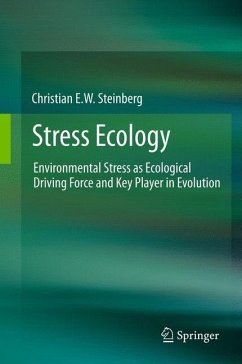
Not all stress is stressful; instead, it appears that stress in the environment, below the mutation threshold, is essential for many subtle manifestations of population structures and biodiversity, and has played a substantial role in the evolution of life. Intrigued by the behavior of laboratory animals that contradicted our current understanding of stress, the author and his group studied the beneficial effects of stress on animals and plants. The seemingly "crazy" animals demonstrated that several stress paradigms are outdated and have to be reconsidered. The book describes the general…mehr
Not all stress is stressful; instead, it appears that stress in the environment, below the mutation threshold, is essential for many subtle manifestations of population structures and biodiversity, and has played a substantial role in the evolution of life. Intrigued by the behavior of laboratory animals that contradicted our current understanding of stress, the author and his group studied the beneficial effects of stress on animals and plants. The seemingly "crazy" animals demonstrated that several stress paradigms are outdated and have to be reconsidered.
The book describes the general stress responses in microorganisms, plants, and animals to abiotic and biotic, to natural and anthropogenic stressors. These stress responses include the activation of oxygen, the biotransformation system, the stress proteins, and the metal-binding proteins. The potential of stress response lies in the transcription of genes, whereas the actual response is manifested by proteins and metabolites. Yet, not all stress responses are in the genes: micro-RNAs and epigenetics play central roles. Multiple stressors, such as environmental realism, do not always act additively; they may even diminish one another. Furthermore, one stressor often prepares the subject for the next one to come and may produce extended lifespans and increased offspring numbers, thus causing shifts in population structures.
This book provides the first comprehensive analysis of the ecological and evolutionary effects of stress.
Christian E.W. Steinberg, educated as ecologist, is interested in pure and applied limnology, particularly aquatic organisms and their nutrition as well as the action of natural aquatic xenobiotic substances. Particularly, humic substances and their long-term impact in entire lake systems as well as their short-term and transgenerational effect in fishes and aquatic invertebrates have been and continue to be studied. Consequently, in 2003, he published the highly acclaimed Ecology of Humic Substances in Freshwater with Springer. The continuation of this research interest led to the identification of beneficial effects of natural mild environmental stresses, for instance, by dissolved humic substances, as ecological driving force and the publication of the 2012 Springer book Stress Ecology. In 1995, he was appointed chairholder of freshwater ecology at Humboldt University in Berlin and, for 10 years, director of the Leibniz Institute of Freshwater Ecology and Inland Fisheries, Berlin, Germany. He has published approximately three hundred papers in peer-reviewed journals and was frequently appointed guest professor at Salzburg University (Austria), Universidade Federal do Rio de Janeiro (Brazil), Huazhong Agricultural University Wuhan (China), and, since 2009 permanently, Kunming University of Science and Technology (China).
Inhaltsangabe
Why a small worm is not crazy (Introduction).-Activation of oxygen: Multipurpose tool.-Defense means against pathogens and parasites: Reactive oxygen species.- Arms race between plants and animals: Biotransformation system.- Heat shock proteins: The minimal, but universal, stress proteome.- Heavy metals: Defense and ecological utilization.- The potential of stress response: Ecological transcriptomics.- Not all is in the genes: microRNAs, transgenerational effects, and epigenetics.- The actual response: Ecological proteomics and metabolomics.- Whatever doesn't kill you might make you stronger: Hormesis.- Multiple stressors as environmental realism: Synergism or antagonism.- One stressor prepares for the next one to come: Cross-tolerance.-Longevity: Risky shift in population structure?.- Footprints of stress in communities.-Environmental stresses: Ecological driving forces and key player in evolution.-References.-Appendices,-Abbreviations and Glossary,-Index.
Why a small worm is not crazy (Introduction).-Activation of oxygen: Multipurpose tool.-Defense means against pathogens and parasites: Reactive oxygen species.- Arms race between plants and animals: Biotransformation system.- Heat shock proteins: The minimal, but universal, stress proteome.- Heavy metals: Defense and ecological utilization.- The potential of stress response: Ecological transcriptomics.- Not all is in the genes: microRNAs, transgenerational effects, and epigenetics.- The actual response: Ecological proteomics and metabolomics.- Whatever doesn't kill you might make you stronger: Hormesis.- Multiple stressors as environmental realism: Synergism or antagonism.- One stressor prepares for the next one to come: Cross-tolerance.-Longevity: Risky shift in population structure?.- Footprints of stress in communities.-Environmental stresses: Ecological driving forces and key player in evolution.-References.-Appendices,-Abbreviations and Glossary,-Index.
Es gelten unsere Allgemeinen Geschäftsbedingungen: www.buecher.de/agb
Impressum
www.buecher.de ist ein Internetauftritt der buecher.de internetstores GmbH
Geschäftsführung: Monica Sawhney | Roland Kölbl | Günter Hilger
Sitz der Gesellschaft: Batheyer Straße 115 - 117, 58099 Hagen
Postanschrift: Bürgermeister-Wegele-Str. 12, 86167 Augsburg
Amtsgericht Hagen HRB 13257
Steuernummer: 321/5800/1497
USt-IdNr: DE450055826