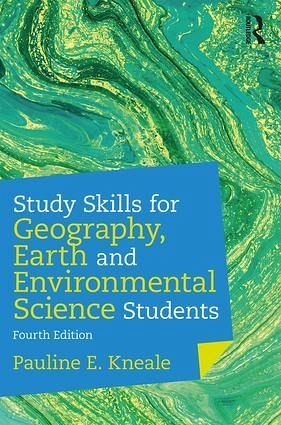
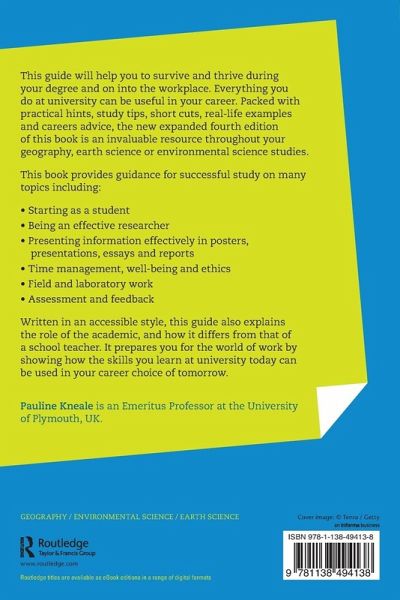
This guide is packed with practical hints, study tips, short cuts, real-life examples and careers advice, the new expanded fourth edition of this book is an invaluable resource throughout your geography, earth science or environmental science studies.
This guide is packed with practical hints, study tips, short cuts, real-life examples and careers advice, the new expanded fourth edition of this book is an invaluable resource throughout your geography, earth science or environmental science studies.
Pauline E. Kneale is an Emeritus Professor at the University of Plymouth, UK.
Inhaltsangabe
Section 1 Getting started, keeping going 1: Transitions - essential info 2: Reflecting, reviewing and acting - adding value to your degree 3: Balancing study, work and fun 4: Looking after yourself, commuting, mature study and well-being advice 5: Random useful stuff 6: Careers and employability Section 2 Transforming your learning, becoming more academic! 7: Threshold concepts - difficult stuff 8: Creativity, innovation and thinking 9: Listening 10: Effective reading 11: Making effective notes 12: Constructing an argument Section 3 Capturing evidence 13: Research - searching for evidence 14: Acknowledging sources 15: Ethics and plagiarism 16: Collaborative learning: team research and reporting 17: Discussion Section 4 Assignments and assessment 18: Effective essay skills 19: Not the essay: reports, laboratory and field notebooks 20: Abstracts and executive summaries 21: Reviewing papers and books 22: Presentations 23: Posters and display stands 24: Examinations and revision 25: Introducing dissertations and extended projects Section 5 Field activities 26: Fieldtrips 27: Presenting maps, sketches and data 28: Answers
Section 1 Getting started, keeping going 1: Transitions - essential info 2: Reflecting, reviewing and acting - adding value to your degree 3: Balancing study, work and fun 4: Looking after yourself, commuting, mature study and well-being advice 5: Random useful stuff 6: Careers and employability Section 2 Transforming your learning, becoming more academic! 7: Threshold concepts - difficult stuff 8: Creativity, innovation and thinking 9: Listening 10: Effective reading 11: Making effective notes 12: Constructing an argument Section 3 Capturing evidence 13: Research - searching for evidence 14: Acknowledging sources 15: Ethics and plagiarism 16: Collaborative learning: team research and reporting 17: Discussion Section 4 Assignments and assessment 18: Effective essay skills 19: Not the essay: reports, laboratory and field notebooks 20: Abstracts and executive summaries 21: Reviewing papers and books 22: Presentations 23: Posters and display stands 24: Examinations and revision 25: Introducing dissertations and extended projects Section 5 Field activities 26: Fieldtrips 27: Presenting maps, sketches and data 28: Answers
Es gelten unsere Allgemeinen Geschäftsbedingungen: www.buecher.de/agb
Impressum
www.buecher.de ist ein Internetauftritt der buecher.de internetstores GmbH
Geschäftsführung: Monica Sawhney | Roland Kölbl | Günter Hilger
Sitz der Gesellschaft: Batheyer Straße 115 - 117, 58099 Hagen
Postanschrift: Bürgermeister-Wegele-Str. 12, 86167 Augsburg
Amtsgericht Hagen HRB 13257
Steuernummer: 321/5800/1497
USt-IdNr: DE450055826