defined as elements of Grassmann algebra (an algebra with anticom muting generators). The derivatives of these elements with respect to anticommuting generators were defined according to algebraic laws, and nothing like Newton's analysis arose when Martin's approach was used. Later, during the next twenty years, the algebraic apparatus de veloped by Martin was used in all mathematical works. We must point out here the considerable contribution made by F. A. Berezin, G 1. Kac, D. A. Leites, B. Kostant. In their works, they constructed a new division of mathematics which can naturally be called…mehr
defined as elements of Grassmann algebra (an algebra with anticom muting generators). The derivatives of these elements with respect to anticommuting generators were defined according to algebraic laws, and nothing like Newton's analysis arose when Martin's approach was used. Later, during the next twenty years, the algebraic apparatus de veloped by Martin was used in all mathematical works. We must point out here the considerable contribution made by F. A. Berezin, G 1. Kac, D. A. Leites, B. Kostant. In their works, they constructed a new division of mathematics which can naturally be called an algebraic superanalysis. Following the example of physicists, researchers called the investigations carried out with the use of commuting and anticom muting coordinates supermathematics; all mathematical objects that appeared in supermathematics were called superobjects, although, of course, there is nothing "super" in supermathematics. However, despite the great achievements in algebraicsuperanaly sis, this formalism could not be regarded as a generalization to the case of commuting and anticommuting variables from the ordinary Newton analysis. What is more, Schwinger's formalism was still used in practically all physical works, on an intuitive level, and physicists regarded functions of anticommuting variables as "real functions" == maps of sets and not as elements of Grassmann algebras. In 1974, Salam and Strathdee proposed a very apt name for a set of super points. They called this set a superspace.
Prof. Andrei Khrennikov is the director of International center for mathematical modeling in physics, engineering and cognitive science, University of Växjö, Sweden, which was created 8 years ago to perform interdisciplinary research. Two series of conferences on quantum foundations (especially probabilistic aspects) were established on the basis of this center: "Foundations of Probability and Physics" and "Quantum Theory: Reconsideration of Foundations". These series became well known in the quantum community (including quantum information groups). Hundreds of theoreticians (physicists and mathematicians), experimenters and even philosophers participated in these conferences presenting a huge diversity of views to quantum foundations. Contacts with these people played the crucial role in creation of the present book. Prof. Andrei Khrennikov published about 300 papers in internationally recognized journals in mathematics, physics and biology and 9 monographs - in p-adic and non-Archimedean analysis with applications to mathematical physics and cognitive sciences as well as foundations of probabilityu theory.
Inhaltsangabe
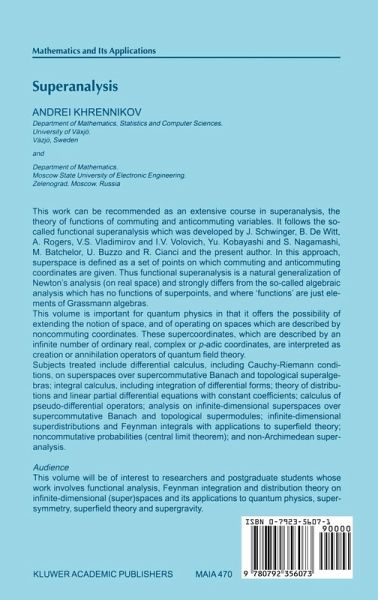
I Analysis on a Superspace over Banach Superalge-bras.- 1. Differential Calculus.- 2. Cauchy-Riemann Conditions and the Condition of A-Linearity of Derivatives.- 3. Integral Calculus.- 4. Integration of Differential Forms of Commuting Variables.- 5. Review of the Development of Superanalysis.- 6. Unsolved Problems and Possible Generalizations.- II Generalized Functions on a Superspace.- 1. Locally Convex Superalgebras and Supermodules.- 2. Analytic Generalized Functions on the Vladimirov-Volovich Superspace.- 3. Fourier Transformation of Superanalytic Generalized Functions.- 4. Superanalog of the Theory of Schwartz Distributions.- 5. Theorem of Existence of a Fundamental Solution.- 6. Unsolved Problems and Possible Generalizations.- III Distribution Theory on an Infinite-Dimensional Superspace.- 1. Polylinear Algebra over Commutative Supermodules.- 2. Banach Supermodules.- 3. Hilbert Supermodules.- 4. Duality of Topological Supermodules.- 5. Differential Calculus on a Superspace over Topological Supermodules.- 6. Analytic Distributions on a Superspace over Topological Supermodules.- 7. Gaussian and Feynman Distributions.- 8. Unsolved Problems and Possible Generalizations.- IV Pseudodifferential Operators in Superanalysis.- 1. Pseudodifferential Operators Calculus.- 2. The Correspondence Principle.- 3. The Feynman-Kac Formula for the Symbol of the Evolution Operator.- 4. Unsolved Problems and Possible Generalizations.- V Fundamentals of the Probability Theory on a Superspace.- 1. Limit Theorems on a Superspace.- 2. Random Processes on a Superspace.- 3. Axiomatics of the Probability Theory over Superalgebras.- 4. Unsolved Problems and Possible Generalizations.- VI Non-Archimedean Superanalysis.- 1. Differentiale and Analytic Functions.- 2. Generalized Functions.- 3. Laplace Transformation.- 4. Gaussian Distributions.- 5. Duhamel non-Archimedean Integral. Chronological Exponent.- 6. Cauchy Problem for Partial Differential Equations with Variable Coefficients.- 7. Non-Archimedean Supersymmetrical Quantum Mechanics.- 8. Trotter Formula for non-Archimedean Banach Algebras.- 9. Volkenborn Distribution on a non-Archimedean Super-space.- 10. Infinite-Dimensional non-Archimedean Superanalysis.- 11. Unsolved Problems and Possible Generalizations.- VII Noncommutative Analysis.- 1. Differential Calculus on a Superspace over a Noncommutative Banach Algebra.- 2. Differential Calculus on Noncommutative Banach Algebras and Modules.- 3. Generalized Functions of Noncommuting Variables.- VIII Applications in Physics.- 1. Quantization in Hilbert Supermodules.- 2. Transition Amplitudes and Distributions on the Space of Schwinger Sources.- References.
I Analysis on a Superspace over Banach Superalge-bras.- 1. Differential Calculus.- 2. Cauchy-Riemann Conditions and the Condition of A-Linearity of Derivatives.- 3. Integral Calculus.- 4. Integration of Differential Forms of Commuting Variables.- 5. Review of the Development of Superanalysis.- 6. Unsolved Problems and Possible Generalizations.- II Generalized Functions on a Superspace.- 1. Locally Convex Superalgebras and Supermodules.- 2. Analytic Generalized Functions on the Vladimirov-Volovich Superspace.- 3. Fourier Transformation of Superanalytic Generalized Functions.- 4. Superanalog of the Theory of Schwartz Distributions.- 5. Theorem of Existence of a Fundamental Solution.- 6. Unsolved Problems and Possible Generalizations.- III Distribution Theory on an Infinite-Dimensional Superspace.- 1. Polylinear Algebra over Commutative Supermodules.- 2. Banach Supermodules.- 3. Hilbert Supermodules.- 4. Duality of Topological Supermodules.- 5. Differential Calculus on a Superspace over Topological Supermodules.- 6. Analytic Distributions on a Superspace over Topological Supermodules.- 7. Gaussian and Feynman Distributions.- 8. Unsolved Problems and Possible Generalizations.- IV Pseudodifferential Operators in Superanalysis.- 1. Pseudodifferential Operators Calculus.- 2. The Correspondence Principle.- 3. The Feynman-Kac Formula for the Symbol of the Evolution Operator.- 4. Unsolved Problems and Possible Generalizations.- V Fundamentals of the Probability Theory on a Superspace.- 1. Limit Theorems on a Superspace.- 2. Random Processes on a Superspace.- 3. Axiomatics of the Probability Theory over Superalgebras.- 4. Unsolved Problems and Possible Generalizations.- VI Non-Archimedean Superanalysis.- 1. Differentiale and Analytic Functions.- 2. Generalized Functions.- 3. Laplace Transformation.- 4. Gaussian Distributions.- 5. Duhamel non-Archimedean Integral. Chronological Exponent.- 6. Cauchy Problem for Partial Differential Equations with Variable Coefficients.- 7. Non-Archimedean Supersymmetrical Quantum Mechanics.- 8. Trotter Formula for non-Archimedean Banach Algebras.- 9. Volkenborn Distribution on a non-Archimedean Super-space.- 10. Infinite-Dimensional non-Archimedean Superanalysis.- 11. Unsolved Problems and Possible Generalizations.- VII Noncommutative Analysis.- 1. Differential Calculus on a Superspace over a Noncommutative Banach Algebra.- 2. Differential Calculus on Noncommutative Banach Algebras and Modules.- 3. Generalized Functions of Noncommuting Variables.- VIII Applications in Physics.- 1. Quantization in Hilbert Supermodules.- 2. Transition Amplitudes and Distributions on the Space of Schwinger Sources.- References.
Rezensionen
'The book will probably make a useful addition to the office library collection of every researcher or mathematical centre with interests in analysis with anticommuting variables.' -- Mathematical Reviews Clippings (2001)
`The book will probably make a useful addition to the office library collection of every researcher or mathematical centre with interests in analysis with anticommuting variables.' Mathematical Reviews Clippings (2001)
Es gelten unsere Allgemeinen Geschäftsbedingungen: www.buecher.de/agb
Impressum
www.buecher.de ist ein Internetauftritt der buecher.de internetstores GmbH
Geschäftsführung: Monica Sawhney | Roland Kölbl | Günter Hilger
Sitz der Gesellschaft: Batheyer Straße 115 - 117, 58099 Hagen
Postanschrift: Bürgermeister-Wegele-Str. 12, 86167 Augsburg
Amtsgericht Hagen HRB 13257
Steuernummer: 321/5800/1497
USt-IdNr: DE450055826