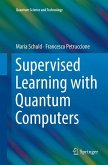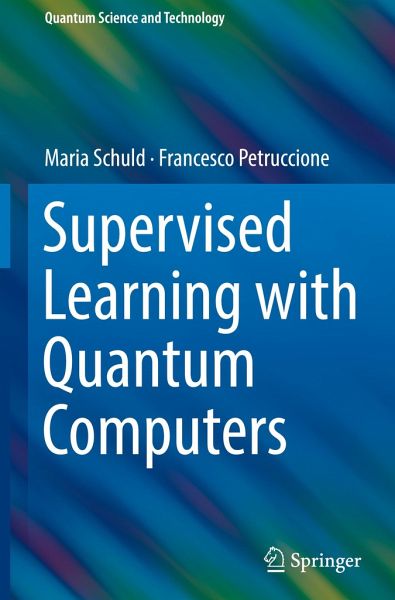
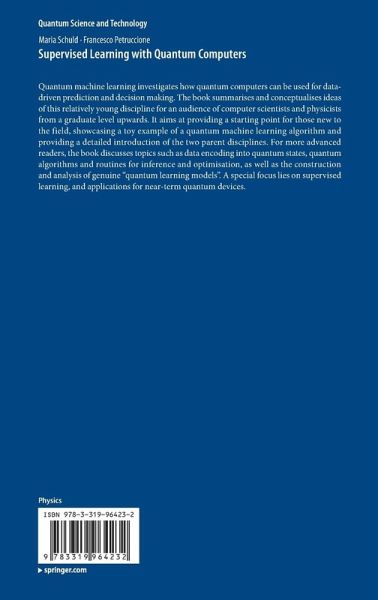
Quantum machine learning investigates how quantum computers can be used for data-driven prediction and decision making. The books summarises and conceptualises ideas of this relatively young discipline for an audience of computer scientists and physicists from a graduate level upwards. It aims at providing a starting point for those new to the field, showcasing a toy example of a quantum machine learning algorithm and providing a detailed introduction of the two parent disciplines. For more advanced readers, the book discusses topics such as data encoding into quantum states, quantum…mehr
Quantum machine learning investigates how quantum computers can be used for data-driven prediction and decision making. The books summarises and conceptualises ideas of this relatively young discipline for an audience of computer scientists and physicists from a graduate level upwards. It aims at providing a starting point for those new to the field, showcasing a toy example of a quantum machine learning algorithm and providing a detailed introduction of the two parent disciplines. For more advanced readers, the book discusses topics such as data encoding into quantum states, quantum algorithms and routines for inference and optimisation, as well as the construction and analysis of genuine ``quantum learning models''. A special focus lies on supervised learning, and applications for near-term quantum devices.
Maria Schuld works as a researcher for the Toronto-based quantum computing start-up Xanadu. She received her Ph.D. from the University of KwaZulu-Natal in 2017, where she began working on the intersection between quantum computing and machine learning in 2013. Besides her numerous contributions to the field, she is a co-developer for the open-source quantum machine learning software framework PennyLane. Francesco Petruccione received his Ph.D. (1988) and "Habilitation" (1994) from the University of Freiburg, Germany. Since 2004, he has been a professor of Theoretical Physics at the University of KwaZulu-Natal in Durban, South Africa, where in 2007, he was granted a South African Research Chair for Quantum Information Processing and Communication. He is the co-author of "The Theory of Open Quantum Systems" (Oxford University Press, 2002) and has published more than 250 papers in refereed journals. Francesco Petruccione's research focuses on open quantum systems and quantum information processing and communication.
Inhaltsangabe
Introduction.- Background.- How quantum computers can classify data.- Organisation of the book.- Machine Learning.- Prediction.- Models.- Training.- Methods in machine learning.- Quantum Information.- Introduction to quantum theory.- Introduction to quantum computing.- An example: The Deutsch-Josza algorithm.- Strategies of information encoding.- Important quantum routines.- Quantum advantages.- Computational complexity of learning.- Sample complexity.- Model complexity.- Information encoding.- Basis encoding.- Amplitude encoding.- Qsample encoding.- Hamiltonian encoding.- Quantum computing for inference.- Linear models.- Kernel methods.- Probabilistic models.- Quantum computing for training.- Quantum blas.- Search and amplitude amplification.- Hybrid training for variational algorithms.- Quantum adiabatic machine learning.- Learning with quantum models.- Quantum extensions of Ising-type models.- Variational classifiers and neural networks.- Other approaches to buildquantum models.- Prospects for near-term quantum machine learning.- Small versus big data.- Hybrid versus fully coherent approaches.- Qualitative versus quantitative advantages.- What machine learning can do for quantum computing.- References.
Rezensionen
"The book is very well written and contains sufficiently many examples and illustrations. The authors make a concerted effort to make the material accessible to both computer science graduates as well as scientists with a quantum physics background. ... The intended audience are thus machine learning scientists that want to explore the quantum approach to their discipline or quantum information scientists that want to enter the field of machine learning." (Andreas Maletti, zbMATH 1411.81008, 2019)
Es gelten unsere Allgemeinen Geschäftsbedingungen: www.buecher.de/agb
Impressum
www.buecher.de ist ein Internetauftritt der buecher.de internetstores GmbH
Geschäftsführung: Monica Sawhney | Roland Kölbl | Günter Hilger
Sitz der Gesellschaft: Batheyer Straße 115 - 117, 58099 Hagen
Postanschrift: Bürgermeister-Wegele-Str. 12, 86167 Augsburg
Amtsgericht Hagen HRB 13257
Steuernummer: 321/5800/1497
USt-IdNr: DE450055826