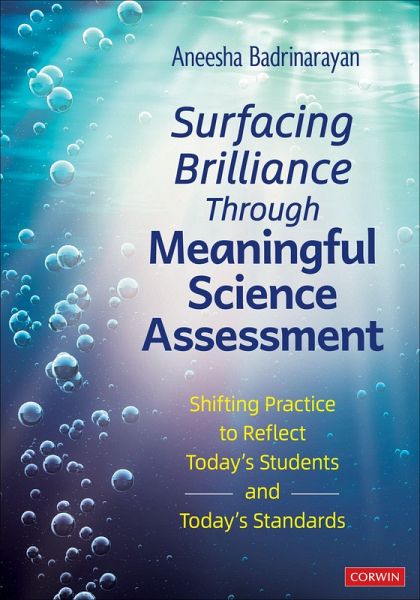
Science education is evolving-and our assessments should, too. The Next Generation Science Standards and similar standards based on A Framework for K-12 Science Education ushered in a bold vision focused on figuring out phenomena and problems, sensemaking that mirrors how scientists work, and real-world relevance. Although instruction has started to shift, assessment has too often lagged behind-failing to capture or support the depth, complexity, and creativity of meaningful science learning. Surfacing Brilliance Through Meaningful Science Assessment: Shifting Practice to Reflect Today's…mehr
Science education is evolving-and our assessments should, too. The Next Generation Science Standards and similar standards based on A Framework for K-12 Science Education ushered in a bold vision focused on figuring out phenomena and problems, sensemaking that mirrors how scientists work, and real-world relevance. Although instruction has started to shift, assessment has too often lagged behind-failing to capture or support the depth, complexity, and creativity of meaningful science learning. Surfacing Brilliance Through Meaningful Science Assessment: Shifting Practice to Reflect Today's Students and Today's Standards is the essential guide for educators and leaders ready to rethink how we understand, evaluate, and support K-12 science learning. Written by Aneesha Badrinarayan, a leading voice in science education and assessment, this book offers a clear roadmap for designing assessments that surface the brilliance of young people in ways that are meaningful, equitable, and grounded in the lived realities of today's classrooms. Drawing on four core priorities-sensemaking, relevance, assets, and opportunity-this book empowers educators to move beyond traditional tests to create assessments that reveal what students truly understand and can do. Bridging cutting-edge research and practical implementation, this book offers: * Concrete strategies for using phenomena, problematizing strategies, and purposeful prompts to drive authentic sensemaking * Frameworks and tools to develop relevant, asset-based assessments that reflect students' strengths and experiences and are specific to a given classroom context * Approaches to using data for targeted feedback and deeper learning * A forward-looking chapter on how to meaningfully integrate AI into science assessment in an age of rapidly evolving technology Whether you're a K-12 teacher, instructional leader, or assessment designer, Surfacing Brilliance Through Meaningful Science Assessment will transform how you think about using assessment to understand, evaluate, and support student learning. This guide ensures that educators and leaders assess students in ways that center student brilliance, embrace innovation, and inspire learners to achieve ambitious learning goals in science.
Aneesha Badrinarayan is an education policy consultant at Education First, where she supports states and districts in developing meaningful teaching, learning, and assessment systems across content areas and strategies. Prior to joining Education First, Aneesha led assessment initiatives and strategy at the Learning Policy Institute and Achieve. She is a national expert on instructionally relevant assessment systems, high-quality assessments, and science teaching, learning, and assessment. Over the last 20 years, Aneesha has led work related to high-quality instructional materials, assessment system development from classroom assessments to state assessments to NAEP, and professional learning. Trained as a behavioral neuroscientist, Aneesha comes to education policy via informal science education and bench science. She received her B.A. in Biology from Cornell University and her M.S. in neuroscience from the University of Michigan. Aneesha lives in Maryland with her husband Dan and their fabulous toddler Rishi. When she isn't playing the role of science assessment superhero, you can find her alter ego with her nose in a romance novel, her hands whisking something in the kitchen, and the rest of her body otherwise occupied with slowly transforming her house into a toddler play place (who needs a dining room, really?)
Inhaltsangabe
Acknowledgments About the Author Author's Note PART 1: UNDERSTANDING SCIENCE STANDARDS IN FUTURE-FOCUSED WAYS Introduction: Setting the Stage A Quick Primer on the Next Generation Science Standards Grounding Principles and Needed Shifts in Science Assessment This Is Not Your Typical Science Assessment Book Overview of This Book Language Use in This Book CHAPTER 1: Future-Focused Science Assessments: Interpreting the NGSS and Similar Standards for Meaningful Assessments in a Rapidly Evolving World Understanding Our Foundation: Current Features of High-Quality Science Assessments Landscape Shift 1: Local and Cultural Relevance and Personalization Landscape Shift 2: Competencies and Durable Skills Landscape Shift 3: Technology and Its Impact on Teaching, Learning, and Assessment in Science Future-Focused Science Assessment: Evolution Chapter Summary Reflection Questions PART 2: FOUR PRIORITIES FOR SURFACING SCIENCE THINKING IN TRUSTWORTHY AND USEFUL WAYS CHAPTER 2: Priority 1: Sensemaking Defining Sensemaking in Assessment Why Is Sensemaking So Important? What Leads to Sensemaking in Assessment Tasks Pathways to Sensemaking: Phenomena, Problematizing, and Prompts Choosing a Phenomenon to Drive Sensemaking Problematizing a Phenomenon to Surface Sensemaking Crafting Prompts to Elicit Sensemaking Scaffolding Sensemaking in Assessment Tasks Deep Dive Into Choosing Meaningful Phenomena: Right-Sizing Phenomena and Problems to a Given Assessment Task Using Phenomena to Understand Transfer and Generalizability of Science Learning Caution: Ensuring Transfer Doesn't Become a Pass for Discrimination and Inequity Chapter Summary Reflection Questions CHAPTER 3: Priority 2: Relevance Making Assessment Tasks Relevant-Not Just Interesting-to Learners and Their Communities Using Culture as a Concrete Path to Relevance in Science Assessments Understanding Our Students: An Example Attending to Culture and Relevance at the Scale of Many Students Windows and Mirrors: A Strategy for Approaching Relevance at Scale Features of Culturally Conscious Assessments Motivation and Affect: Reimagining One of Assessment's Cardinal Rules Chapter Summary Reflection Questions CHAPTER 4: Priority 3: Assets Looking for Assets in Student Sensemaking Key Features of Asset-Based Assessment Practices in Science Moving Beyond Misconceptions: Reframing Our Orientation to Wrong and Incomplete Answers Implications of Asset-Based Approaches for Assessment Tasks and Data Dashboards Habits and Beliefs of Asset-Based Assessors Celebrating Assets of Students Who Think Differently Than We Do Chapter Summary Reflection Questions CHAPTER 5: Priority 4: Opportunity and Experience The Relationship Between Opportunity, Experience, and Performance Making the Right Information Available Impact on Students A Window Into Practices and Durable Skills What Experiences Should We Measure? Turning Experience Information Into Insights About Opportunity to Learn That Influence Our Interpretations of Student Performance and Next Steps in Instruction Using Opportunity and Experience Data to Foster New Conversations With Parents Chapter Summary Reflection Questions PART 3: PUTTING THE PRIORITIES TO WORK CHAPTER 6: Choosing and Designing Assessments That Center the Four Priorities Reviewing Tasks: Criteria Reviewing Tasks: Process Some Tips to Help Quick Task Evaluation Developing Assessments That Are Designed for the Science Standards in Ways That Center the Four Priorities Step 1: Understand and Define Your Assessment Targets Within a Future-Focused Framework Step 2: Unpack Standards and Other Learning Goals With Learners' Culture, Interests, and Identities in Mind Step 3: Write Claims for Your Assessment That Synthesize Your Focal DCIs, SEPs, CCCs, and Durable Skills Into a Statement About Student Learning Step 4: Choose a Phenomenon or Problem That Centers Specific Communities, Interests, and Reasons for Engaging Step 5: Create a Problematized Scenario Based on the Phenomenon Step 6: Develop Complete Student Explanations or Models That Specifically Account for How Different Perspectives and Ideas Can Be Valued in Complete Responses Step 7: Develop Prompts That Elicit Sensemaking With Multiple Dimensions and Lived Experiences Step 8: Develop Asset-Oriented Interpretation Guidance for Student Responses Step 9: Invite Feedback and Review From Those Closest to Students You Are Least Connected To Step 10: Pilot and Revise, Focusing on Learners at the Margins Chapter Summary Reflection Questions CHAPTER 7: Using Generative AI in Responsible Ways to Support Science Assessment Design and Use Defining Terms Understanding the Current State of Generative AI in Science Assessment Ways Generative AI Might Support Science Assessment Approaching AI as a "Collaborator" in Science Assessment Activities A Use-Case: AI in Science Assessment Review Guiding Principles for Using Generative AI in Science Assessment Processes (AKA Aneeshäs Laws of Assessment Machines) Supporting Social Sensemaking Some Final Caveats Chapter Summary Reflection Questions CHAPTER 8: Epilogue: An Invitation to Imagine References Index
Acknowledgments About the Author Author's Note PART 1: UNDERSTANDING SCIENCE STANDARDS IN FUTURE-FOCUSED WAYS Introduction: Setting the Stage A Quick Primer on the Next Generation Science Standards Grounding Principles and Needed Shifts in Science Assessment This Is Not Your Typical Science Assessment Book Overview of This Book Language Use in This Book CHAPTER 1: Future-Focused Science Assessments: Interpreting the NGSS and Similar Standards for Meaningful Assessments in a Rapidly Evolving World Understanding Our Foundation: Current Features of High-Quality Science Assessments Landscape Shift 1: Local and Cultural Relevance and Personalization Landscape Shift 2: Competencies and Durable Skills Landscape Shift 3: Technology and Its Impact on Teaching, Learning, and Assessment in Science Future-Focused Science Assessment: Evolution Chapter Summary Reflection Questions PART 2: FOUR PRIORITIES FOR SURFACING SCIENCE THINKING IN TRUSTWORTHY AND USEFUL WAYS CHAPTER 2: Priority 1: Sensemaking Defining Sensemaking in Assessment Why Is Sensemaking So Important? What Leads to Sensemaking in Assessment Tasks Pathways to Sensemaking: Phenomena, Problematizing, and Prompts Choosing a Phenomenon to Drive Sensemaking Problematizing a Phenomenon to Surface Sensemaking Crafting Prompts to Elicit Sensemaking Scaffolding Sensemaking in Assessment Tasks Deep Dive Into Choosing Meaningful Phenomena: Right-Sizing Phenomena and Problems to a Given Assessment Task Using Phenomena to Understand Transfer and Generalizability of Science Learning Caution: Ensuring Transfer Doesn't Become a Pass for Discrimination and Inequity Chapter Summary Reflection Questions CHAPTER 3: Priority 2: Relevance Making Assessment Tasks Relevant-Not Just Interesting-to Learners and Their Communities Using Culture as a Concrete Path to Relevance in Science Assessments Understanding Our Students: An Example Attending to Culture and Relevance at the Scale of Many Students Windows and Mirrors: A Strategy for Approaching Relevance at Scale Features of Culturally Conscious Assessments Motivation and Affect: Reimagining One of Assessment's Cardinal Rules Chapter Summary Reflection Questions CHAPTER 4: Priority 3: Assets Looking for Assets in Student Sensemaking Key Features of Asset-Based Assessment Practices in Science Moving Beyond Misconceptions: Reframing Our Orientation to Wrong and Incomplete Answers Implications of Asset-Based Approaches for Assessment Tasks and Data Dashboards Habits and Beliefs of Asset-Based Assessors Celebrating Assets of Students Who Think Differently Than We Do Chapter Summary Reflection Questions CHAPTER 5: Priority 4: Opportunity and Experience The Relationship Between Opportunity, Experience, and Performance Making the Right Information Available Impact on Students A Window Into Practices and Durable Skills What Experiences Should We Measure? Turning Experience Information Into Insights About Opportunity to Learn That Influence Our Interpretations of Student Performance and Next Steps in Instruction Using Opportunity and Experience Data to Foster New Conversations With Parents Chapter Summary Reflection Questions PART 3: PUTTING THE PRIORITIES TO WORK CHAPTER 6: Choosing and Designing Assessments That Center the Four Priorities Reviewing Tasks: Criteria Reviewing Tasks: Process Some Tips to Help Quick Task Evaluation Developing Assessments That Are Designed for the Science Standards in Ways That Center the Four Priorities Step 1: Understand and Define Your Assessment Targets Within a Future-Focused Framework Step 2: Unpack Standards and Other Learning Goals With Learners' Culture, Interests, and Identities in Mind Step 3: Write Claims for Your Assessment That Synthesize Your Focal DCIs, SEPs, CCCs, and Durable Skills Into a Statement About Student Learning Step 4: Choose a Phenomenon or Problem That Centers Specific Communities, Interests, and Reasons for Engaging Step 5: Create a Problematized Scenario Based on the Phenomenon Step 6: Develop Complete Student Explanations or Models That Specifically Account for How Different Perspectives and Ideas Can Be Valued in Complete Responses Step 7: Develop Prompts That Elicit Sensemaking With Multiple Dimensions and Lived Experiences Step 8: Develop Asset-Oriented Interpretation Guidance for Student Responses Step 9: Invite Feedback and Review From Those Closest to Students You Are Least Connected To Step 10: Pilot and Revise, Focusing on Learners at the Margins Chapter Summary Reflection Questions CHAPTER 7: Using Generative AI in Responsible Ways to Support Science Assessment Design and Use Defining Terms Understanding the Current State of Generative AI in Science Assessment Ways Generative AI Might Support Science Assessment Approaching AI as a "Collaborator" in Science Assessment Activities A Use-Case: AI in Science Assessment Review Guiding Principles for Using Generative AI in Science Assessment Processes (AKA Aneeshäs Laws of Assessment Machines) Supporting Social Sensemaking Some Final Caveats Chapter Summary Reflection Questions CHAPTER 8: Epilogue: An Invitation to Imagine References Index
Es gelten unsere Allgemeinen Geschäftsbedingungen: www.buecher.de/agb
Impressum
www.buecher.de ist ein Internetauftritt der buecher.de internetstores GmbH
Geschäftsführung: Monica Sawhney | Roland Kölbl | Günter Hilger
Sitz der Gesellschaft: Batheyer Straße 115 - 117, 58099 Hagen
Postanschrift: Bürgermeister-Wegele-Str. 12, 86167 Augsburg
Amtsgericht Hagen HRB 13257
Steuernummer: 321/5800/1497
USt-IdNr: DE450055826