
Andere Kunden interessierten sich auch für
 Suspense29,99 €
 Suspense15,99 €
 The Gods are Athirst17,99 €
 The Lion of Petra18,99 €
 The Flame18,99 €
 The Lion Of Petra22,99 €
 The Flame11,60 €

Set in early 19th-century Italy during Napoleon's tightening grip on Europe, this unfinished novel follows an English naval officer sent on a covert mission into enemy-held territory. Disguised and operating in secrecy, he becomes entangled with royalist rebels, mysterious allies, and a woman whose fate is tied to both sides of the conflict. As political tides shift and danger draws closer, the line between deception and loyalty begins to blur. With its slow-burning tension and rich historical setting, the story explores the personal costs of espionage and the complexities of duty during wartime upheaval.
Joseph Conrad (1857 - 1924) is regarded as one of the greatest novelists in English. He was granted British nationality in 1886, but always considered himself a Pole. Though he did not speak English fluently until he was in his twenties (and always with a marked accent), he was a master prose stylist who brought a distinctly non-English sensibility into English literature. He wrote stories and novels, many with a nautical setting, that depict trials of the human spirit in the midst of an impassive, inscrutable universe. Joseph Conrad is considered an early modernist, though his works still contain elements of nineteenth-century realism. His narrative style and anti-heroiccharacters have influenced many authors, including T.S. Eliot, William Faulkner, Graham Greene, and more recently Salman Rushdie. Many films have been adapted from, or inspired by, Conrad's works. Writing in the heyday of the British Empire, Conrad drew on his native Poland's national experiences and on his personal experiences in the French andBritish merchant navies to create short stories and novels that reflect aspects of a European-dominated world, while profoundly exploring human psychology. Appreciated early on by literary critics, his fiction and nonfiction have since been seen as almost prophetic, in the light of subsequent national and international disasters of the 20th and 21st centuries.
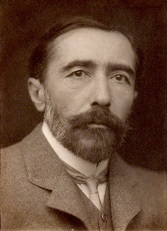
Foto: George Charles Beresford