
Andere Kunden interessierten sich auch für
 Organic-Based Nanomaterials in Food Packaging136,99 €
 Organic-Based Nanomaterials in Food Packaging170,99 €
 Post-Harvest Processing, Packaging and Inspection of Frozen Shrimp: A Practical Guide113,99 €
 Dry Fish: A Global Perspective on Nutritional Security and Economic Sustainability166,99 €
 Food and Industry 5.0: Transforming the Food System for a Sustainable Future152,99 €
 Sustainable Innovations in Food Packaging53,99 €
 Nanotechnology in Food Packaging151,99 €
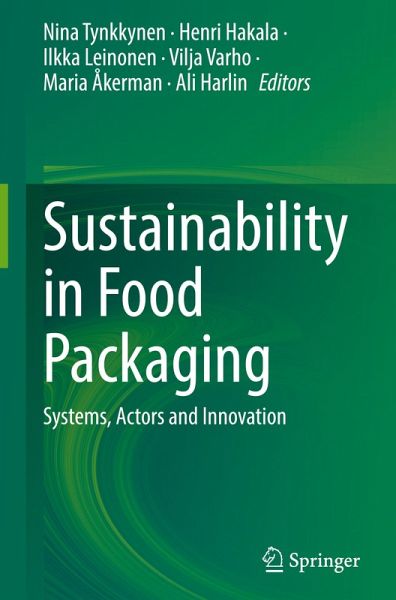
The sustainability of food packaging is a key priority in the food industry, as plastic waste and littering have become global concerns. Packaging waste accounts for over half of total global waste, predominantly from single-use plastic food packaging. Production of packaging consumes significant natural resources and contributes to climate change and pollution. However, packaging is also crucial for reducing food waste, protecting food safety, and providing vital information about contents, making it an essential sustainability solution, not just a problem.
Sustainability Transition in Food Packaging: Systems, Actors, and Innovation explores sustainable food packaging from an interdisciplinary perspective, integrating economics, environmental science, technology, social sciences and cultural studies. This broad approach expands beyond the traditional focus on packaging as a product, considering its content and the services it provides. While sustainable packaging is often defined by four principles effectiveness, efficiency, circularity, and safety current applications primarily focus on the packaging itself, overlooking broader impacts such as marine and soil littering.
Life cycle assessments (LCA) of packaging frequently ignore social, cultural, and economic sustainability aspects and often fail to account for the diverse interpretations of LCA standards. While the Product Environmental Footprint (PEF) offers a uniform solution, challenges remain due to undefined packaging category rules.
Food packaging is rapidly evolving, driven by innovation, political action, and consumer demand. Given the global and varied nature of the food supply chain, one-size-fits-all solutions are insufficient. This book offers a holistic, interdisciplinary approach to sustainability, fostering dialogue and research across different research fields. It examines different conceptualizations of sustainable food packaging including methods for analyzing sustainability. The volume introduces novel methodologies, such as LCA with a focus on littering, and provides insights on overcoming the challenges of transitioning to a more sustainable food packaging system.
Sustainability Transition in Food Packaging: Systems, Actors, and Innovation explores sustainable food packaging from an interdisciplinary perspective, integrating economics, environmental science, technology, social sciences and cultural studies. This broad approach expands beyond the traditional focus on packaging as a product, considering its content and the services it provides. While sustainable packaging is often defined by four principles effectiveness, efficiency, circularity, and safety current applications primarily focus on the packaging itself, overlooking broader impacts such as marine and soil littering.
Life cycle assessments (LCA) of packaging frequently ignore social, cultural, and economic sustainability aspects and often fail to account for the diverse interpretations of LCA standards. While the Product Environmental Footprint (PEF) offers a uniform solution, challenges remain due to undefined packaging category rules.
Food packaging is rapidly evolving, driven by innovation, political action, and consumer demand. Given the global and varied nature of the food supply chain, one-size-fits-all solutions are insufficient. This book offers a holistic, interdisciplinary approach to sustainability, fostering dialogue and research across different research fields. It examines different conceptualizations of sustainable food packaging including methods for analyzing sustainability. The volume introduces novel methodologies, such as LCA with a focus on littering, and provides insights on overcoming the challenges of transitioning to a more sustainable food packaging system.