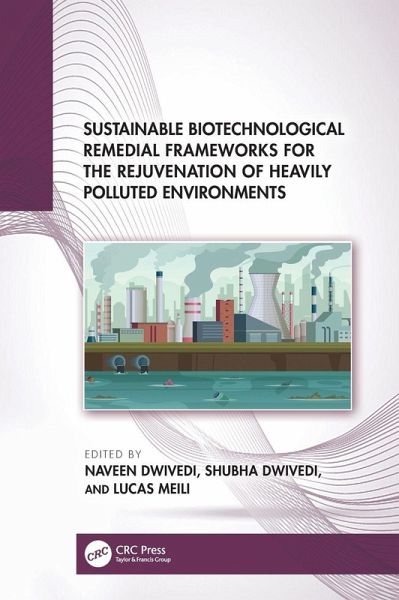
This book discusses advanced research in mitigation of heavily polluted environments through a sustainable biotechnological remedial framework along with their role in betterment of conventional treatment methods. It includes sustainable biotechnology-based approach to rejuvenate the heavily polluted environment highlighting related impacts.
This book discusses advanced research in mitigation of heavily polluted environments through a sustainable biotechnological remedial framework along with their role in betterment of conventional treatment methods. It includes sustainable biotechnology-based approach to rejuvenate the heavily polluted environment highlighting related impacts.
Naveen Dwivedi is Professor and Head in the Department of Biotechnology Engineering and Food Technology, University Institute of Engineering, Chandigarh University, Mohali, Punjab, India. He obtained his M. Tech. degree in Biotechnology Engineering from Institute of Engineering & Technology, Lucknow. Dr. Dwivedi has completed his M. Tech. dissertation work from Fermentation Division of Central Drug Research Institute (CSIR-CDRI), Lucknow and Ph.D. research work from Bioenergy & Environmental Engineering Research Lab, Indian Institute of Technology Roorkee. Dr. Dwivedi is broadly interested in the fields of environmental biotechnology, bioprocess engineering, bioenergy, biological remediation of wastewater and waste valorization. Dr. Dwivedi has more than 21 years of teaching and research experience. He has a good number of research publications in peer-reviewed journals and conferences, has edited books and written more than two dozen chapters in books published by reputed international publishers. Shubha Dwivedi is Associate Professor and Head in the Department of Biotechnology, IIMT University, Meerut, India. She received her postgraduation degree in biochemistry from Jiwaji University Gwalior and Ph.D. research work from Sustainable Processing and Water Treatment Research Lab, Indian Institute of Technology Roorkee. She was associated with Institute of Genomics and Integrative Biology (CSIR-IGIB) Delhi during her masters. Her working area has been in the development of eco-friendly technology for the removal of hazardous contaminants from wastewater. Dr. Dwivedi has more than 19 years of teaching and research experience. Her outstanding research work is evidenced by a good number of research publications, books and book chapters, patents and so on. Lucas Meili is Full Professor at the Center for Technology of the Federal University of Alagoas (UFAL), in Maceió, Alagoas, Brazil. Professor Meili graduated in chemical engineering from the Federal University of Rio Grande (Brazil) and obtained his Ph.D. in chemical engineering from the Federal University of São Carlos (Brazil) in 2009. His areas of interest are focused on separation processes, water and wastewater treatment, and materials synthesis. He has several publications in peer-reviewed high-impact scientific journals, covering various topics related to pollutant removal, adsorption, materials synthesis, and water treatment. His publications demonstrate a particular focus on the application of materials as adsorbents in pollutant removal processes, as well as the evaluation of synthesis methods and water treatment processes.
Inhaltsangabe
1. Biotechnological framework for the treatment of environmental pollution and challenges thereof 2. Integration of bioremediation planning and execution for restoring the ecosystem 3. Water resources management through nature-based solutions 4. Nano-Biomaterials used for the elimination of harmful contaminants 5. Production of carbon with high specific surface area from West African agricultural waste: Evaluation of product quality and potential application 6. Global situation of environmental pollution and its sustainable remedial solutions 7. Microbial Rejuvenation of Heavily Polluted Soil 8. Sustainable Energy Production through Microbial Fuel Cells and Waste Management 9. Insights into omics approaches in plant phytoremediation of heavy metals 10. Resources recovery potential from solid waste and bioeconomy model toward sustainable production and responsible consumption 11. Microbial electrolysis: An emerging biotechnology for energy production and wastewater treatment 12. Prediction of heavy metal adsorption by biomass ash using artificial neural network 13. Bio-Inspired Materials for Reducing Ecological Footprint and Life Cycle Assessment 14. Enzymes Based Technologies for Bioremediation of Environmental Pollution 15. Bio-refinery Approach for a Sustainable Eco-system and Circular Bio-economy 16. Metabolic Engineering in Waste Prevention 17. IoT/ AI Based Solutions in Environmental Waste Management and Monitoring 18. Nano-biosensors for detecting environmental pollutants 19. Industrial Framework for Net Zero Emission Transition in Emerging Economies
1. Biotechnological framework for the treatment of environmental pollution and challenges thereof 2. Integration of bioremediation planning and execution for restoring the ecosystem 3. Water resources management through nature-based solutions 4. Nano-Biomaterials used for the elimination of harmful contaminants 5. Production of carbon with high specific surface area from West African agricultural waste: Evaluation of product quality and potential application 6. Global situation of environmental pollution and its sustainable remedial solutions 7. Microbial Rejuvenation of Heavily Polluted Soil 8. Sustainable Energy Production through Microbial Fuel Cells and Waste Management 9. Insights into omics approaches in plant phytoremediation of heavy metals 10. Resources recovery potential from solid waste and bioeconomy model toward sustainable production and responsible consumption 11. Microbial electrolysis: An emerging biotechnology for energy production and wastewater treatment 12. Prediction of heavy metal adsorption by biomass ash using artificial neural network 13. Bio-Inspired Materials for Reducing Ecological Footprint and Life Cycle Assessment 14. Enzymes Based Technologies for Bioremediation of Environmental Pollution 15. Bio-refinery Approach for a Sustainable Eco-system and Circular Bio-economy 16. Metabolic Engineering in Waste Prevention 17. IoT/ AI Based Solutions in Environmental Waste Management and Monitoring 18. Nano-biosensors for detecting environmental pollutants 19. Industrial Framework for Net Zero Emission Transition in Emerging Economies
Es gelten unsere Allgemeinen Geschäftsbedingungen: www.buecher.de/agb
Impressum
www.buecher.de ist ein Internetauftritt der buecher.de internetstores GmbH
Geschäftsführung: Monica Sawhney | Roland Kölbl | Günter Hilger
Sitz der Gesellschaft: Batheyer Straße 115 - 117, 58099 Hagen
Postanschrift: Bürgermeister-Wegele-Str. 12, 86167 Augsburg
Amtsgericht Hagen HRB 13257
Steuernummer: 321/5800/1497
USt-IdNr: DE450055826