

Andere Kunden interessierten sich auch für
 The Development of British Immigration Law151,99 €
 Peace Studies in the Chinese Century113,99 €
 Religion, Disability, and Sustainable Development in Africa179,99 €
 Sustainable Development and Local Government in South Korea179,99 €
 Chinese Peace in Africa54,99 €
 Sustainable Development in India and South-East Asia173,99 €
 The Peace Process between Turkey and the Kurds71,99 €



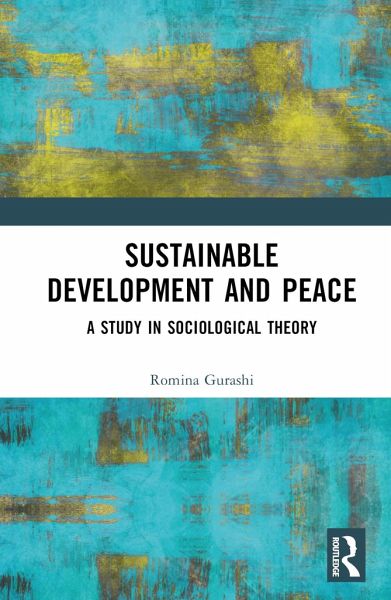
With a focus on sociological theory and its development, this book explores the growing attention that sociology has started to give to environmental issues in terms of peace and social justice, reconstructing the journey towards the reconstruction of the problems associated with the implementation of conditions of peace and sustainability.
'A well-documented book on sociological theory that takes the reader on an unexpected journey through topical issues such as peace and sustainable development.'
Paolo De Nardis, Professor Emeritus of Sociology, 'Sapienza' University of Rome, Italy
'A highly topical and timely book inviting us to reflect on how peace has always been studied although not organically in sociological terms. The originality of this work lies precisely in having filled this gap by bringing together sociological topics scattered across time and space into a single cognitive effort.'
Roberta Iannone, Full Professor of Sociology, 'Sapienza' University of Rome, Italy
'By choosing the study of peace as her research field, Gurashi succeeded in mapping the notions and experiences associated with this topic of investigation across a broad spatial-temporal spectrum. In this sense, the strength of this work lies in starting from clear assumptions and probing aspects that have not yet been explored in depth.'
Patrizia Sterpetti, Cultural Antropologist, President Wilpf Italy
Paolo De Nardis, Professor Emeritus of Sociology, 'Sapienza' University of Rome, Italy
'A highly topical and timely book inviting us to reflect on how peace has always been studied although not organically in sociological terms. The originality of this work lies precisely in having filled this gap by bringing together sociological topics scattered across time and space into a single cognitive effort.'
Roberta Iannone, Full Professor of Sociology, 'Sapienza' University of Rome, Italy
'By choosing the study of peace as her research field, Gurashi succeeded in mapping the notions and experiences associated with this topic of investigation across a broad spatial-temporal spectrum. In this sense, the strength of this work lies in starting from clear assumptions and probing aspects that have not yet been explored in depth.'
Patrizia Sterpetti, Cultural Antropologist, President Wilpf Italy