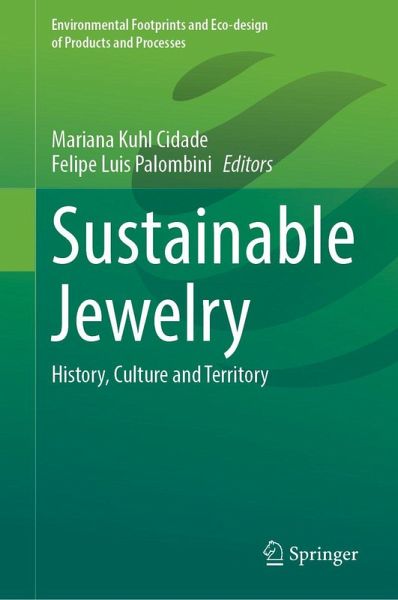
This book offers a variety of cases detailing developments in jewelry sustainability, highlighting growing consumer awareness and desire for more environmentally and socially conscious products. Its component chapters describe trends in jewelry that embrace new materials, processes, styles, and technologies. Initiatives spanning various sectors are presented, including chapters covering large industries, independent artisanal jewelers, and research facilities. The cases here highlight how societal demands influence product development and shape the jewelry market. This book is intended for…mehr
This book offers a variety of cases detailing developments in jewelry sustainability, highlighting growing consumer awareness and desire for more environmentally and socially conscious products. Its component chapters describe trends in jewelry that embrace new materials, processes, styles, and technologies. Initiatives spanning various sectors are presented, including chapters covering large industries, independent artisanal jewelers, and research facilities. The cases here highlight how societal demands influence product development and shape the jewelry market. This book is intended for industry professionals, designers, researchers, and consumers as a comprehensive resource for sustainable practices in the jewelry industry.
Produktdetails
Produktdetails
Environmental Footprints and Eco-design of Products and Processes
Artikelnr. des Verlages: 89551067, 978-3-032-07625-0
Seitenzahl: 364
Erscheinungstermin: 8. Februar 2026
Englisch
Abmessung: 235mm x 155mm
ISBN-13: 9783032076250
ISBN-10: 3032076250
Artikelnr.: 75310342
Herstellerkennzeichnung
Springer-Verlag GmbH
Tiergartenstr. 17
69121 Heidelberg
ProductSafety@springernature.com
Autorenporträt
Mariana Kuhl Cidade – Professor in the Department of Industrial Design (DDI) and in the Graduate Program in Architecture, Urbanism, and Landscaping (PPGAUP) at the Federal University of Santa Maria (UFSM). Dr. Cidade graduated in Industrial Design and holds an MSc and PhD in Design (PGDesign) from the Federal University of Rio Grande do Sul (UFRGS). Her research includes Contemporary and Traditional Jewelry, Gems and Cuts, Jewelry with Natural and Unusual Materials; Sustainable Jewelry; Bionics, Recycling and Reuse of Problematic Materials, CO2 and Fiber Laser Cutting and Engraving Process, and Creative Technologies. She is associated with the Innovation and Sustainability in Design Lab (NOVA Lab) at UFSM. Felipe Luis Palombini – Professor in the Department of Industrial Design (DDI) and Coordinator of the Graduate Program in Architecture, Urbanism, and Landscaping (PPGAUP) at the Federal University of Santa Maria (UFSM). Dr. Palombini holds an MSc and a PhD in Design (PGDesign), and PostDoc in Botany from the Federal University of Rio Grande do Sul (UFRGS). His main research topics are focused on sustainability, ecodesign, digital manufacturing, bionics, and materials characterization. He is associated with the Innovation and Sustainability in Design Lab (NOVA Lab) at UFSM, the Design and Computer Simulation Research Group (DSC), and the Plant Anatomy Laboratory (LAVeg), at UFRGS.
Inhaltsangabe
Chapter 1. Situated jewelry: social mediation and fabulation in adornment.- Chapter 2. Circularity as a Force for Sustainable Creative Jewelry Creation and Production.- Chapter 3. The Jewelry Effect: Exploring the Influence of Jewelry Quality on Wearer Perception.- Chapter 4. Sustainable Jewellery: Social, Economic, and Cultural Perspectives with special reference to India.- Chapter 5. Caio Mourão, the lord of metals.- Chapter 6. African Joy. Precious artifacts between tradition and innovation, as a model of ecodesign.- Chapter 7. Jewellery as Therapy: Uncovering the Hidden Healing Properties.- Chapter 8. Indigenous People s Accessory on Designomics Model: The Uniqueness of Saga Seeds Transformed into Exclusive Accessories.- Chapter 9. Nature and artistry: buriti fiber in Brazilian contemporary jewelry and Ivete Cattani s vision.- Chapter 10. Who Defines Adornment? Questioning Gender Norms in Contemporary Jewelry Through Beauvoir and Butler.- Chapter 11. Ornamental potential of the UFJF Botanical Garden: analysis of local flora for use in territorial jewelry.- Chapter 12. The Nacre and the Grain: Approaches to Ecological Empathy in Scotland.- Chapter 13. Sustainable materials and processes in the jewelry sector on the Amazonian scenery: reflections and possibilities of action.- Chapter 14. Bamboo as a Sustainable Alternative for Developing Contemporary Jewelry: Advantages and Limitations.- Chapter 15. Systemic Design and Circular Economy: Transforming Waste into Raw Material in Jewelry The Case of Coconut and Gold Jewelry and the Itaporarte Project.
Chapter 1. Situated jewelry: social mediation and fabulation in adornment.- Chapter 2. Circularity as a Force for Sustainable Creative Jewelry Creation and Production.- Chapter 3. The Jewelry Effect: Exploring the Influence of Jewelry Quality on Wearer Perception.- Chapter 4. Sustainable Jewellery: Social, Economic, and Cultural Perspectives with special reference to India.- Chapter 5. Caio Mourão, the lord of metals.- Chapter 6. African Joy. Precious artifacts between tradition and innovation, as a model of ecodesign.- Chapter 7. Jewellery as Therapy: Uncovering the Hidden Healing Properties.- Chapter 8. Indigenous People s Accessory on Designomics Model: The Uniqueness of Saga Seeds Transformed into Exclusive Accessories.- Chapter 9. Nature and artistry: buriti fiber in Brazilian contemporary jewelry and Ivete Cattani s vision.- Chapter 10. Who Defines Adornment? Questioning Gender Norms in Contemporary Jewelry Through Beauvoir and Butler.- Chapter 11. Ornamental potential of the UFJF Botanical Garden: analysis of local flora for use in territorial jewelry.- Chapter 12. The Nacre and the Grain: Approaches to Ecological Empathy in Scotland.- Chapter 13. Sustainable materials and processes in the jewelry sector on the Amazonian scenery: reflections and possibilities of action.- Chapter 14. Bamboo as a Sustainable Alternative for Developing Contemporary Jewelry: Advantages and Limitations.- Chapter 15. Systemic Design and Circular Economy: Transforming Waste into Raw Material in Jewelry The Case of Coconut and Gold Jewelry and the Itaporarte Project.
Es gelten unsere Allgemeinen Geschäftsbedingungen: www.buecher.de/agb
Impressum
www.buecher.de ist ein Internetauftritt der buecher.de internetstores GmbH
Geschäftsführung: Monica Sawhney | Roland Kölbl | Günter Hilger
Sitz der Gesellschaft: Batheyer Straße 115 - 117, 58099 Hagen
Postanschrift: Bürgermeister-Wegele-Str. 12, 86167 Augsburg
Amtsgericht Hagen HRB 13257
Steuernummer: 321/5800/1497
USt-IdNr: DE450055826