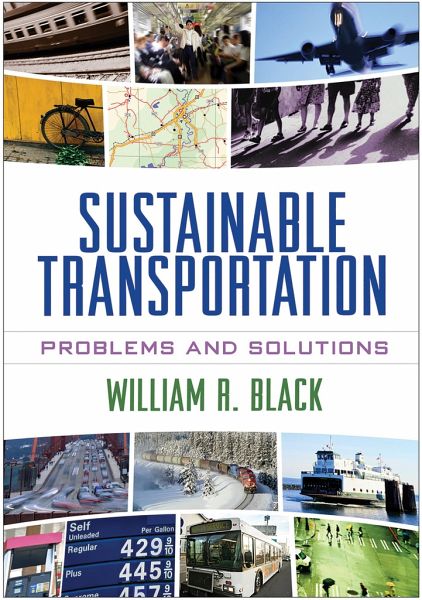
During the last two decades, sustainability has become the dominant concern of transportation planners and policymakers. This timely text provides a framework for developing systems that move people and products efficiently while minimizing damage to the local and global environment. The book offers a uniquely comprehensive perspective on the problems surrounding current transportation systems: climate change, urban air pollution, diminishing petroleum reserves, safety issues, and congestion. It explores the full range of possible solutions, including applications of pricing, planning, policy,…mehr
During the last two decades, sustainability has become the dominant concern of transportation planners and policymakers. This timely text provides a framework for developing systems that move people and products efficiently while minimizing damage to the local and global environment. The book offers a uniquely comprehensive perspective on the problems surrounding current transportation systems: climate change, urban air pollution, diminishing petroleum reserves, safety issues, and congestion. It explores the full range of possible solutions, including applications of pricing, planning, policy, education, and technology. Numerous figures, tables, and examples are featured, with a primary focus on North America.
William R. Black, PhD, until his death in 2013, was Professor Emeritus in the Department of Geography at Indiana University in Bloomington. A foundational figure in transport geography, he directed over 20 transportation research and planning projects, published over 200 research papers and reports, and authored, coauthored, or edited seven books. He founded the Transportation Geography Specialty Group of the Association of American Geographers (AAG), was a key figure in the development of the Journal of Transport Geography, and served on numerous panels and committees of the Transportation Research Board of the National Research Council. Dr. Black received the Edward L. Ullman Award for significant contributions to transportation geography from the AAG, which also selected him to present the Fleming Lecture in Transportation Geography.
Inhaltsangabe
I. The Nature of the Problem 1. The Problem of Sustainability in the Transport Sector 2. The Historical Problem of Sustainability in the Transport Sector 3. Climate Change 4. Urban Air Quality 5. The Finite Nature of Petroleum Reserves 6. Motor Vehicle Crashes and Safety 7. Congestion and Sustainability II. Possible Solutions 8. An Introduction to the Range of Possible Solutions Pricing 9. The Full Costs of Transportation 10. Pricing and Taxation Planning 11. Urban Form: Planning for Sustainability 12. Indicator-Based Planning Policy 13. A Continuum of Policies 14. The Special Role of Speed and Speed Limit Policies 15. National Policy Solutions 16. Sustainable Travel Demand Management Education 17. Educating for Change Technology 18. Information and Communication Technologies, and E-Commerce 19. The Potential of Alternative Fuels 20. New Vehicles, Fuel Cells, and Catalytic Converters 21. Intelligent Transport Systems III. Summary and Conclusions 22. Summary, Conclusions, and the Current Status of Sustainable Transport
I. The Nature of the Problem 1. The Problem of Sustainability in the Transport Sector 2. The Historical Problem of Sustainability in the Transport Sector 3. Climate Change 4. Urban Air Quality 5. The Finite Nature of Petroleum Reserves 6. Motor Vehicle Crashes and Safety 7. Congestion and Sustainability II. Possible Solutions 8. An Introduction to the Range of Possible Solutions Pricing 9. The Full Costs of Transportation 10. Pricing and Taxation Planning 11. Urban Form: Planning for Sustainability 12. Indicator-Based Planning Policy 13. A Continuum of Policies 14. The Special Role of Speed and Speed Limit Policies 15. National Policy Solutions 16. Sustainable Travel Demand Management Education 17. Educating for Change Technology 18. Information and Communication Technologies, and E-Commerce 19. The Potential of Alternative Fuels 20. New Vehicles, Fuel Cells, and Catalytic Converters 21. Intelligent Transport Systems III. Summary and Conclusions 22. Summary, Conclusions, and the Current Status of Sustainable Transport
Es gelten unsere Allgemeinen Geschäftsbedingungen: www.buecher.de/agb
Impressum
www.buecher.de ist ein Internetauftritt der buecher.de internetstores GmbH
Geschäftsführung: Monica Sawhney | Roland Kölbl | Günter Hilger
Sitz der Gesellschaft: Batheyer Straße 115 - 117, 58099 Hagen
Postanschrift: Bürgermeister-Wegele-Str. 12, 86167 Augsburg
Amtsgericht Hagen HRB 13257
Steuernummer: 321/5800/1497
USt-IdNr: DE450055826