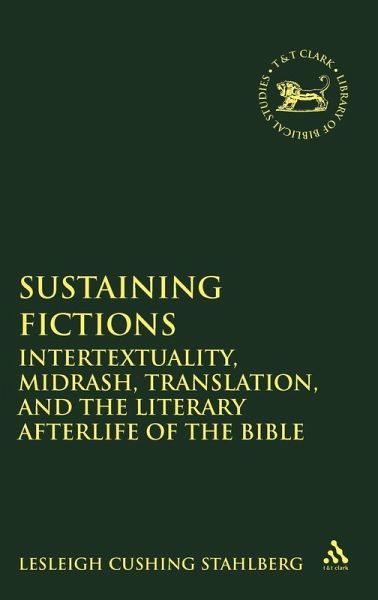
Even before the biblical canon became fixed, writers have revisited and reworked its stories. The author of Joshua takes the haphazard settlement of Israel recorded in the Book of Judges and retells it as an orderly military conquest. The writer of Chronicles expurgates the David cycle in Samuel I and II, offering an upright and virtuous king devoid of baser instincts. This literary phenomenon is not contained to inner-biblical exegesis. Once the telling becomes known, the retellings begin: through the New Testament, rabbinic midrash, medieval mystery plays, medieval and Renaissance poetry,…mehr
Even before the biblical canon became fixed, writers have revisited and reworked its stories. The author of Joshua takes the haphazard settlement of Israel recorded in the Book of Judges and retells it as an orderly military conquest. The writer of Chronicles expurgates the David cycle in Samuel I and II, offering an upright and virtuous king devoid of baser instincts. This literary phenomenon is not contained to inner-biblical exegesis. Once the telling becomes known, the retellings begin: through the New Testament, rabbinic midrash, medieval mystery plays, medieval and Renaissance poetry, nineteenth century novels, and contemporary literature, writers of the Western world have continued to occupy themselves with the biblical canon. However, there exists no adequate vocabulary academic or popular, religious or secular, literary or theological to describe the recurring appearances of canonical figures and motifs in later literature. Literary critics, bible scholars and book reviewers alike seek recourse in words like adaptation, allusion, echo, imitation and influence to describe what the author, for lack of better terms, has come to call retellings or recastings. Although none of these designations rings false, none approaches precision. They do not tell us what the author of a novel or poem has done with a biblical figure, do not signal how this newly recast figure is different from other recastings of it, and do not offer any indication of why these transformations have occurred. Sustaining Fictions sets out to redress this problem, considering the viability of the vocabularies of literary, midrashic, and translation theory for speaking about retelling.
Chapter 1: Tellings Beget Retellings I. The Question(s) of Retelling II. The Exploding Canon A. The Example of Timothy Findley and the Wester Classics B. The First Theoretical Paradigm: Intertextuality III. Exploding The Canon A. The Example of Timothy Findley and the Bible B. The Second Theoretical Paradigm: Midrash IV. Theorizing Retelling A. Critical Dimensions: Approach, Stance, and Filter B. The Third Theoretical Paradigm: Translation Theory V. The Project: Talking about Retelling Chapter 2: Speaking of the Silence I. It Ain't Nothin': What the Critics are Saying II. The Pervasiveness of Retelling and the Paucity of Terms III. The Paucity Examined A. Retelling and the Western Canon B. Retelling and the Biblical Canon Compiling Biblical Retellings Compiling Biblical Influences Confronting Biblical Influences The Art of Biblical Retelling IV. The Shadows of a Language Chapter 3: Naming the Animals: The Languages of Literary Criticism and Theory I. Imitation II. Invention III. Influence V. Intentiveness VI. Intentional Interrelationships Gerard Genette's Palimpsests Varieties of Transtextual Relationship The Place of Genre A Hypertextual Taxonomy Thematic Transpositions Semantic Transpositions Naming the Animals "Hypertexts, as it is well known, generate hypertexts" Chapter 4: Words of Torah Need Each Other I. Midrash in the Service of Literature What is Midrash? The Two Faces of Midrash: Halakhah and Aggadah The Nature of the Aggadah The Inner Logic of Aggadic Midrash II. Post-Modern Midrash: Midrash Meets Theory Why is Midrash Part of the Language of Literary Theory? What is the Midrash of the Literary Theorists? Midrash and Indeterminancy? Lo B'Shamayim Hi: The Problem with the Midrash of the Literary Theorists III. The Retelling as Modern Midrash The Jewish Question Bringing Tradition and Time: The Problem with Designating Retelling as Midrashic IV. From Aggadah to Halakhah: Co-opting the Vocabulary of Midrash Thinknig in Terms of Midrash's Approach and Stance V. Co-opting Anew the Vocabulary of Midrash The Middot: Principles of Rabbinic Exegesis i. Kal vaHomer ii. Gezerah Shavah iii. Binyan Av MiKatuv Echad iv. Binyan Av MiShnei Ktuvim v. Clal Ufrat vi. Ke-yotsei Bo BiM'kom Aher vii. Davar Halamed Mi-Inyano The Viability of the Co-option Chapter 5: Radical Translation? I. The Disease of Translation The Literary Afterlife: Where Retelling and Translation Intersect II. Histories (if not Theories) of Translation The Translator's Approach The Translator's Stance Translating the Language of Translation III. Vocabularies of Translation Dryden: Metaphrase, Paraphrase and Imitation Goethe's Epochs of Translation The Family "Trans" Jakobson and the Translation of Verbal Signs IV. Theories of Translation V. Theoretical Vocabularies The Science of Translation Early Translation Studies Polysystem Theory Deconstruction (Or, Translation and the Vocabulary of Deformation) VI. Translation as Cure Chapter 6: Literary Afterlives, Literary Afterthoughts Sustaining Fictions Wither Thou Goest, I will Go Bibliography
Es gelten unsere Allgemeinen Geschäftsbedingungen: www.buecher.de/agb
Impressum
www.buecher.de ist ein Internetauftritt der buecher.de internetstores GmbH
Geschäftsführung: Monica Sawhney | Roland Kölbl | Günter Hilger
Sitz der Gesellschaft: Batheyer Straße 115 - 117, 58099 Hagen
Postanschrift: Bürgermeister-Wegele-Str. 12, 86167 Augsburg
Amtsgericht Hagen HRB 13257
Steuernummer: 321/5800/1497
USt-IdNr: DE450055826