
Andere Kunden interessierten sich auch für
 COMPARATIVE POLITICAL THEORY:27,99 €
 Romanian Power System - European Energy Security Generator40,99 €
 Political Gladiators45,99 €
 Multipolar World & Future Power Dynamics53,99 €
 The Persuasive Power of Modality in Political Discourse45,99 €
 Foundations of National Security Theory76,99 €
 Political participation and community development in Etche LGA, Rivers29,99 €





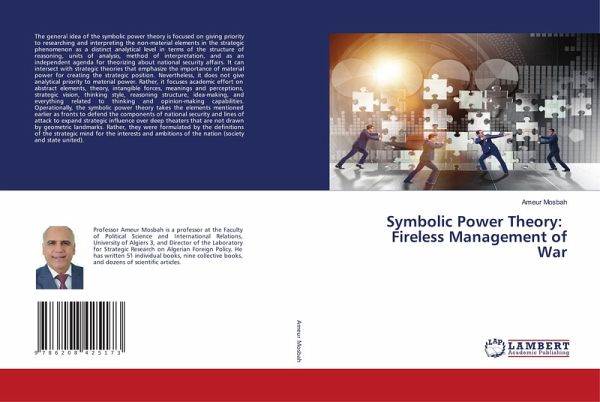
The general idea of the symbolic power theory is focused on giving priority to researching and interpreting the non-material elements in the strategic phenomenon as a distinct analytical level in terms of the structure of reasoning, units of analysis, method of interpretation, and as an independent agenda for theorizing about national security affairs. It can intersect with strategic theories that emphasize the importance of material power for creating the strategic position. Nevertheless, it does not give analytical priority to material power. Rather, it focuses academic effort on abstract elements, theory, intangible forces, meanings and perceptions, strategic vision, thinking style, reasoning structure, idea-making, and everything related to thinking and opinion-making capabilities. Operationally, the symbolic power theory takes the elements mentioned earlier as fronts to defend the components of national security and lines of attack to expand strategic influence over deep theaters that are not drawn by geometric landmarks. Rather, they were formulated by the definitions of the strategic mind for the interests and ambitions of the nation (society and state united).