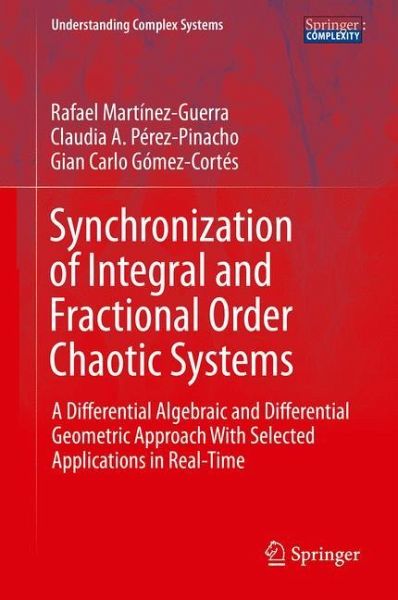
This book provides a general overview of several concepts of synchronization and brings together related approaches to secure communication in chaotic systems. This is achieved using a combination of analytic, algebraic, geometrical and asymptotical methods to tackle the dynamical feedback stabilization problem. In particular, differential-geometric and algebraic differential concepts reveal important structural properties of chaotic systems and serve as guide for the construction of design procedures for a wide variety of chaotic systems. The basic differential algebraic and geometric…mehr
This book provides a general overview of several concepts of synchronization and brings together related approaches to secure communication in chaotic systems. This is achieved using a combination of analytic, algebraic, geometrical and asymptotical methods to tackle the dynamical feedback stabilization problem. In particular, differential-geometric and algebraic differential concepts reveal important structural properties of chaotic systems and serve as guide for the construction of design procedures for a wide variety of chaotic systems. The basic differential algebraic and geometric concepts are presented in the first few chapters in a novel way as design tools, together with selected experimental studies demonstrating their importance. The subsequent chapters treat recent applications. Written for graduate students in applied physical sciences, systems engineers, and applied mathematicians interested in synchronization of chaotic systems and in secure communications, this self-contained text requires only basic knowledge of integer ordinary and fractional ordinary differential equations. Design applications are illustrated with the help of several physical models of practical interest.
Rafael Martínez-Guerra obtained the B.Sc. degree in Physics and Mathematics from the National Polytechnic Institute (IPN), Mexico City (Mexico) and the M.Sc. degree in Automatic Control from CINVESTAV-IPN (Center for Research and Advanced Studies of IPN), Mexico City. He also got a M.Sc. degree in Mathematics and Automatic from Ecole des Mines, Paris (France) and earned his Ph.D. Degree from the Universidad Autónoma Metropolitana in 1996. Currently, he is a Researcher at the Automatic Control Department of the CINVESTAV-IPN and a Member of the National System Researchers since 1992 (Level 3, now). He is author and co-author of more than 90 papers in international journals and more than 140 contributions in international conference proceedings. He is co-author of 9 books. His main research interests are in the areas of nonlinear systems, differential geometric and differential algebraic methods, fractional nonlinear observers, fractional fault detection and diagnosis, secure communications, fractional synchronization and chaos. Juan Pablo Flores-Flores obtained the B.Sc. degree as Aerospace Engineer from the National Polytechnic Institute (IPN) and the M.Sc. degree in Control Theory from the Automatic Control Department of CINVESTAV-IPN (Center for Research and Advanced Studies of IPN). He earned his Ph.D. from the same institution in 2022. He is co-author of the book Encryption and Decryption Algorithms for Plain Text and Images using Fractional Calculus (Springer, 2023) and has published research papers in international journals and conference proceedings. His main research interests are nonlinear systems, differential algebra methods, partial differential equations systems and integer and fractional synchronization of nonlinear systems.
Inhaltsangabe
Control theory and synchronization.- A model-free based proportional reduced-order observer design for the synchronization of Lorenz system.- A Model-Free Sliding Observer to Synchronization Problem Using Geometric Techniques.- Experimental synchronization by means of observers.- Synchronization of an uncertain Rikitake System with parametric estimation.- Secure Communications and Synchronization via a Sliding-mode Observer.- Synchronization and anti-synchronization of chaotic systems: A differential and algebraic approach.- Synchronization of chaotic Liouvillian systems: An application to Chua's oscillator.- Synchronization of Partially unknown Nonlinear Fractional Order
Systems.- Generalized Synchronization via the differential primitive element.- Generalized synchronization for a class of non-differentially flat and Liouvillian chaotic systems.- Generalized multi-synchronization by means of a family of dynamical feedbacks.- Fractional generalized synchronizationin nonlinear fractional order systems via a dynamical feedback.- An Observer for a Class of Incommensurate Fractional Order Systems.- Appendex.- Index.
Control theory and synchronization.- A model-free based proportional reduced-order observer design for the synchronization of Lorenz system.- A Model-Free Sliding Observer to Synchronization Problem Using Geometric Techniques.- Experimental synchronization by means of observers.- Synchronization of an uncertain Rikitake System with parametric estimation.- Secure Communications and Synchronization via a Sliding-mode Observer.- Synchronization and anti-synchronization of chaotic systems: A differential and algebraic approach.- Synchronization of chaotic Liouvillian systems: An application to Chua's oscillator.- Synchronization of Partially unknown Nonlinear Fractional Order
Systems.- Generalized Synchronization via the differential primitive element.- Generalized synchronization for a class of non-differentially flat and Liouvillian chaotic systems.- Generalized multi-synchronization by means of a family of dynamical feedbacks.- Fractional generalized synchronizationin nonlinear fractional order systems via a dynamical feedback.- An Observer for a Class of Incommensurate Fractional Order Systems.- Appendex.- Index.
Rezensionen
"This book provides a general overview of several concepts of synchronization and brings together related approaches to secure communication using chaotic systems. ... The monograph will be useful to engineers and physicists, graduate students and researchers interested in mathematical modelling, the theory of fractional ordinary differential equations, numerical simulations, synchronization of chaotic systems and secure communications and to everybody interested in mastering the new mathematical methods finding more and more applications." (Paulius Miskinis, Mathematical Reviews, April, 2017)
Es gelten unsere Allgemeinen Geschäftsbedingungen: www.buecher.de/agb
Impressum
www.buecher.de ist ein Internetauftritt der buecher.de internetstores GmbH
Geschäftsführung: Monica Sawhney | Roland Kölbl | Günter Hilger
Sitz der Gesellschaft: Batheyer Straße 115 - 117, 58099 Hagen
Postanschrift: Bürgermeister-Wegele-Str. 12, 86167 Augsburg
Amtsgericht Hagen HRB 13257
Steuernummer: 321/5800/1497
USt-IdNr: DE450055826