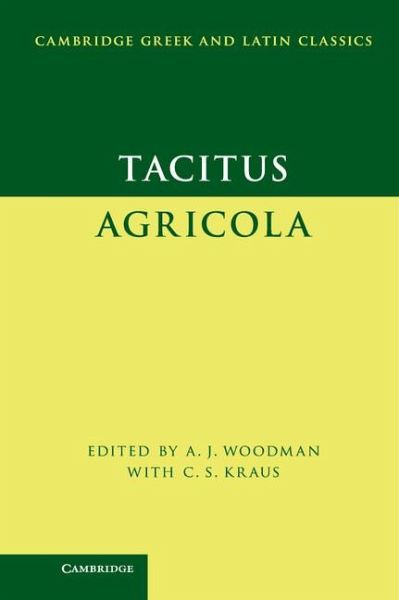
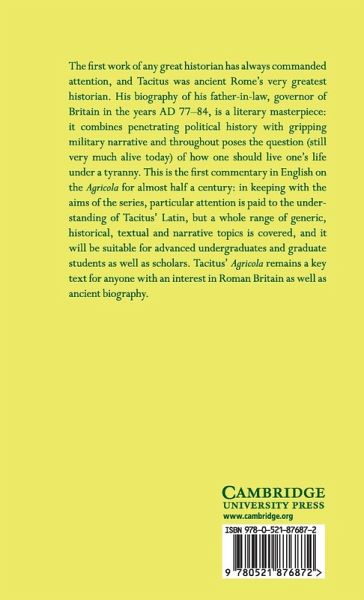
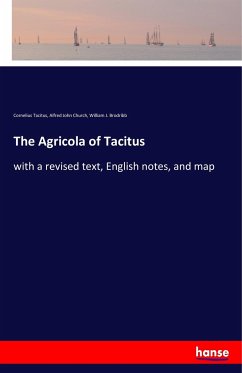
The first work of any great historian has always commanded attention, and Tacitus was ancient Rome's very greatest historian. His biography of his father-in-law, governor of Britain in the years AD 77-84, is a literary masterpiece: it combines penetrating political history with gripping military narrative and throughout poses the question (still very much alive today) of how one should live one's life under a tyranny. This is the first commentary in English on the Agricola for almost half a century: in keeping with the aims of the series, particular attention is paid to the understanding of…mehr
The first work of any great historian has always commanded attention, and Tacitus was ancient Rome's very greatest historian. His biography of his father-in-law, governor of Britain in the years AD 77-84, is a literary masterpiece: it combines penetrating political history with gripping military narrative and throughout poses the question (still very much alive today) of how one should live one's life under a tyranny. This is the first commentary in English on the Agricola for almost half a century: in keeping with the aims of the series, particular attention is paid to the understanding of Tacitus' Latin, but a whole range of generic, historical, textual and narrative topics is covered, and it will be suitable for advanced undergraduates and graduate students as well as scholars. Tacitus' Agricola remains a key text for anyone with an interest in Roman Britain as well as ancient biography.
Tacitus, born around AD 56, was a Roman historian and senator admired for his sharp analysis of historical events. His notable works, the Annals and the Histories, chronicle the Roman Empire during its most turbulent years. Tacitus also wrote Germania and Agricola, which provide unique insights into Germanic tribes and his father-in-law's life.He held several public offices, including consul in AD 97 under Emperor Nerva, which shaped his critical view of Roman governance. Tacitus's writings reflect his disapproval of corruption and moral decline in Roman society. His concise, impactful prose continues to captivate historians and readers alike.Tacitus's works remain central to understanding Roman history and politics. His commitment to accuracy and his critique of power dynamics have influenced generations of scholars. Through his enduring legacy, Tacitus exemplifies the timeless value of thoughtful historical inquiry.
Es gelten unsere Allgemeinen Geschäftsbedingungen: www.buecher.de/agb
Impressum
www.buecher.de ist ein Internetauftritt der buecher.de internetstores GmbH
Geschäftsführung: Monica Sawhney | Roland Kölbl | Günter Hilger
Sitz der Gesellschaft: Batheyer Straße 115 - 117, 58099 Hagen
Postanschrift: Bürgermeister-Wegele-Str. 12, 86167 Augsburg
Amtsgericht Hagen HRB 13257
Steuernummer: 321/5800/1497
USt-IdNr: DE450055826