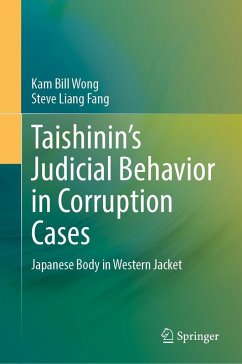
Legal transplant in the Meiji Restoration gave birth to Taishinin, which is the former of today s Supreme Court of Japan, but the objective of it was not solely for legal justice at the beginning. Taishinin s criminalization of corruption as an offense was out of both legal and non-legal factors. Law is often unclear and general because legislator cannot foresee all modus operandi in future. Judges judicial decision-making and sentencing practices have space to interpret it with opinions, discretion, legal consciousness and innovation for an immediate legal effect of criminal justice on…mehr
Legal transplant in the Meiji Restoration gave birth to Taishinin, which is the former of today s Supreme Court of Japan, but the objective of it was not solely for legal justice at the beginning. Taishinin s criminalization of corruption as an offense was out of both legal and non-legal factors. Law is often unclear and general because legislator cannot foresee all modus operandi in future. Judges judicial decision-making and sentencing practices have space to interpret it with opinions, discretion, legal consciousness and innovation for an immediate legal effect of criminal justice on society. This book applies robust judicial behavior concept to analyze how Taishinin s judicial behavior of such factors rationalized its rulings on corruption cases. This is not only a matter of transplanted Western jacket of Germanic Penal Code, but also departmental internal instructions, integrity standards and traditional legal consciousness of unwritten codes of conduct. The original findings of this book reveal that Taishinin s judicial behavior in corruption cases was subject to many non-legal considerations, such as historical development of anticorruption law, traditional jurisprudential concepts, mission of and commitment to judicial role, values, judge appointment, judicial training and the political impacts of Ministry of Justice s administration of judiciary.
Dr. Kam Bill Wong is a criminologist and researcher with a strong interest in Japanese studies. His academic background spans international human rights law, arbitration law, Japanese culture and history, business administration, and marketing. He has extensive teaching and research experience at institutions in Hong Kong, Japan, the United States, and mainland China. In 2009, he served as a visiting scholar at Stanford University. His current research focuses on the relationship between judicial behavior and justice, particularly in relation to judgments in corruption cases adjudicated by the Taishinin in pre-war Japan. Dr. Wong received his Ph.D. from the University of Hong Kong in 2008. Dr. Steve Liang Fang is a researcher specializing in Japanese history, with a particular focus on pre-modern history and Japan’s foreign relations in the nineteenth century. He is currently a research fellow at the Graduate School of Social Sciences, Chiba University, and a member of the Fair Society Studies group at the same institution. His work explores the historical factors contributing to social injustice, aiming to identify solutions to contemporary issues related to fairness and equality. Dr. Fang received his Ph.D. from Chiba University in 2022.
Inhaltsangabe
Introduction. Literature review of judicial behavior models. Historical evolution of Japanese anti corruption law. The Itabuneken and Hiratabuneken Compensation Case. The Keisei Electric Railway Company Case. Banquet bribe, social trust and hybrid judicial behavior. Police corruption and sex industry in Tokyo. Sexual bribe, culinary entertainment and police corruption in Osaka. Taishinin’s role and judicial behavior in state polity. Conclusive evaluation of Taishinin’s judicial behavior. Index.
Introduction. Literature review of judicial behavior models. Historical evolution of Japanese anti corruption law. The Itabuneken and Hiratabuneken Compensation Case. The Keisei Electric Railway Company Case. Banquet bribe, social trust and hybrid judicial behavior. Police corruption and sex industry in Tokyo. Sexual bribe, culinary entertainment and police corruption in Osaka. Taishinin’s role and judicial behavior in state polity. Conclusive evaluation of Taishinin’s judicial behavior. Index.
Es gelten unsere Allgemeinen Geschäftsbedingungen: www.buecher.de/agb
Impressum
www.buecher.de ist ein Internetauftritt der buecher.de internetstores GmbH
Geschäftsführung: Monica Sawhney | Roland Kölbl | Günter Hilger
Sitz der Gesellschaft: Batheyer Straße 115 - 117, 58099 Hagen
Postanschrift: Bürgermeister-Wegele-Str. 12, 86167 Augsburg
Amtsgericht Hagen HRB 13257
Steuernummer: 321/5800/1497
USt-IdNr: DE450055826