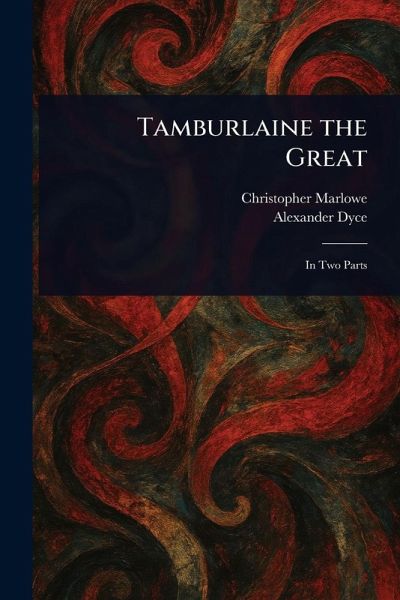
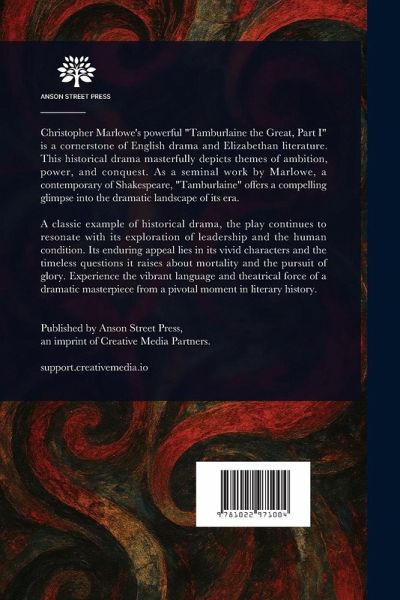
Christopher Marlowe's powerful "Tamburlaine the Great, Part I" is a cornerstone of English drama and Elizabethan literature. This historical drama masterfully depicts themes of ambition, power, and conquest. As a seminal work by Marlowe, a contemporary of Shakespeare, "Tamburlaine" offers a compelling glimpse into the dramatic landscape of its era. A classic example of historical drama, the play continues to resonate with its exploration of leadership and the human condition. Its enduring appeal lies in its vivid characters and the timeless questions it raises about mortality and the pursuit…mehr
Christopher Marlowe's powerful "Tamburlaine the Great, Part I" is a cornerstone of English drama and Elizabethan literature. This historical drama masterfully depicts themes of ambition, power, and conquest. As a seminal work by Marlowe, a contemporary of Shakespeare, "Tamburlaine" offers a compelling glimpse into the dramatic landscape of its era. A classic example of historical drama, the play continues to resonate with its exploration of leadership and the human condition. Its enduring appeal lies in its vivid characters and the timeless questions it raises about mortality and the pursuit of glory. Experience the vibrant language and theatrical force of a dramatic masterpiece from a pivotal moment in literary history. This work has been selected by scholars as being culturally important, and is part of the knowledge base of civilization as we know it. This work is in the public domain in the United States of America, and possibly other nations. Within the United States, you may freely copy and distribute this work, as no entity (individual or corporate) has a copyright on the body of the work. Scholars believe, and we concur, that this work is important enough to be preserved, reproduced, and made generally available to the public. We appreciate your support of the preservation process, and thank you for being an important part of keeping this knowledge alive and relevant.
Dramatist, son of a shoemaker at Canterbury, where he was born, was educated at the King's School there, and in 1581 went to Benet's (now Corpus Christi) College, Cambridge, where he graduated B.A. 1583, and M.A. in 1587. Marlowe shunned a life as a clergyman which university wits like himself were expected to follow, and moved to London to pursue the insecure craft of a playwright. Among his early plays were 'Tamburlaine the Great' and 'The Famous Tragedy of the Rich Jew of Malta', all well-received by Elizabethan audiences and displaying an impressive poetic talent that was bold enough to use high-quality blank verse for the first time in English theatre. He collaborated with friend and literary colleague, William Shakespeare, on 'Henry VI' and 'Titus Andronicus' and his influence on Shakespeare is seen in the latter's restrained use of rhyme in 'Richard III'. Traditional rhyme was eschewed by Marlowe in preference for blank verse, over which he acquired a constantly increasing mastery.
Es gelten unsere Allgemeinen Geschäftsbedingungen: www.buecher.de/agb
Impressum
www.buecher.de ist ein Internetauftritt der buecher.de internetstores GmbH
Geschäftsführung: Monica Sawhney | Roland Kölbl | Günter Hilger
Sitz der Gesellschaft: Batheyer Straße 115 - 117, 58099 Hagen
Postanschrift: Bürgermeister-Wegele-Str. 12, 86167 Augsburg
Amtsgericht Hagen HRB 13257
Steuernummer: 321/5800/1497
USt-IdNr: DE450055826