This book presents a novel analytical framework for examining the role of taxation in corporate finance, grounded in the Brusov Filatova Orekhova (BFO) theory and its perpetuity limit the Modigliani Miller (MM) theory. The authors investigate the influence of taxation on key financial indicators and investment project performance, incorporating the practical realities of corporate operations, such as the timing and frequency of tax payments and income variability. The book formulates evidence-based recommendations for regulatory bodies concerning the structure, timing, and differentiation…mehr
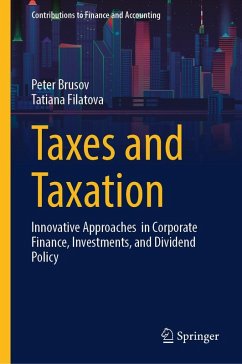
This book presents a novel analytical framework for examining the role of taxation in corporate finance, grounded in the Brusov Filatova Orekhova (BFO) theory and its perpetuity limit the Modigliani Miller (MM) theory. The authors investigate the influence of taxation on key financial indicators and investment project performance, incorporating the practical realities of corporate operations, such as the timing and frequency of tax payments and income variability.
The book formulates evidence-based recommendations for regulatory bodies concerning the structure, timing, and differentiation of profit tax payments, particularly in relation to corporate debt levels and other financial characteristics. It also provides strategic guidance for firms in selecting optimal tax payment methodologies.
Furthermore, the authors explore the implications of tax burden on dividend policy and identify a range of innovative effects with the potential to inform both regulatory tax policy and managerial decision-making. This work contributes to the advancement of financial theory by integrating taxation into dynamic investment and capital structure models under realistic economic conditions.
Peter Brusov is professor at the Financial University under the Government of the Russian Federation in Moscow (Russia). He is an expert in financial management, corporate finance, investments, ratings, taxation, business valuation. He is a co-author of the famous Brusov-Filatova-Orekhova theory, which replaced the well-known Modigliani-Miller theory, created by Nobel Prize Laureates. As well he is a co-author of the CAPM 2.0 model, which generalized the famous CAPM model for accounting the financial risk along with business risk. Peter Brusov is the author of the qualitatively new approach to business valuation. He has been a visiting Professor of Northwestern University (USA), Cornell University (USA), Osaka City University (Japan) and National Chung Cheng University (Taiwan) among other places. He is the author of over 550 research publications including nine monographs, numerous textbooks and articles. Tatiana Filatova is professor at the Financial University under the Government of the Russian Federation in Moscow (Russia). She is an expert in financial management, corporate finance, investments, ratings, taxation, business valuation. Tatiana Filatova is a co-author of the famous Brusov-Filatova-Orekhova theory, which replaced the well-known Modigliani-Miller theory, created by Nobel Prize Laureates. As well she is a co-author of the CAPM 2.0 model, which generalized the famous CAPM model for accounting the financial risk along with business risk. Tatiana Filatova is the author of the qualitatively new approach to business valuation. In the past 20 years, she has been Dean of the faculties of financial management, management, state and municipal government at the Financial University. Tatiana Filatova is the author of over 300 research publications including eight monographs, numerous textbooks and articles.
Inhaltsangabe
Taxes Functions.- Capital Structure.- Capital Structure: Modigliani–Miller Theory.- Modern Theory of Capital Cost and Capital Structure: Brusov–Filatova–Orekhova Theory (BFO Theory).- The Modigliani–Miller theory with arbitrary frequency of payment of tax on profit.- Modification of the Modigliani–Miller Theory for the Case of Advance Tax on Profit Payments.- How Frequently Should Companies Pay Tax on Profit.- Generalization of the Modigliani–Miller Theory for the Case of Variable Profit.- Inflation in Brusov–Filatova–Orekhova theory and in its perpetuity limit – Modigliani – Miller theory.- The Generalization of the Brusov–Filatova–Orekhova Theory for the Case of Payments of Tax on Profit with Arbitrary Frequency.- Benefits of Advance Payments of Tax on Profit: Consideration within Brusov–Filatova–Orekhova (BFO) Theory.- Influence of Method and Frequency of Profit Tax Payments on Company Financial Indicators.- Generalization of the Brusov–Filatova–Orekhova Theory for the Case of Variable Income.- Investment Models with Debt Repayment at the End of the Project and Their Application.- Investment Models with Uniform Debt Repayment and Their Application.- Innovative Investment Models with Frequent Payments of Tax on Income and of Interest on Debt.- Investment Models with Advance Frequent Payments of Tax on Profit and of Interest on Debt.- Whether it is possible to increase taxing and conserve a good investment climate in the country?.- Whether it is possible to increase of the investment efficiency, increasing tax on profit rate? An abnormal influence of growth of tax on profit rate on the efficiency of the investment.- Optimizing the investment structure of the telecommunication sector company.- The Role of the Central Bank and Commercial Banks in Creating and Maintaining of a Favorable Investment Climate in the Country.- Cost of Equity, Taxes and Dividend Policy.- Conclusions.
Taxes Functions.- Capital Structure.- Capital Structure: Modigliani–Miller Theory.- Modern Theory of Capital Cost and Capital Structure: Brusov–Filatova–Orekhova Theory (BFO Theory).- The Modigliani–Miller theory with arbitrary frequency of payment of tax on profit.- Modification of the Modigliani–Miller Theory for the Case of Advance Tax on Profit Payments.- How Frequently Should Companies Pay Tax on Profit.- Generalization of the Modigliani–Miller Theory for the Case of Variable Profit.- Inflation in Brusov–Filatova–Orekhova theory and in its perpetuity limit – Modigliani – Miller theory.- The Generalization of the Brusov–Filatova–Orekhova Theory for the Case of Payments of Tax on Profit with Arbitrary Frequency.- Benefits of Advance Payments of Tax on Profit: Consideration within Brusov–Filatova–Orekhova (BFO) Theory.- Influence of Method and Frequency of Profit Tax Payments on Company Financial Indicators.- Generalization of the Brusov–Filatova–Orekhova Theory for the Case of Variable Income.- Investment Models with Debt Repayment at the End of the Project and Their Application.- Investment Models with Uniform Debt Repayment and Their Application.- Innovative Investment Models with Frequent Payments of Tax on Income and of Interest on Debt.- Investment Models with Advance Frequent Payments of Tax on Profit and of Interest on Debt.- Whether it is possible to increase taxing and conserve a good investment climate in the country?.- Whether it is possible to increase of the investment efficiency, increasing tax on profit rate? An abnormal influence of growth of tax on profit rate on the efficiency of the investment.- Optimizing the investment structure of the telecommunication sector company.- The Role of the Central Bank and Commercial Banks in Creating and Maintaining of a Favorable Investment Climate in the Country.- Cost of Equity, Taxes and Dividend Policy.- Conclusions.
Es gelten unsere Allgemeinen Geschäftsbedingungen: www.buecher.de/agb
Impressum
www.buecher.de ist ein Internetauftritt der buecher.de internetstores GmbH
Geschäftsführung: Monica Sawhney | Roland Kölbl | Günter Hilger
Sitz der Gesellschaft: Batheyer Straße 115 - 117, 58099 Hagen
Postanschrift: Bürgermeister-Wegele-Str. 12, 86167 Augsburg
Amtsgericht Hagen HRB 13257
Steuernummer: 321/5800/1497
USt-IdNr: DE450055826