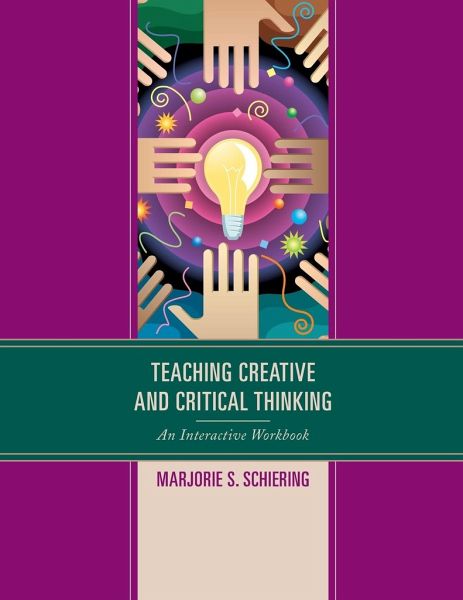
This workbook contains over sixty activities for learning-through-play. The activities were created by teacher-candidates, retired educators, and student-learners. They include interdisciplinary activities for first through twelfth grade levels. Each activity includes how-to-implement instructions along with applicable learning standards.
This workbook contains over sixty activities for learning-through-play. The activities were created by teacher-candidates, retired educators, and student-learners. They include interdisciplinary activities for first through twelfth grade levels. Each activity includes how-to-implement instructions along with applicable learning standards.
Marjorie S. Schiering began her educational career at Ohio State University before earning her Master's in Reading at the College of New Rochelle and Doctorate at St. John's University. Teaching in Ohio, NC, and NY she has devoted her career, as an educator, to utilizing the Interactive Method (IM) by engaging student learners in project and performance-based instruction and, simultaneously, developing their critical and creative thinking skills.She is currently a professor at Molloy College.
Inhaltsangabe
ForewordbyDrew Bogner, PhD: President of Molloy College Preface Acknowledgments Introduction Author's Philosophy Chapter 1: Learning-through-Play Overview Explaining and Defining Creativity Creative Cognition and Meta-cognition Two Processes of Creativity: Linear and Reciprocal Advantages of IM and IBR for Academics and Socialization IM or IBR as Learning Centers + Alternative Means of Assessment Reciprocal Thinking Phases Connecting Creative Cognition to Constructing and Playing IBR Pages Effects and Affects of IM and IBR Chapter 2: The IM and IBR with Four Interactive Resources Introduction: Louis Laupheimer Overview Project and Performance-based Instruction: Flip-Chute: Uses, Materials, Construction Directions Pic-A-Dot: Uses, Materials, Construction Directions Wrap-Around: Uses, Materials, Construction Directions Electro-Board: Uses, Materials, Construction Directions Templates for Four Interactive Resources A Narrative: IM, A Learning Center, and the IBR: Amanda Lockwood Section Two Summary Chapter 3: Playing-the-Pages Activities: Overview Interactive Activities to Make and/or Play Reciprocal Thinking Skills for 15 Activities: A Narrative: M. Schiering Learning Standards for 23 (A-W) of the Section Three Activities: Nicole Diblasio Addendum to Section Three Activities: Kicking it up a Notch: Joshua Schiering Chapter 4: IM AND IBR: Summing-up the Method and Strategy: Overview Creative Cognition's IBR: Leadership Building Step-by-Step Directions: Literature Step-by-Step Directions: Thematic Unit of Study Overall IBR Important Message The Gruffolo: A 1st Grade IBR: Elizabeth Struzzieri Intertwining Creativity and Innovation for Classroom Success: The IM and IBR as Inspiration: Dr. Laura Shea Doolan IBR and IM Within and Beyond the College Classroom Author's Closing Statements References
ForewordbyDrew Bogner, PhD: President of Molloy College Preface Acknowledgments Introduction Author's Philosophy Chapter 1: Learning-through-Play Overview Explaining and Defining Creativity Creative Cognition and Meta-cognition Two Processes of Creativity: Linear and Reciprocal Advantages of IM and IBR for Academics and Socialization IM or IBR as Learning Centers + Alternative Means of Assessment Reciprocal Thinking Phases Connecting Creative Cognition to Constructing and Playing IBR Pages Effects and Affects of IM and IBR Chapter 2: The IM and IBR with Four Interactive Resources Introduction: Louis Laupheimer Overview Project and Performance-based Instruction: Flip-Chute: Uses, Materials, Construction Directions Pic-A-Dot: Uses, Materials, Construction Directions Wrap-Around: Uses, Materials, Construction Directions Electro-Board: Uses, Materials, Construction Directions Templates for Four Interactive Resources A Narrative: IM, A Learning Center, and the IBR: Amanda Lockwood Section Two Summary Chapter 3: Playing-the-Pages Activities: Overview Interactive Activities to Make and/or Play Reciprocal Thinking Skills for 15 Activities: A Narrative: M. Schiering Learning Standards for 23 (A-W) of the Section Three Activities: Nicole Diblasio Addendum to Section Three Activities: Kicking it up a Notch: Joshua Schiering Chapter 4: IM AND IBR: Summing-up the Method and Strategy: Overview Creative Cognition's IBR: Leadership Building Step-by-Step Directions: Literature Step-by-Step Directions: Thematic Unit of Study Overall IBR Important Message The Gruffolo: A 1st Grade IBR: Elizabeth Struzzieri Intertwining Creativity and Innovation for Classroom Success: The IM and IBR as Inspiration: Dr. Laura Shea Doolan IBR and IM Within and Beyond the College Classroom Author's Closing Statements References
Es gelten unsere Allgemeinen Geschäftsbedingungen: www.buecher.de/agb
Impressum
www.buecher.de ist ein Internetauftritt der buecher.de internetstores GmbH
Geschäftsführung: Monica Sawhney | Roland Kölbl | Günter Hilger
Sitz der Gesellschaft: Batheyer Straße 115 - 117, 58099 Hagen
Postanschrift: Bürgermeister-Wegele-Str. 12, 86167 Augsburg
Amtsgericht Hagen HRB 13257
Steuernummer: 321/5800/1497
USt-IdNr: DE450055826