Geraldine Heng (University of Texas at Austin)
Teaching Early Global Literatures and Cultures
Geraldine Heng (University of Texas at Austin)
Teaching Early Global Literatures and Cultures
- Broschiertes Buch
- Merkliste
- Auf die Merkliste
- Bewerten Bewerten
- Teilen
- Produkt teilen
- Produkterinnerung
- Produkterinnerung
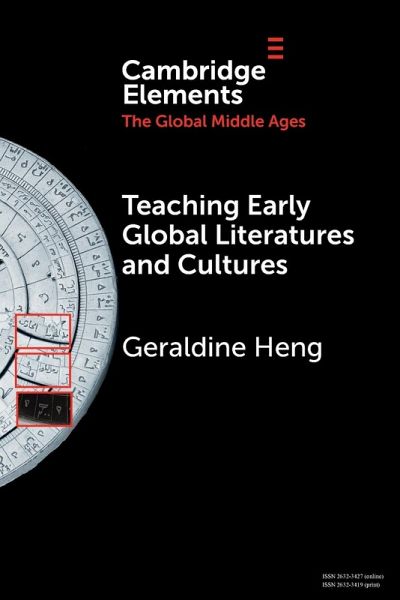
Teaching Early Global Literatures and Cultures is a guide to the terra incognita of the global literature classroom. It should be possible for faculty and graduate instructors to take this Element and begin teaching its sample syllabus right away.
Andere Kunden interessierten sich auch für
Helen Young (Victoria Deakin University)Global Medievalism22,99 €
Sarah E. BairesCahokia and the North American Worlds23,99 €
Shao-yun Yang (Ohio Denison University)Early Tang China and the World, 618-750 CE22,99 €
Shahzad Bashir (Rhode Island Brown University)The Market in Poetry in the Persian World23,99 €
Amanda Luyster (College of the Holy Cross)The Chertsey Tiles, the Crusades, and Global Textile Motifs22,99 €
Derek Heng (Northern Arizona University)Southeast Asian Interconnections29,99 €
Amanda Respess (Ohio State University-Marion)Global Ships22,99 €-
-
-
Teaching Early Global Literatures and Cultures is a guide to the terra incognita of the global literature classroom. It should be possible for faculty and graduate instructors to take this Element and begin teaching its sample syllabus right away.
Produktdetails
- Produktdetails
- Elements in the Global Middle Ages
- Verlag: Cambridge University Press
- Seitenzahl: 114
- Erscheinungstermin: 6. Mai 2025
- Englisch
- Abmessung: 229mm x 152mm x 6mm
- Gewicht: 176g
- ISBN-13: 9781009633031
- ISBN-10: 1009633031
- Artikelnr.: 73331512
- Herstellerkennzeichnung
- Libri GmbH
- Europaallee 1
- 36244 Bad Hersfeld
- gpsr@libri.de
- Elements in the Global Middle Ages
- Verlag: Cambridge University Press
- Seitenzahl: 114
- Erscheinungstermin: 6. Mai 2025
- Englisch
- Abmessung: 229mm x 152mm x 6mm
- Gewicht: 176g
- ISBN-13: 9781009633031
- ISBN-10: 1009633031
- Artikelnr.: 73331512
- Herstellerkennzeichnung
- Libri GmbH
- Europaallee 1
- 36244 Bad Hersfeld
- gpsr@libri.de
1. Introduction: An Experiment in Learning - and Teaching - Early Global
Literatures and Cultures; 2. Why Teach Early Global Literatures and
Cultures?; 3. Organizing a Course, and a Scaffold of Questions in Search of
Answers; 4. What Should We Teach? Two Dozen Texts from Which to Extract a
Possible Syllabus; 5. What Interconnects the Early World of AfroEurasia?
What Does that Early World Look like? Teaching The Vinland Sagas, Sundiata:
An Epic of Old Mali, and Ibn Fadlan's Mission to the Volga as Global Texts;
6. Encountering the Other, or Slaves, Race, Religion, Gender, and Sexuality
in a World of Differences: Teaching 'The Slave of MS. H.6,' selected
documents from India Traders of the Middle Ages, Amitav Ghosh's In an
Antique Land: History in the Guise of a Traveler's Tale, and Kamaluddin
Abdul-Razzaq Samarqandi's Mission to Calicut and Vijayanagar; 7. Oceans of
Stories, and Island Worlds: Teaching Buzurg ibn Shahriyar's Book of the
Wonders of India, and Abu Zayd Al-Sirafi's Accounts of India and China,
with the Malay Annals; 8. The Globalism of Pax Mongolica: Teaching the
Secret History of the Mongols and Marco Polo-Rustichello of Pisa's
Description of the World; 9. The Role/s of Students in the Early Global
Literature Classroom: Taking Ownership of the Course, Research, and Team
Projects.
Literatures and Cultures; 2. Why Teach Early Global Literatures and
Cultures?; 3. Organizing a Course, and a Scaffold of Questions in Search of
Answers; 4. What Should We Teach? Two Dozen Texts from Which to Extract a
Possible Syllabus; 5. What Interconnects the Early World of AfroEurasia?
What Does that Early World Look like? Teaching The Vinland Sagas, Sundiata:
An Epic of Old Mali, and Ibn Fadlan's Mission to the Volga as Global Texts;
6. Encountering the Other, or Slaves, Race, Religion, Gender, and Sexuality
in a World of Differences: Teaching 'The Slave of MS. H.6,' selected
documents from India Traders of the Middle Ages, Amitav Ghosh's In an
Antique Land: History in the Guise of a Traveler's Tale, and Kamaluddin
Abdul-Razzaq Samarqandi's Mission to Calicut and Vijayanagar; 7. Oceans of
Stories, and Island Worlds: Teaching Buzurg ibn Shahriyar's Book of the
Wonders of India, and Abu Zayd Al-Sirafi's Accounts of India and China,
with the Malay Annals; 8. The Globalism of Pax Mongolica: Teaching the
Secret History of the Mongols and Marco Polo-Rustichello of Pisa's
Description of the World; 9. The Role/s of Students in the Early Global
Literature Classroom: Taking Ownership of the Course, Research, and Team
Projects.
1. Introduction: An Experiment in Learning - and Teaching - Early Global
Literatures and Cultures; 2. Why Teach Early Global Literatures and
Cultures?; 3. Organizing a Course, and a Scaffold of Questions in Search of
Answers; 4. What Should We Teach? Two Dozen Texts from Which to Extract a
Possible Syllabus; 5. What Interconnects the Early World of AfroEurasia?
What Does that Early World Look like? Teaching The Vinland Sagas, Sundiata:
An Epic of Old Mali, and Ibn Fadlan's Mission to the Volga as Global Texts;
6. Encountering the Other, or Slaves, Race, Religion, Gender, and Sexuality
in a World of Differences: Teaching 'The Slave of MS. H.6,' selected
documents from India Traders of the Middle Ages, Amitav Ghosh's In an
Antique Land: History in the Guise of a Traveler's Tale, and Kamaluddin
Abdul-Razzaq Samarqandi's Mission to Calicut and Vijayanagar; 7. Oceans of
Stories, and Island Worlds: Teaching Buzurg ibn Shahriyar's Book of the
Wonders of India, and Abu Zayd Al-Sirafi's Accounts of India and China,
with the Malay Annals; 8. The Globalism of Pax Mongolica: Teaching the
Secret History of the Mongols and Marco Polo-Rustichello of Pisa's
Description of the World; 9. The Role/s of Students in the Early Global
Literature Classroom: Taking Ownership of the Course, Research, and Team
Projects.
Literatures and Cultures; 2. Why Teach Early Global Literatures and
Cultures?; 3. Organizing a Course, and a Scaffold of Questions in Search of
Answers; 4. What Should We Teach? Two Dozen Texts from Which to Extract a
Possible Syllabus; 5. What Interconnects the Early World of AfroEurasia?
What Does that Early World Look like? Teaching The Vinland Sagas, Sundiata:
An Epic of Old Mali, and Ibn Fadlan's Mission to the Volga as Global Texts;
6. Encountering the Other, or Slaves, Race, Religion, Gender, and Sexuality
in a World of Differences: Teaching 'The Slave of MS. H.6,' selected
documents from India Traders of the Middle Ages, Amitav Ghosh's In an
Antique Land: History in the Guise of a Traveler's Tale, and Kamaluddin
Abdul-Razzaq Samarqandi's Mission to Calicut and Vijayanagar; 7. Oceans of
Stories, and Island Worlds: Teaching Buzurg ibn Shahriyar's Book of the
Wonders of India, and Abu Zayd Al-Sirafi's Accounts of India and China,
with the Malay Annals; 8. The Globalism of Pax Mongolica: Teaching the
Secret History of the Mongols and Marco Polo-Rustichello of Pisa's
Description of the World; 9. The Role/s of Students in the Early Global
Literature Classroom: Taking Ownership of the Course, Research, and Team
Projects.