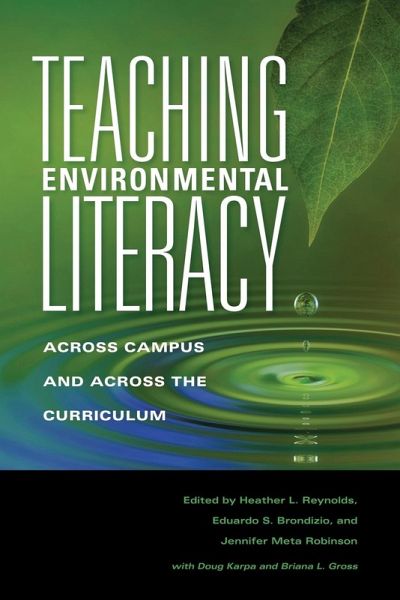
To prepare today's students to meet growing global environmental challenges, colleges and universities must make environmental literacy a core learning goal for all students, in all disciplines. But what should an environmentally literate citizen know? What teaching and learning strategies are most effective in helping students think critically about human-environment interactions and sustainability, and integrate what they have learned in diverse settings? In Teaching Environmental Literacy, educators from the natural and social sciences and humanities discuss the critical content, skills,…mehr
To prepare today's students to meet growing global environmental challenges, colleges and universities must make environmental literacy a core learning goal for all students, in all disciplines. But what should an environmentally literate citizen know? What teaching and learning strategies are most effective in helping students think critically about human-environment interactions and sustainability, and integrate what they have learned in diverse settings? In Teaching Environmental Literacy, educators from the natural and social sciences and humanities discuss the critical content, skills, and affective qualities essential to environmental literacy. This volume will be an invaluable resource for developing integrated, campuswide programs to graduate a citizenry that can think critically about, design, and live in a sustainable society.
Heather L. Reynolds is Associate Professor of Biology at Indiana University Bloomington. Eduardo S. Brondizio is Professor of Anthropology at Indiana University Bloomington. Jennifer Meta Robinson is Senior Lecturer in the Department of Communication and Culture at Indiana University Bloomington and former Director of Campus Instructional Consulting. She is author (with J. A. Hartenfeld) of The Farmers' Market Book: Growing Food, Cultivating Community (IUP, 2007).
Inhaltsangabe
Acknowledgments Introduction: The Rationale for Teaching Environmental Literacy in Higher Education / Heather L. Reynolds, Eduardo S. Brondizio, Jennifer Meta Robinson, Doug Karpa, and Briana L. Gross Part 1. A Model for Grassroots, Multidisciplinary Faculty Inquiry Jennifer Meta Robinson and Heather L. Reynolds Part 2. Core Learning Goals for Campus-wide Environmental Literacy Overview / Heather L. Reynolds (Biology) 1. At the Forest's Edge: A Place-Based Approach to Teaching Ecosystem Services / Keith M. Vogelsang and Eric J. Baack (Biology) 2. Population, Energy, and Sustainability / Bennet B. Brabson (Physics) 3. Population, Consumption, and Environment / Emilio F. Moran (Anthropology) 4. Economics and Sustainability / Christine Glaser (Economics) 5. A Sense of Place / Scott Russell Sanders (English) 6. Environmental Justice and a Sense of Place / John Applegate (Law) 7. Environmental Literacy and the Lifelong Cultivation of Wonder / Lisa H. Sideris (Religious Studies) 8. Teaching Environmental Communication Through Rhetorical Controversy / Phaedra C. Pezzullo (Communication and Culture) Part 3. Strategies for Teaching Environmental Literacy: Beyond the Traditional Classroom Overview / Doug Karpa (Campus Instructional Consulting) 9. Effective Education for Environmental Literacy / Craig E. Nelson (Biology) 10. Learning in Place: The Campus as Ecosystem / James H. Capshew (History and Philosophy of Science) 11. Environmental Literacy and Service-Learning: A Multi-Text Rendering / Nicole Schonemann, Andrew Libby, and Claire King (Office of Service-Learning) 12. Sense of Place and the Physical Senses in Outdoor Environmental Learning / Matthew R. Auer (Public and Environmental Affairs and Hutton Honors College) 13. A Natural Environment for Environmental Literacy / Keith Clay (Biology) 14. Teaching Outdoors / Vicky J. Meretsky (Public and Environmental Affairs) Part 4. Beyond Courses: Teaching Environmental Literacy Across Campus and Across the Curriculum Overview / Jennifer Meta Robinson (Communication and Culture) 15. Environmental Literacy and the Curriculum-An Administrative Perspective / Catherine Larson (Spanish and Portuguese) 16. Faculty, Staff, and Student Partnerships for Environmental Literacy and Sustainability / Briana L. Gross (Biology) 17. Food for Thought: A Multidisciplinary Faculty Grassroots Initiative for Sustainability and Service-Learning / Whitney Schlegel (Human Biology), Heather L. Reynolds (Biology), Victoria M. Getty (Health, Physical Education, and Recreation), Diane Henshel (Public and Environmental Affairs), and James W. Reidhaar (Fine Arts) Conclusion / Eduardo S. Brondizio (Anthropology) Appendix Contributors Index
Acknowledgments Introduction: The Rationale for Teaching Environmental Literacy in Higher Education / Heather L. Reynolds, Eduardo S. Brondizio, Jennifer Meta Robinson, Doug Karpa, and Briana L. Gross Part 1. A Model for Grassroots, Multidisciplinary Faculty Inquiry Jennifer Meta Robinson and Heather L. Reynolds Part 2. Core Learning Goals for Campus-wide Environmental Literacy Overview / Heather L. Reynolds (Biology) 1. At the Forest's Edge: A Place-Based Approach to Teaching Ecosystem Services / Keith M. Vogelsang and Eric J. Baack (Biology) 2. Population, Energy, and Sustainability / Bennet B. Brabson (Physics) 3. Population, Consumption, and Environment / Emilio F. Moran (Anthropology) 4. Economics and Sustainability / Christine Glaser (Economics) 5. A Sense of Place / Scott Russell Sanders (English) 6. Environmental Justice and a Sense of Place / John Applegate (Law) 7. Environmental Literacy and the Lifelong Cultivation of Wonder / Lisa H. Sideris (Religious Studies) 8. Teaching Environmental Communication Through Rhetorical Controversy / Phaedra C. Pezzullo (Communication and Culture) Part 3. Strategies for Teaching Environmental Literacy: Beyond the Traditional Classroom Overview / Doug Karpa (Campus Instructional Consulting) 9. Effective Education for Environmental Literacy / Craig E. Nelson (Biology) 10. Learning in Place: The Campus as Ecosystem / James H. Capshew (History and Philosophy of Science) 11. Environmental Literacy and Service-Learning: A Multi-Text Rendering / Nicole Schonemann, Andrew Libby, and Claire King (Office of Service-Learning) 12. Sense of Place and the Physical Senses in Outdoor Environmental Learning / Matthew R. Auer (Public and Environmental Affairs and Hutton Honors College) 13. A Natural Environment for Environmental Literacy / Keith Clay (Biology) 14. Teaching Outdoors / Vicky J. Meretsky (Public and Environmental Affairs) Part 4. Beyond Courses: Teaching Environmental Literacy Across Campus and Across the Curriculum Overview / Jennifer Meta Robinson (Communication and Culture) 15. Environmental Literacy and the Curriculum-An Administrative Perspective / Catherine Larson (Spanish and Portuguese) 16. Faculty, Staff, and Student Partnerships for Environmental Literacy and Sustainability / Briana L. Gross (Biology) 17. Food for Thought: A Multidisciplinary Faculty Grassroots Initiative for Sustainability and Service-Learning / Whitney Schlegel (Human Biology), Heather L. Reynolds (Biology), Victoria M. Getty (Health, Physical Education, and Recreation), Diane Henshel (Public and Environmental Affairs), and James W. Reidhaar (Fine Arts) Conclusion / Eduardo S. Brondizio (Anthropology) Appendix Contributors Index
Es gelten unsere Allgemeinen Geschäftsbedingungen: www.buecher.de/agb
Impressum
www.buecher.de ist ein Internetauftritt der buecher.de internetstores GmbH
Geschäftsführung: Monica Sawhney | Roland Kölbl | Günter Hilger
Sitz der Gesellschaft: Batheyer Straße 115 - 117, 58099 Hagen
Postanschrift: Bürgermeister-Wegele-Str. 12, 86167 Augsburg
Amtsgericht Hagen HRB 13257
Steuernummer: 321/5800/1497
USt-IdNr: DE450055826