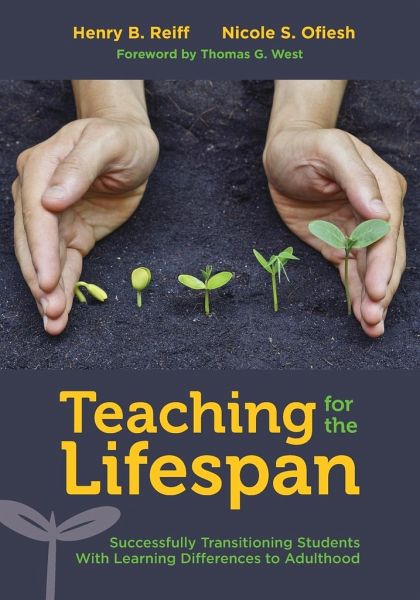
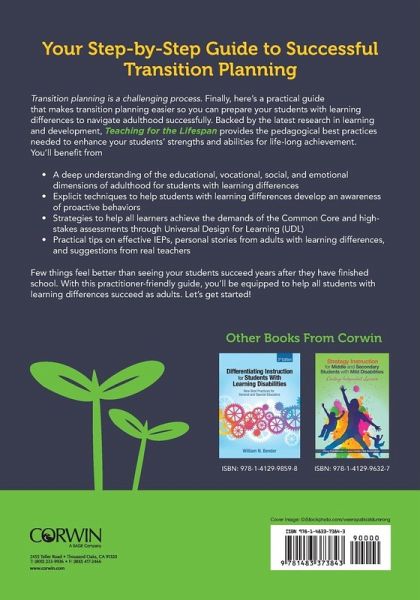
Your step-by-step guide to successful transition planning Finally, here's a practical guide that makes transition planning easier. Backed by the latest research in learning and development, Teaching for the Lifespan provides you with the pedagogical best practices to promote your students' strengths for life-long success. You'll benefit from: A deep understanding of the educational, vocational, social, and emotional dimensions of adulthood for students with learning differences Techniques to help students with learning differences develop an awareness of proactive behaviors Strategies to help…mehr
Your step-by-step guide to successful transition planning Finally, here's a practical guide that makes transition planning easier. Backed by the latest research in learning and development, Teaching for the Lifespan provides you with the pedagogical best practices to promote your students' strengths for life-long success. You'll benefit from: A deep understanding of the educational, vocational, social, and emotional dimensions of adulthood for students with learning differences Techniques to help students with learning differences develop an awareness of proactive behaviors Strategies to help all learners achieve the demands of the Common Core and high-stakes assessments through Universal Design for Learning (UDL)
Henry B. Reiff, Ph.D. is a writer, public speaker, researcher, and leader in the field of learning disabilities and the community. He has published numerous articles on adults and adolescents with learning disabilities and has written or co-written four books, including Exceeding Expectations: Successful Adults with Learning Disabilities, an American Library Association "Top 20 LD Resource." His most recent book is Self-Advocacy for Students with Learning Disabilities: Making It Happen in College and Beyond. He has given presentations and workshops across the country. Currently a regular blogger on the popular website, FriendsofQuinn.com, Dr. Reiff continues to focus on promoting positive outcomes for persons with learning differences. A faculty member in special education at McDaniel College since 1989, Dr. Reiff has served as Dean of Student Academic Life and Dean of Graduate and Professional Studies for 19 of those years. He is currently Professor of Education and Coordinator of the Graduate Program in Special Education at McDaniel. He regularly counsels young adults with learning differences. He and his wife, Jacki, reside in Westminster, MD with their two children and two dogs.
Inhaltsangabe
Introduction Part One: Context 1. The Construct of Learning Differences A Fundamental Question A Paradigm Shift to a Strengths-Based Model Historical Perspectives Definitions of Learning Disabilities: How Much do They Matter? Differences, Not Disabilities Moving Forward 2. Adult Developmental Theory and Learning Differences Theories of Adult Development Implications of Theories of Adult Development for Individuals with Learning Differences 3. Keys to Success Abraham Maslow Steven Covey Dale Carnegie Deepak Chopra Summary and Synthesis of Models of Success What is Success in Adulthood? 4. Success of Adults with Learning Differences New Perspectives Accentuate the Positive Focusing on Success Stories of Success Parto Two: Good Teaching 5. Building a Better Classroom Facing New Challenges A Multifaceted Approach to School Success (MASSive) Two Examples of the MASSive Approach The Most Critical Variable: Praise, Praise, Praise 6. The Common Core: Teaching for a Lifetime or Teaching for One Way of Life? Good Intentions, Change, and Confusion The Good The Meh The Ugly 7. Self-Understanding Building a Sense of Self Implications for Adulthood Skills for Building Relationships Social Skills and Teachable Moments The IEP as Relationship Builder A Systematic Approach to Building Self-Awareness, Self-Efficacy, and Agency 8. Breaking the Failure Cycle The Winning Picture Skills and Game Success Acquiring Social Skills Meditation not Medication Stress, Anxiety, and Other Realities of Adulthood Don't Forget the Arts Life Skills Outside the Box Inclusion It's not the Program. - It's You 9. Teaching the Attributes of Successful Adults with Learning Differences Seven Attributes of Successful Adults with Learning Differences It Comes Down to This Self-Advocacy Goal Planning and Goodness of Fit Learned Creativity
Introduction Part One: Context 1. The Construct of Learning Differences A Fundamental Question A Paradigm Shift to a Strengths-Based Model Historical Perspectives Definitions of Learning Disabilities: How Much do They Matter? Differences, Not Disabilities Moving Forward 2. Adult Developmental Theory and Learning Differences Theories of Adult Development Implications of Theories of Adult Development for Individuals with Learning Differences 3. Keys to Success Abraham Maslow Steven Covey Dale Carnegie Deepak Chopra Summary and Synthesis of Models of Success What is Success in Adulthood? 4. Success of Adults with Learning Differences New Perspectives Accentuate the Positive Focusing on Success Stories of Success Parto Two: Good Teaching 5. Building a Better Classroom Facing New Challenges A Multifaceted Approach to School Success (MASSive) Two Examples of the MASSive Approach The Most Critical Variable: Praise, Praise, Praise 6. The Common Core: Teaching for a Lifetime or Teaching for One Way of Life? Good Intentions, Change, and Confusion The Good The Meh The Ugly 7. Self-Understanding Building a Sense of Self Implications for Adulthood Skills for Building Relationships Social Skills and Teachable Moments The IEP as Relationship Builder A Systematic Approach to Building Self-Awareness, Self-Efficacy, and Agency 8. Breaking the Failure Cycle The Winning Picture Skills and Game Success Acquiring Social Skills Meditation not Medication Stress, Anxiety, and Other Realities of Adulthood Don't Forget the Arts Life Skills Outside the Box Inclusion It's not the Program. - It's You 9. Teaching the Attributes of Successful Adults with Learning Differences Seven Attributes of Successful Adults with Learning Differences It Comes Down to This Self-Advocacy Goal Planning and Goodness of Fit Learned Creativity
Es gelten unsere Allgemeinen Geschäftsbedingungen: www.buecher.de/agb
Impressum
www.buecher.de ist ein Internetauftritt der buecher.de internetstores GmbH
Geschäftsführung: Monica Sawhney | Roland Kölbl | Günter Hilger
Sitz der Gesellschaft: Batheyer Straße 115 - 117, 58099 Hagen
Postanschrift: Bürgermeister-Wegele-Str. 12, 86167 Augsburg
Amtsgericht Hagen HRB 13257
Steuernummer: 321/5800/1497
USt-IdNr: DE450055826